
Neo-Impressionism
Bathers at Asnières
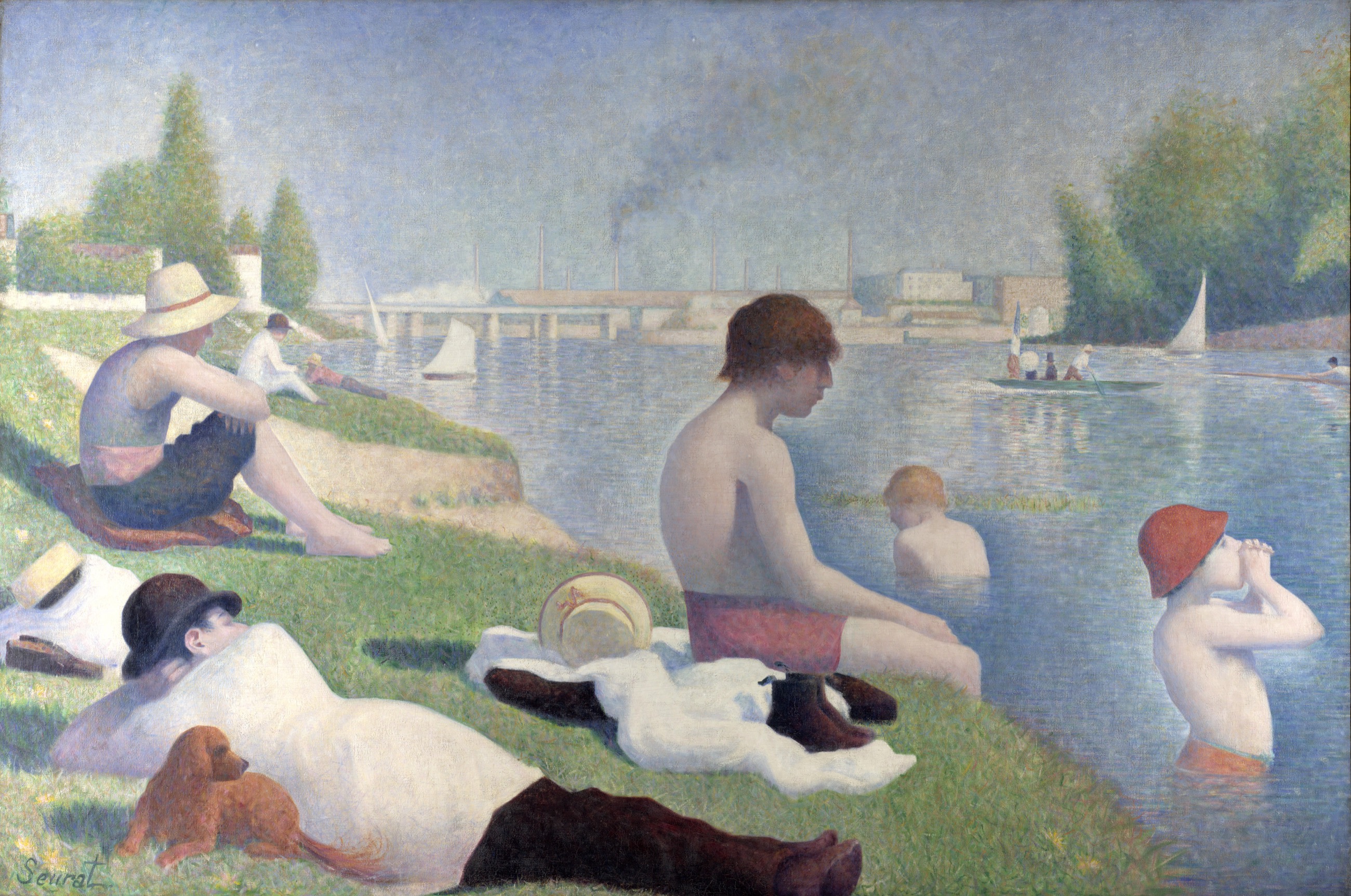
A boy sits at the edge of the Seine and calls across the water, but the whole scene feels strangely still. In Bathers at Asnières, Georges Seurat gives working-class leisure the scale and calm usually reserved for older history painting. The bodies are relaxed, the river is bright, the factories sit in the distance, and yet nothing feels casual. Seurat is already turning modern life into order.
A monumental suburb scene before La Grande Jatte
Painted in 1884, Bathers at Asnières is Seurat's first large-scale masterpiece. The National Gallery identifies it as oil on canvas, 201 x 300 cm, bought with the Courtauld Fund in 1924 and now inventory NG3908. Asnières lay northwest of Paris, near industrial suburbs along the Seine, across from the more bourgeois leisure world of the island of La Grande Jatte.
The subject looks simple: young men and boys pause by the river, some dressed, some partly undressed, some in the water. But Seurat treats this modern, ordinary leisure as something almost monumental. The painting is not anecdote. It is a carefully built field of light, class, rest, and distance.
What the painting shows
Start in the foreground. A young man sits with his legs extended, his profile cut cleanly against the river. Behind him, another seated figure wears a bowler hat, boots, and work clothes. Nearby, a boy in the water lifts his face and calls toward the opposite bank. Clothes lie on the grass. Boats and bathers occupy the river. Across the water, chimneys, buildings, and bridges mark the industrial edge of Paris.
Seurat makes all of this easy to see, but not noisy. The figures are simplified into broad contours. The bank forms a strong diagonal, the river opens a flat band of light, and the far shore is held in pale, hazy order. The result is calm without intimacy. These figures share the same place, but each seems sealed inside his own rhythm.
The method is already visible. Seurat is not yet using the tight pointillist surface of La Grande Jatte, but he is already organizing perception through measured forms, controlled color, and exact spacing. The painting asks the viewer to feel modern leisure as something constructed, not merely observed.
Workers at rest, not an idyllic river scene
The men's clothing gives the scene its social charge. The bowler hat, boots, sleeveless vest, and plain working clothes suggest workers or lower-middle-class Parisians rather than aristocratic bathers. Seurat does not turn them into heroic laborers. He shows them after work, suspended between heat, rest, and the industrial world behind them.
Seurat's restraint keeps the scene from turning into accusation, sentiment, or drama. Instead, he gives working-class leisure an unusual dignity through scale. A scene that might have been small, quick, or picturesque becomes as large and composed as a public mural.
Color before full pointillism
Bathers at Asnières sits at a hinge in Seurat's method. It is often discussed beside Neo-Impressionism, but it predates his fully developed pointillist language. The surface is broader and smoother than the later Seurat. Forms are built from flat color areas, careful contours, and tonal contrasts rather than from a dense grid of dots.
Still, the later method is already forming. Look at the contrasts between warm flesh, blue water, orange accents, pale shirts, and green grass. Color is not just descriptive. It separates bodies, stabilizes shapes, and gives the whole scene a deliberate temperature. Seurat is moving away from Impressionist speed toward planned visual construction.
The other bank of La Grande Jatte
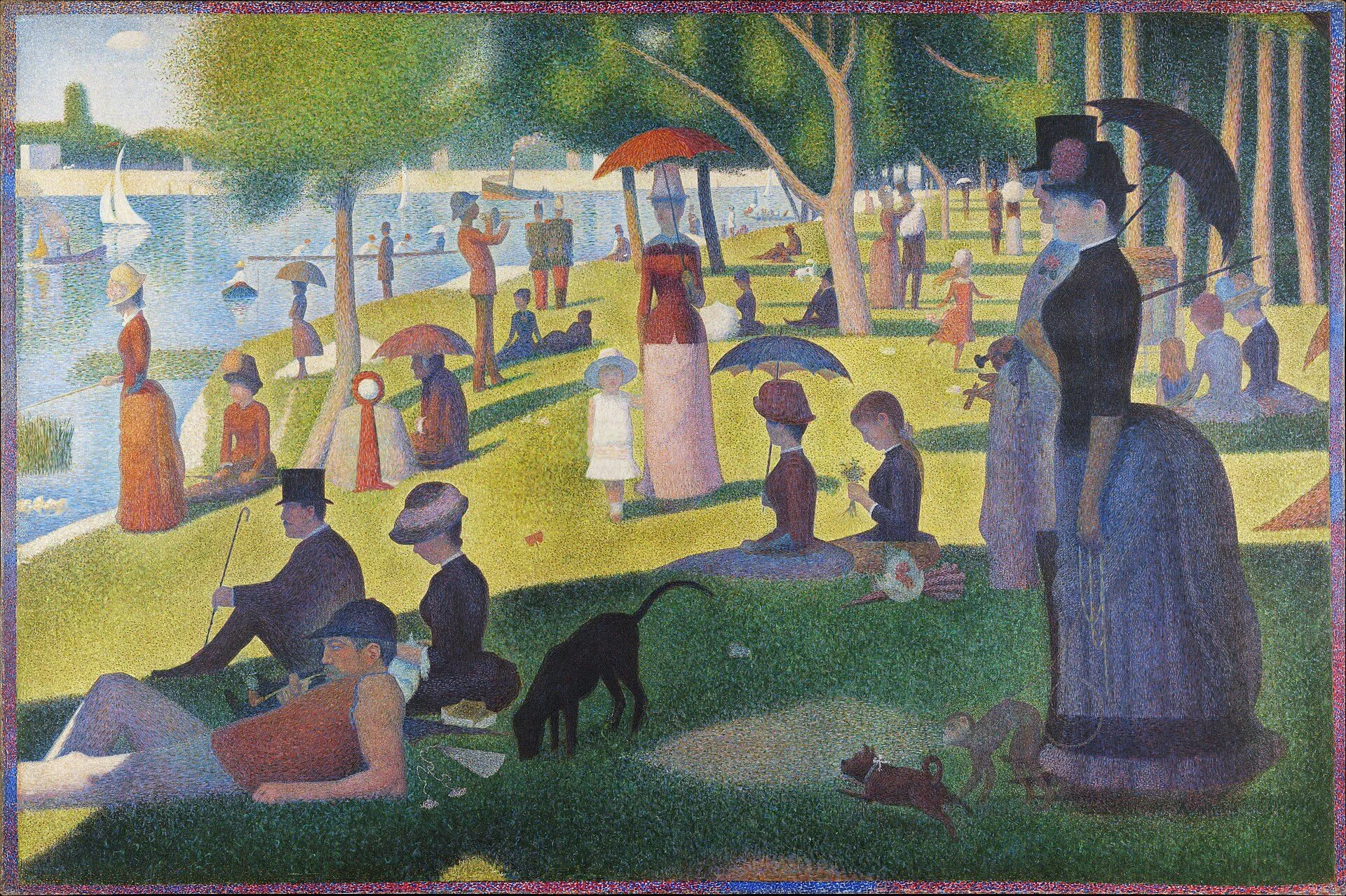
Set it beside Seurat's later A Sunday Afternoon on the Island of La Grande Jatte and the two paintings almost face each other socially. Bathers at Asnières shows young men at rest near the industrial bank; La Grande Jatte shows a more formal park world of parasols, dresses, pets, soldiers, and controlled public display.
Put simply: Bathers is open air and working-class pause; La Grande Jatte is public leisure arranged like a social diagram. Together they show Seurat's deeper project. He is not painting leisure because it is charming. He is using leisure to study how modern bodies occupy shared space without necessarily belonging to one another.
Where to look first
- Start with the seated figure in the foreground: his profile and extended legs anchor the whole riverbank.
- Move to the boy in the water: his open mouth gives the quiet scene its one audible gesture.
- Look across the river: the factories and bridges keep industry inside the leisure scene.
- Step back: the figures become almost architectural, arranged by contour, color, and spacing.
Why the painting holds its force
Bathers at Asnières gives modern leisure a new kind of seriousness before Seurat's pointillism becomes famous. It is not the completed system of La Grande Jatte, but it already contains the ambition: to make modern life stable enough to study and strange enough to keep looking at.
The painting's quietness is deceptive. Behind the calm lies a shift in art history: the ordinary suburb becomes monumental, workers at rest become worthy of large-scale painting, and color begins to behave like structure. Seurat's later dots will make the method more visible, but the discipline is already here.
Continue from Seurat
Comparison path
Then try the art quiz.
Primary sources
Frequently asked questions
It shows young men and boys resting and bathing beside the Seine at Asnières, an industrial suburb northwest of Paris.
It comes just before Seurat's fully developed pointillist method. The picture already shows his controlled color, simplified forms, and planned structure, with later touches that point toward divisionism.
Bathers at Asnières is in The National Gallery, London, inventory number NG3908.