
International Gothic
The Wilton Diptych
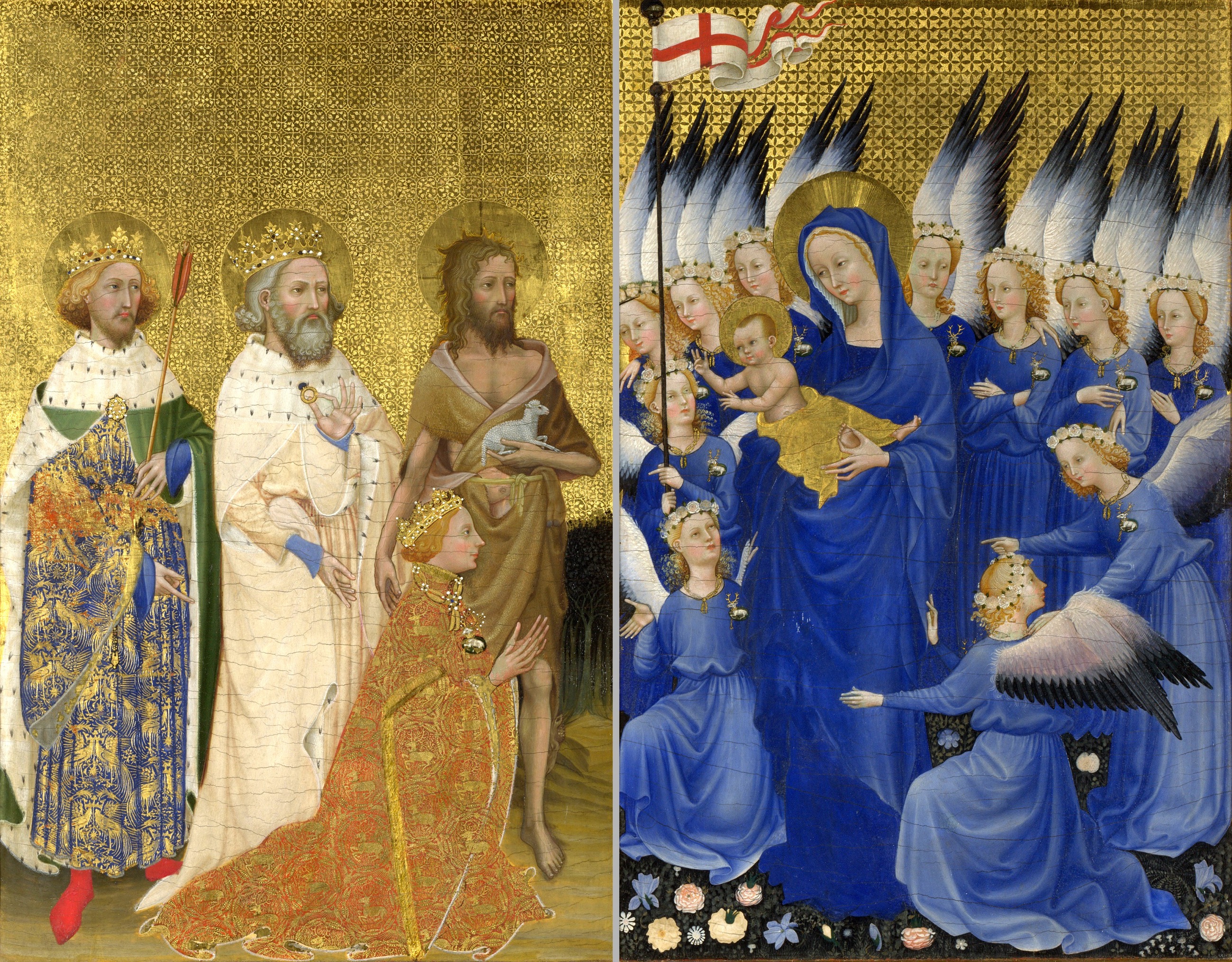
Richard II kneels in a field of gold, but the painting does not let him remain alone. In The Wilton Diptych, a king, three saints, the Virgin, the Christ Child, angels, badges, standards, flowers, and heraldic signs all lock into one small devotional object. The result is intimate in scale and enormous in ambition. It is a private image that stages a public claim: Richard's kingship belongs inside a sacred order.
A small royal image with a large claim
The National Gallery dates the diptych to about 1395-1399 and identifies the artist as English or French. It was made for Richard II, King of England from 1377 to 1399, probably in the last five years of his life. The work is small and portable: two oak panels painted in egg tempera, each about 53 x 37 cm, hinged so that the image could close like a precious book.
Portability changes the kind of image this is. This was not a huge altarpiece for a public church. It could be opened, closed, carried, protected, and used in a royal devotional setting. Yet the image is not modest. It treats private prayer as a place where politics, dynastic memory, and divine favor can be arranged with dazzling precision.
What the painting shows
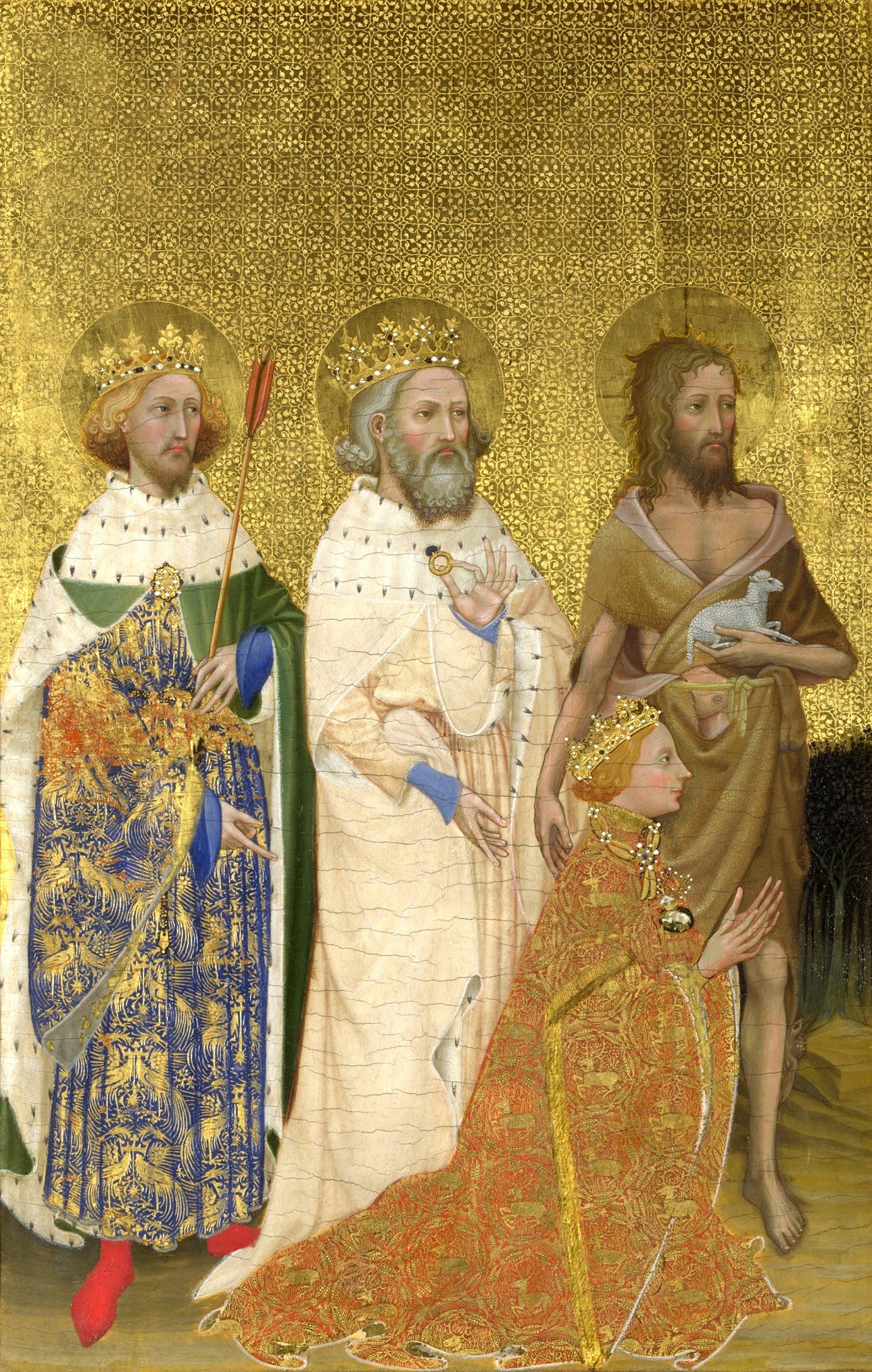
On the left, Richard II kneels in a blue robe patterned with gold harts and broom pods. Behind him stand three holy figures: John the Baptist, who carries the Lamb of God; Saint Edward the Confessor, holding a ring; and Saint Edmund, holding the arrow of his martyrdom. They do not simply accompany the king. They present him.
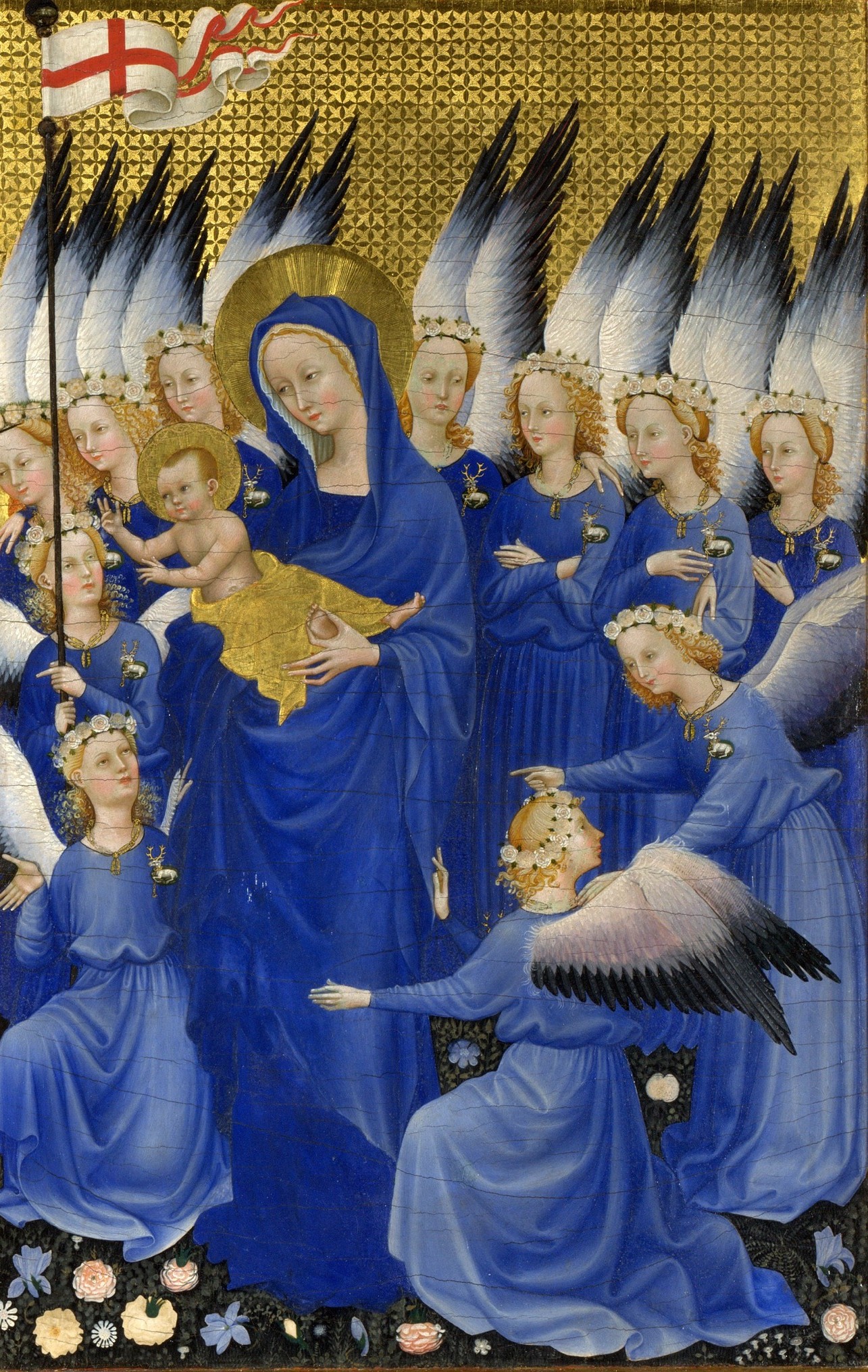
On the right, the Virgin Mary holds the Christ Child among a group of angels. One angel carries a white standard marked with the red cross of Saint George, while Christ raises his hand in blessing. The gold background refuses ordinary space. Richard kneels in the earthly panel, but the composition pulls him toward a heavenly court where his rule can be confirmed.
The painting is easy to admire for its surface: blue, gold, delicate faces, fine robes, flowers, and small painted jewels. The hinge carries the deeper argument. It separates two worlds and connects them at the same time. The king remains outside heaven, yet everything in the painting is arranged to bring him into relation with it.
Two panels, one argument
A diptych naturally creates a before-and-after rhythm, or a left-and-right exchange. Here that structure becomes political theology. Richard does not look directly at the viewer. He looks across the hinge toward Mary and Christ, while the saints behind him make his approach legitimate. The right panel answers with blessing, standard, and angelic recognition.
The image feels both tender and formal because Richard appears young, kneeling, and vulnerable, while surrounded by signs of status. His prayer is not only personal devotion. It is a visual claim about the origin of royal authority. Heaven does not merely receive Richard's devotion; it appears to acknowledge his rule.
The white hart and the politics of signs
The most memorable sign is Richard's white hart. It appears on his robe, on his jewel, and on the angels' badges. The National Gallery notes that Richard adopted the emblem from his mother and that it also worked as a visual pun on his name, Richart in French. In the painting, that badge does extraordinary work. It turns the angels into Richard's supporters.
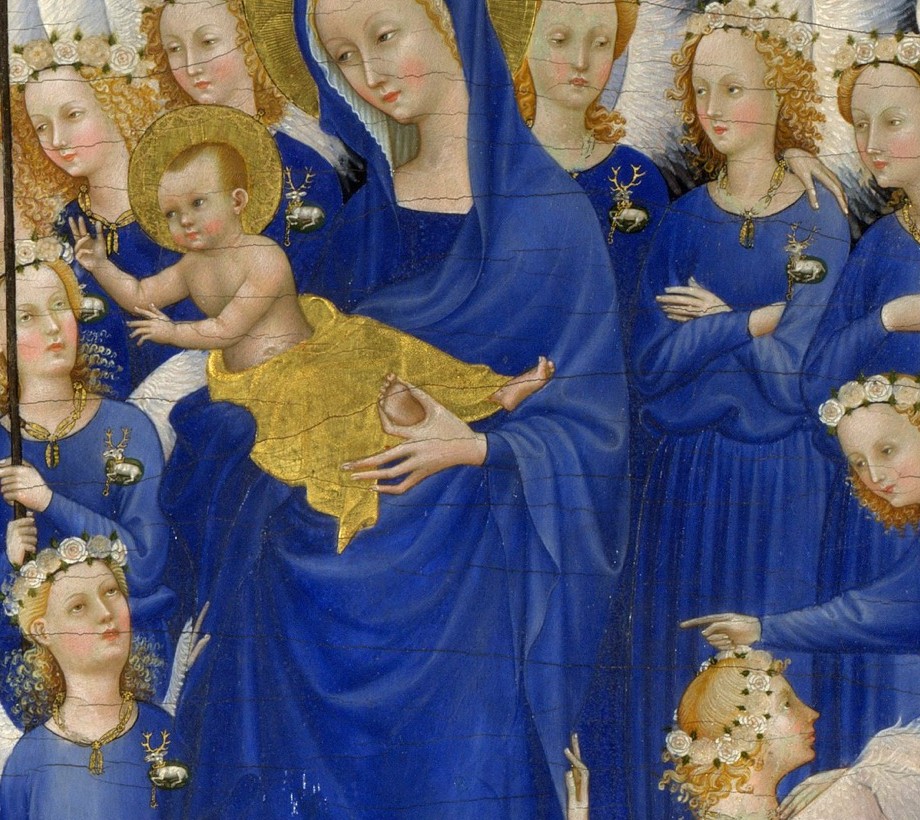
The image therefore collapses court culture and sacred space. Badges, livery, heraldry, and saintly protection belong to the same visual system. The angels do not wear neutral decoration. They wear the king's sign. Looking closely, the painting becomes less like a simple devotional picture and more like a carefully staged alliance between heaven and the royal household.
International Gothic refinement
The Wilton Diptych is one of the clearest English survivals connected with International Gothic. The style is courtly, polished, decorative, and mobile across borders. Its figures are graceful, its colors luxurious, its gold surfaces intense, and its natural details precise without becoming fully naturalistic space.
The unknown painter does not build a believable room or landscape in the later Renaissance sense. Instead, the work makes a world of refinement. The meadow flowers are observed with care, the faces are soft and idealized, and the gold ground turns the scene into a realm of sacred display. The painting is not trying to look ordinary. It is trying to look elevated, rare, and ceremonially exact.
Where to look first
- Start with Richard II: his kneeling body anchors the left panel and gives the whole image its human subject.
- Move behind him to the saints: they make his approach to Mary and Christ legitimate.
- Cross the hinge to the Virgin and Child: the blessing turns devotion into royal authorization.
- Look for the white harts: the repeated badge links robe, jewel, angels, and royal identity.
- Step back to the gold field: the surface makes both panels feel like one ceremonial vision.
Why the diptych still holds attention
The Wilton Diptych holds attention because it keeps several scales active at once. It is small enough for private use, but grand enough to imagine kingship as a sacred drama. It is devotional, but never merely devotional. It is political, but too beautiful and delicate to read as propaganda alone.
Its power lies in that compression. A few square centimeters carry a king's image, a national emblem, saintly ancestry, heavenly blessing, and one of the most refined surfaces of late medieval painting. The eye moves from king to saints, from saints to Virgin, from Christ to the standard, and from the standard back to the white hart. Everything returns to the question of how power wants to be seen.
Continue from the Wilton Diptych
Comparison path
Then try the art quiz.
Primary sources
- The National Gallery: The Wilton Diptych
- The National Gallery catalogue entry: The Wilton Diptych
- The National Gallery glossary: International Gothic
- Smarthistory: The Wilton Diptych
- Dillian Gordon, "A New Discovery in the Wilton Diptych", The Burlington Magazine, JSTOR
- Ashmolean Museum: Explore the Wilton Diptych
- Wikimedia Commons file
Frequently asked questions
It shows Richard II kneeling before the Virgin and Christ Child, presented by John the Baptist, Saint Edward the Confessor, and Saint Edmund. Angels surround the Virgin and wear Richard's white hart badge.
The painter is unknown. The National Gallery identifies the artist as English or French, reflecting the uncertainty around the work's origin and the international court style of the period.
The Wilton Diptych is in The National Gallery, London, inventory number NG4451.