
Artwork Analysis
Bal du moulin de la Galette: Renoir's Crowd, Light, and Modern Paris
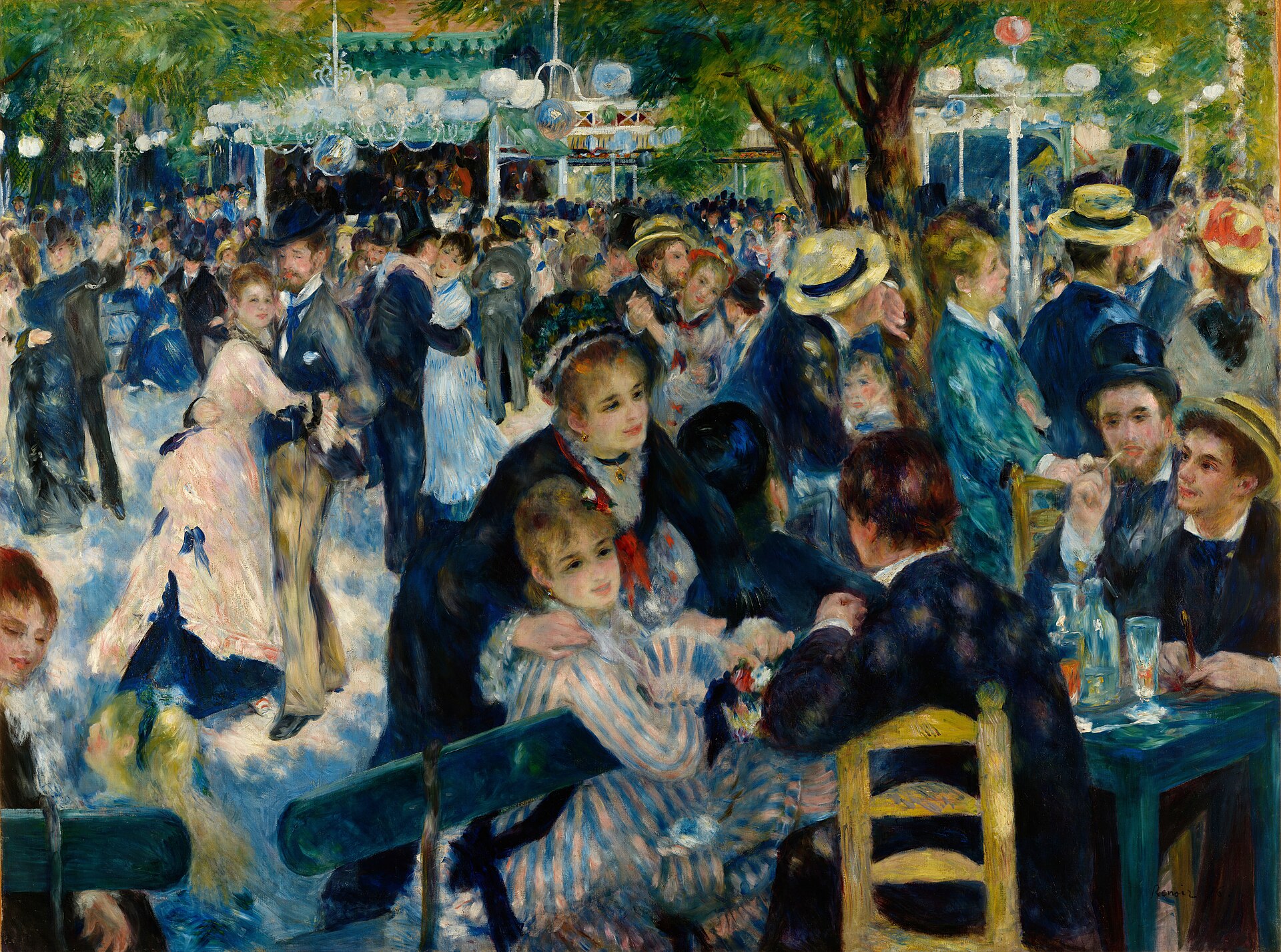
The first impression is noise: hats, faces, dresses, glasses, shadows, and dancing bodies packed under the trees. Renoir turns that crowded Sunday afternoon at the Moulin de la Galette into a readable structure. First shown at the Third Impressionist Exhibition in 1877, Bal du moulin de la Galette makes modern leisure large enough for serious painting: strangers share space, class lines loosen for a few hours, and dappled light ties the crowd into one atmosphere.
The crowd-reading method
The painting is not just a sunny dance scene; it is Renoir's test of how modern leisure can become a major subject. Start with the lower-left table, follow the diagonals of hats and shoulders, then watch how dappled light binds the crowd into one shared atmosphere. That structure is what connects the work to Impressionism, not only its broken brushwork.
What is happening in the scene
Renoir chooses a subject academic painting considered too ordinary: people dancing, flirting, talking, drinking. The Moulin de la Galette was a popular open-air dance venue in Montmartre, named after the small galettes sold there. The clientele was mixed: workers, artisans, clerks, artists, and small bourgeois families.
That choice is central to Impressionism. Instead of mythology, battle, or state portraiture, the painting treats everyday urban leisure as historically meaningful. Read next to Impression, Sunrise, you can see how the movement expands from modern labor scenes to modern social rituals.
How to read the painting in 30 seconds
Start at the seated figures in the lower left. Their table gives you a stable base. Then follow the diagonal rhythm of hats, shoulders, and tilted heads toward the middle distance. Renoir uses these angled currents to pull your eye into depth without relying on a single heroic focal point.
Now scan the color accents: repeated blues and warm skin notes act like visual punctuation. They keep the crowd coherent even as brushwork breaks form into quick touches. The result is a controlled choreography that feels like spontaneity.
That choreography also gives the page a useful reading path. Move from the seated group at front left to the dancers in the center, then to the standing figures behind them. Each group behaves like a small conversation, but Renoir's diagonals keep them from becoming separate anecdotes.
Light as structure, not decoration
The dappled light is the painting's engine. Sunlight filtered through leaves lands in moving patches across jackets, faces, hats, and ground. These flashes stop the figures from becoming static portraits; everything appears to shimmer in the same shared air.
Nineteenth-century critics mocked these blue and violet shadows as improper. Today, they read as an observational breakthrough: Renoir paints not objects in isolation, but bodies inside changing optical conditions. The canvas still feels immediate on a museum wall because the light makes social movement visible before the viewer has sorted out every person in the crowd.
What made the picture radical in 1876
Scale matters. At 131 x 175 cm, Renoir gives monumental dimensions to a scene with no hero and no moral lesson. This was not a sketchbook curiosity; it was a strategic claim about what modern painting should take seriously.
He also borrows from contemporary visual culture: cropped edges and partial figures suggest the logic of photography and Japanese print framing. The painting says, in effect, that lived urban time is fragmentary, and art must adapt its grammar to match.
A social laboratory, not a postcard
The canvas is often reduced to cheerful nostalgia. That misses its precision. Renoir stages a dense social microclimate where people perform rank, desire, and ease in public. Clothes signal status, but gestures keep status unstable: a glance, a turn of the shoulder, a hand on a chair can change social distance in seconds.
Seen against the harder urban tension in Street, Berlin, Renoir's solution looks almost utopian: modern city life can produce friction, but it can also produce temporary civic harmony.
Reception, revisions, and legacy
Renoir developed the work through studies, then adjusted passages in the studio. Contemporary reviews split quickly: some praised vitality, others attacked what they called unfinished handling. The same brush freedom later became a model for modern painting.
Renoir also made a smaller version in 1876, proof that this subject was not a one-off success but a deliberate problem he kept refining. Today, the Musée d'Orsay version remains a cornerstone because it shows something difficult and rare: how to paint collective pleasure without sentimentality, and structure without stiffness.
Primary sources
- Musée d'Orsay - collection record
- The Met - Auguste Renoir overview
- Encyclopaedia Britannica - artwork entry