
Artist Guide
Pierre-Auguste Renoir
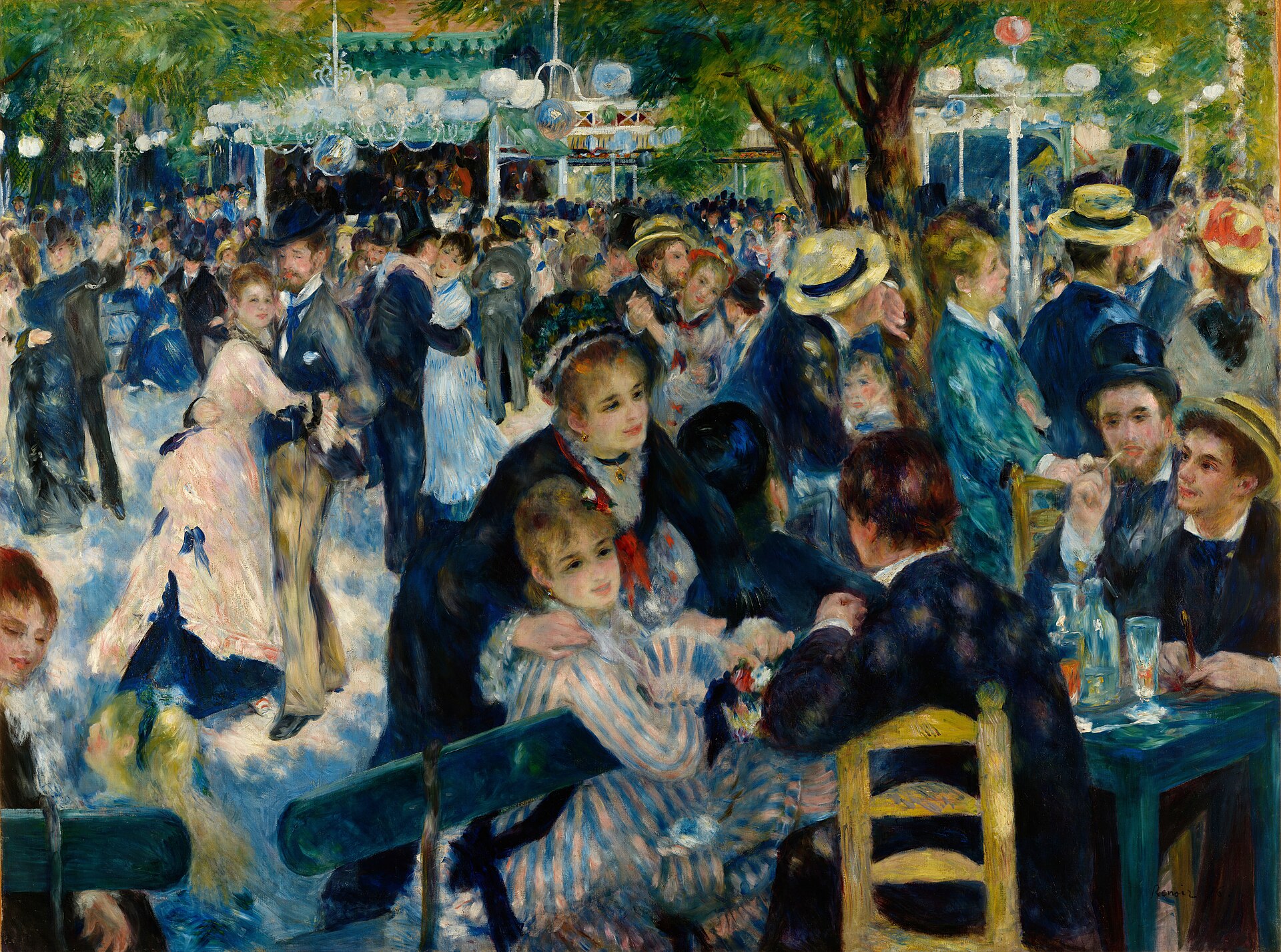
Renoir is usually introduced as the painter of happiness. That is too soft. His real achievement is harder: he makes pleasure structurally convincing. In his best paintings, warmth, flirtation, ease, and physical beauty are not decorative extras. They are the means by which modern social life becomes pictorially serious.
From porcelain workshop to painter of modern sociability
Born in Limoges in 1841, Renoir first trained as a porcelain painter. That early apprenticeship matters more than it sounds. It sharpened his feel for luminous surface, decorative rhythm, and the appeal of objects meant to reward close looking. When he moved into the Paris studio world and met painters who would help form Impressionism, including Claude Monet, he brought that sensitivity with him.
But Renoir never shared Monet's priorities completely. Where Monet often turned toward harbor, river, cliff, or facade, Renoir kept returning to bodies, proximity, and the performance of public leisure. That difference is central. Renoir makes sociability itself into a formal problem: how do you paint a crowd without freezing it, and how do you make pleasure legible without reducing it to anecdote?
Bal du moulin de la Galette and the choreography of nearness
His most persuasive answer is Bal du moulin de la Galette. The painting feels spontaneous, but it is tightly engineered. Hats, shoulders, benches, drifting glances, and patches of filtered sun are woven into one continuous field. Dappled light does not merely beautify the crowd; it binds the figures into a shared atmosphere where no single protagonist can dominate the scene for long.
That is why the canvas matters within Impressionism. Compared with the cooler optical testing of Impression, Sunrise, Renoir makes perception social. He turns modern vision into proximity: bodies brushing past each other, faces half-seen, time felt as circulation rather than as weather alone. The painting is pleasurable, but its pleasure is organized with exceptional discipline.
Italy was a reset, not a betrayal
The usual story says Renoir abandoned Impressionism in the 1880s. The stronger version is that he found a limit and recalibrated. After traveling in Italy and studying Raphael, he felt broken brushwork could dissolve the figure too far. The so-called Ingresque or dry period was not a conservative retreat from modernity. It was a technical correction: more contour, firmer anatomy, more deliberate long-form design.
That shift keeps Renoir from becoming a one-effect painter. He refused to choose forever between atmospheric vibration and classical construction. In that sense he stands near the hinge that leads from Impressionism toward Post-Impressionism: not because he anticipates every later movement, but because he treats style as a revisable tool rather than as a fixed identity.
Legacy, disagreement, and historical position
Renoir's legacy remains divisive because his paintings force an uncomfortable question: can beauty carry social knowledge, or does it always soften reality? Viewers who want alienation, rupture, or explicit critique often find him too accommodating. Yet that judgment can be too quick. His cafes, boating parties, interiors, and dancing grounds are also documents of class visibility, gender display, and new forms of public leisure in late nineteenth-century France.
Read him against the sharper urban unease of Expressionism, or even against works such as Street, Berlin, and his distinctiveness becomes clearer. Renoir does not deny modernity's tensions; he answers them by insisting that pleasure itself has a history, a structure, and a politics of access.
The late image of brushes strapped to arthritic hands is often treated sentimentally, but its real value is methodological. Renoir kept treating painting as physical intelligence even when the body resisted. That persistence helps explain why he remains useful in 2026 for readers building visual literacy: he is one of the clearest cases for understanding how surface seduction, formal control, and historical meaning can coexist in a single frame.
Key works in Explainary
Associated movements
A strong route through Renoir on Explainary is simple: start with Bal du moulin de la Galette, then return to Impressionism, then compare him with Monet and the later tensions of Post-Impressionism and Expressionism. That sequence makes his position much easier to judge accurately.
Use the art quiz as a quick check: can you identify Renoir through visual signals such as dappled light, warm skin tonality, and densely staged sociability?