
Artwork Analysis
Street, Berlin
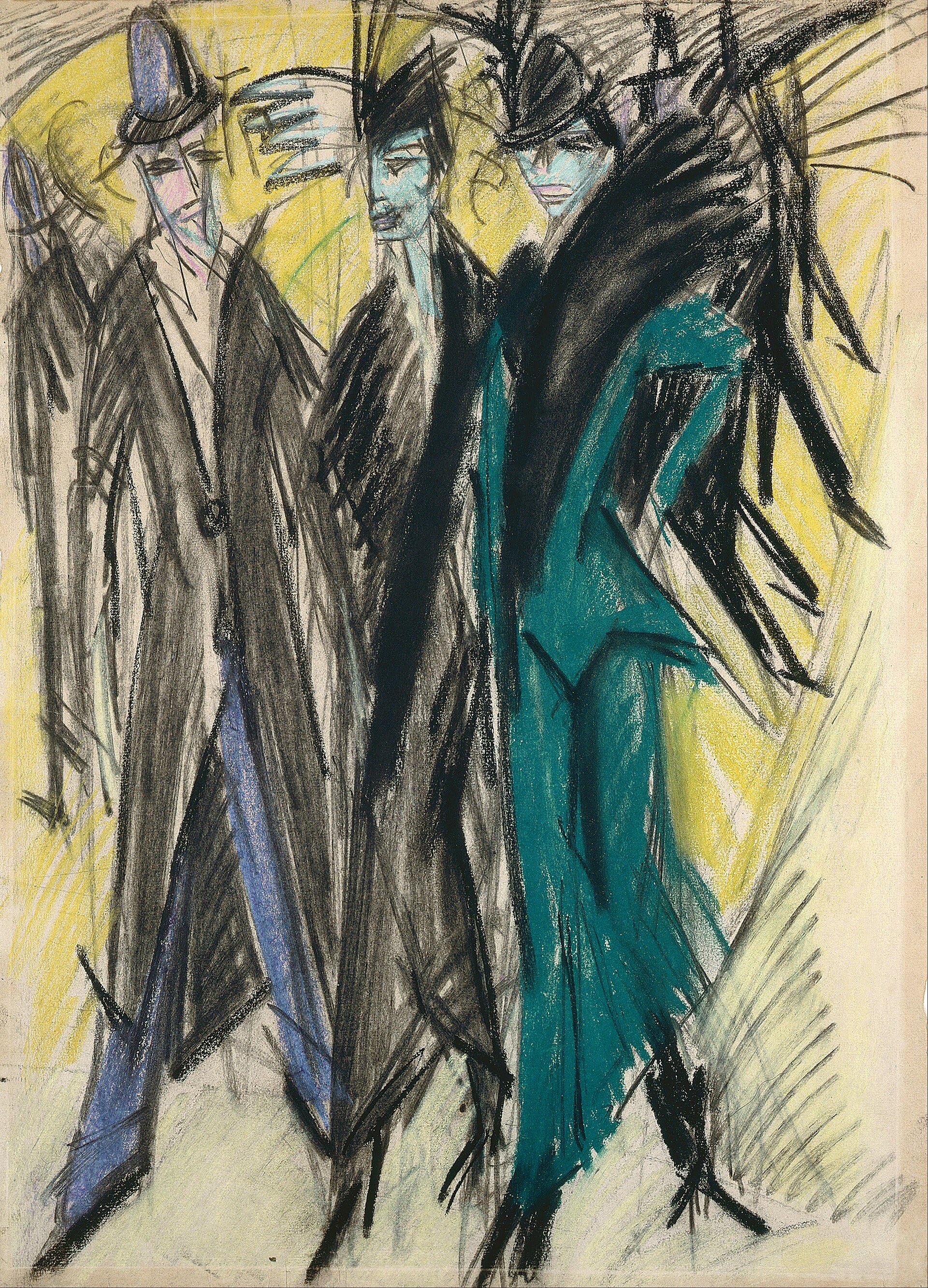
The fastest way into this painting is simple: if it feels loud and cold at the same time, you are reading it correctly. Painted in 1913, just before World War I, Kirchner's Street, Berlin turns a crowded city scene into a study of social distance. It is one of the clearest statements of Expressionism: painting should not only describe what the eye sees, but what the body feels under pressure.
What you are looking at
Two women dominate the foreground in oversized hats and elegant coats. For a 1913 Berlin audience, they were recognizable as sex workers operating in a commercial entertainment district. Around them moves a crowd of men in dark suits and bowler hats, less like individuals than repeated social units.
Kirchner is not moralizing about vice. He is mapping an economy of glances, transactions, and fast judgments. The street becomes a public stage where visibility is high and intimacy is low. Put this next to Bal du moulin de la Galette and the contrast is sharp: Renoir paints social ease, Kirchner paints social strain.
The Anatomy of a Fractured Metropolis
Start with the two central women, then let your eye move outward to the male crowd. Notice how quickly faces lose identity. Then check the street angle: there is no stable horizon, no safe resting point. The ground seems to tilt toward you, pulling you into the scene rather than inviting calm observation.
This is a deliberate construction. Kirchner engineers discomfort through composition, so urban anxiety is not only represented; it is physically staged for the viewer.
Artist's Intention
Kirchner's intention was to move beyond the "surface" of the city to reveal its psychological anatomy. By using mask-like faces, he aimed to depersonalize his subjects, turning them into symbols of the modern alienation he felt in Berlin. His method was visceral: he wanted the viewer to feel the "nervous speed" and overstimulation of pre-war metropolitan life, where isolation persists despite physical proximity.
Line, color, and the woodcut mentality
Kirchner's lines cut more than they describe. Bodies are elongated, faces are mask-like, and contours feel incised, which reflects his deep engagement with woodcut technique. Instead of rounded modeling, he uses angular breaks that make human presence feel brittle.
Color does the same work. Acid greens, pinks, black accents, and abrupt shifts in tone resist naturalistic harmony. Like The Scream, the palette carries affect before it carries information. You do not read these colors as weather; you read them as tension.
Berlin before collapse
The historical timing matters. Pre-war Berlin was expanding rapidly, saturated with new media, electric nightlife, and intense class mobility. Kirchner had moved there from Dresden and experienced the metropolis as both opportunity and threat. The painting records that contradiction without sentimentality.
The key point is that the city is treated as a system, not a backdrop. Gender, money, desire, and status are negotiated in open view. Everyone occupies the same pavement, but no one shares the same world.
Why this painting still feels current
Street, Berlin opened Kirchner's crucial 1913-1915 street series and later became entangled in twentieth-century politics, including Nazi denunciation as "Degenerate Art." Its survival is part of its power: it carries historical evidence and formal invention at once.
In 2026 the canvas still reads clearly because it captures a condition we know well: maximum exposure, minimum connection. You are seen by everyone and held by no one. That is why the painting keeps returning in discussions of crowd behavior, urban stress, and visual culture under constant stimulus.
Useful comparison path
To deepen your reading, move across three works in sequence: Bal du moulin de la Galette for social ease, Street, Berlin for social pressure, and The Scream for distilled psychological rupture. The same half-century can generate radically different emotional grammars.
One detail many viewers miss: Kirchner minimizes eye contact in ways that feel almost algorithmic. Faces are present, but recognition is weak. This subtle refusal of mutual acknowledgment is part of the painting's intelligence. The fear here is not dramatic violence; it is social indifference, rendered as form.
Primary sources
- MoMA - Street, Berlin collection entry
- The Met - Die Brücke and German Expressionism
- Encyclopaedia Britannica - Kirchner biography