
Neoclassical Painting
The Death of Socrates
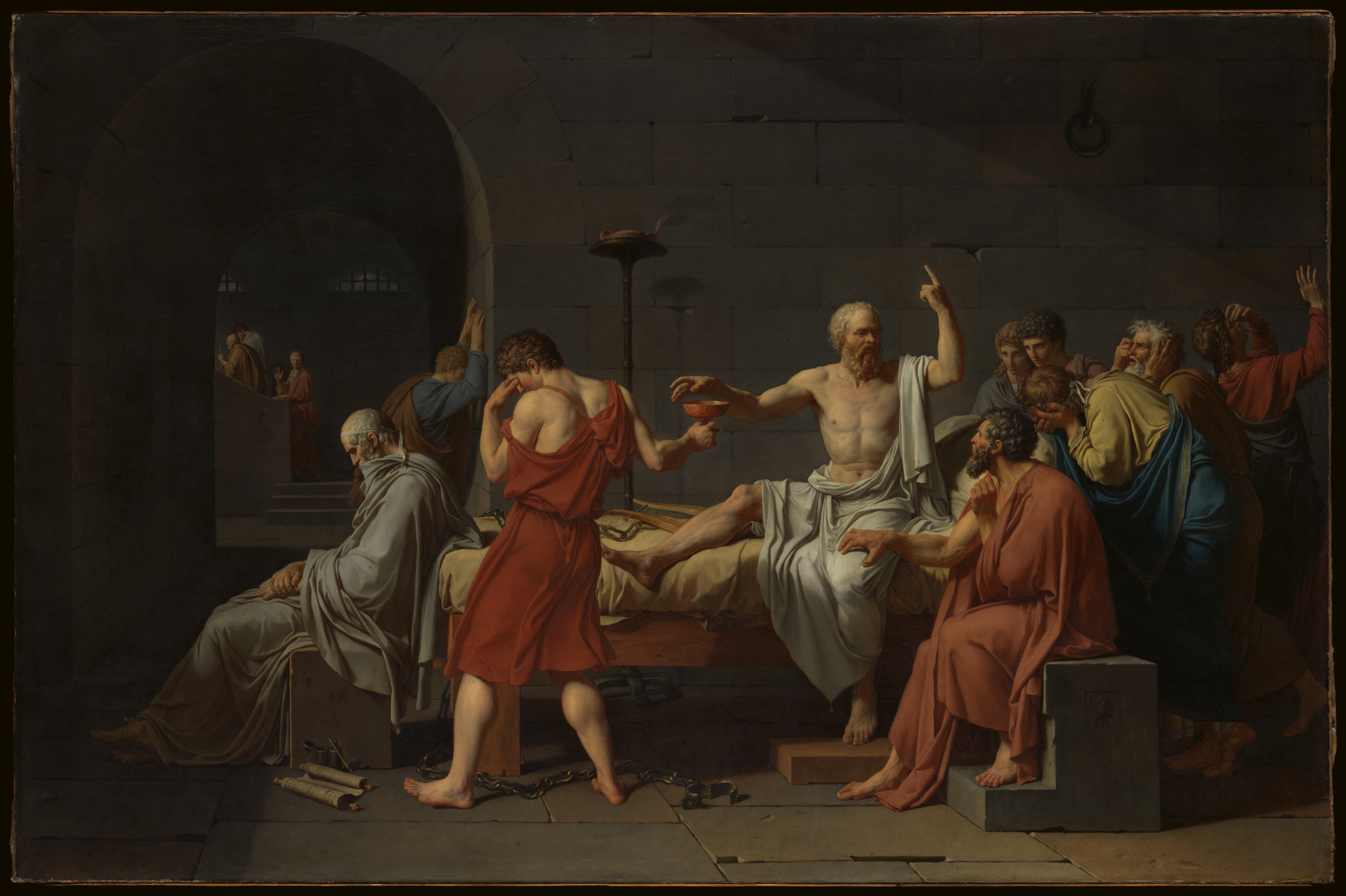
Socrates reaches for the cup while still teaching, and everyone around him has already given way to grief. In The Death of Socrates, Jacques-Louis David turns an ancient execution into a severe image of reason, conviction, and self-command. The painting is about death, but even more about what a mind looks like when it refuses to yield.
1787: an ancient death painted for a modern moral public
David paints the work in 1787, just two years after The Oath of the Horatii and just before the French Revolution. The subject comes from Plato's Phaedo: accused of impiety and of corrupting the youth of Athens, Socrates accepts the sentence of death rather than renounce his beliefs. For late eighteenth-century viewers, this was not remote classical lore. It was a model of moral firmness under pressure.
That matters because David is not painting philosophy as abstraction. He is giving public form to a choice: speak clearly, remain inwardly free, and accept the cost. As in much of Neoclassicism, antiquity becomes a language for modern seriousness. The antique setting provides distance, but the moral demand is contemporary.
One raised finger, one cup waiting
The scene is built with unusual precision. Socrates sits upright on the bed, his torso still firm, one hand extended toward the cup of hemlock, the other pointing upward as if the argument is still continuing. Around him, his disciples lean, collapse, or turn away. The jailer averts his face. Crito grips Socrates' thigh. The cup is already there, yet the intellectual act has not stopped.
That is the painting's central paradox. Everything around Socrates belongs to human distress, but Socrates himself seems to belong to another register. David isolates him not by placing him alone, but by making posture, contour, and gesture keep him clear when everyone else buckles. Conviction becomes visible in the body.
Why Plato is old and silent
One of David's most revealing choices sits at the foot of the bed. Plato appears as an old man, seated in silence, turned inward rather than active in the scene. Historically, Plato was much younger and may not even have been present. David ages him deliberately. He wants more than eyewitness drama. He wants memory, transmission, and authorship inside the image.
That choice tells you how the painting works. The Death of Socrates is not a neutral reconstruction of an event. It is a carefully edited moral image. Plato becomes the witness through whom the scene enters history. He anchors the painting in thought and writing, while Socrates embodies thought under trial.
David makes reason look physical
David's method is more severe here than in The Oath of the Horatii. He strips the setting down, sharpens the contour, and stages each body by function. Panic does not spread evenly across the canvas. It is distributed. Socrates remains vertical. The others curve, fold, or fall away. The geometry itself divides self-command from emotional collapse.
This is why the painting matters so much for David. He proves that an image can feel dramatic without movement or spectacle. Philosophy, usually thought of as invisible, is made legible through design: the raised finger, the reaching hand, the seated witness, the withdrawn jailer, the chain just released from Socrates' ankle. Each element pushes the eye toward the same conclusion. The body is dying, but the principle is not.
After The Oath of the Horatii
Seen after The Oath of the Horatii, the shift is revealing. There, David organizes public duty through father, brothers, and civic vow. Here, the scene is smaller, tighter, and more inward, but no less public in meaning. The oath becomes a final lesson. Political virtue turns into philosophical steadfastness.
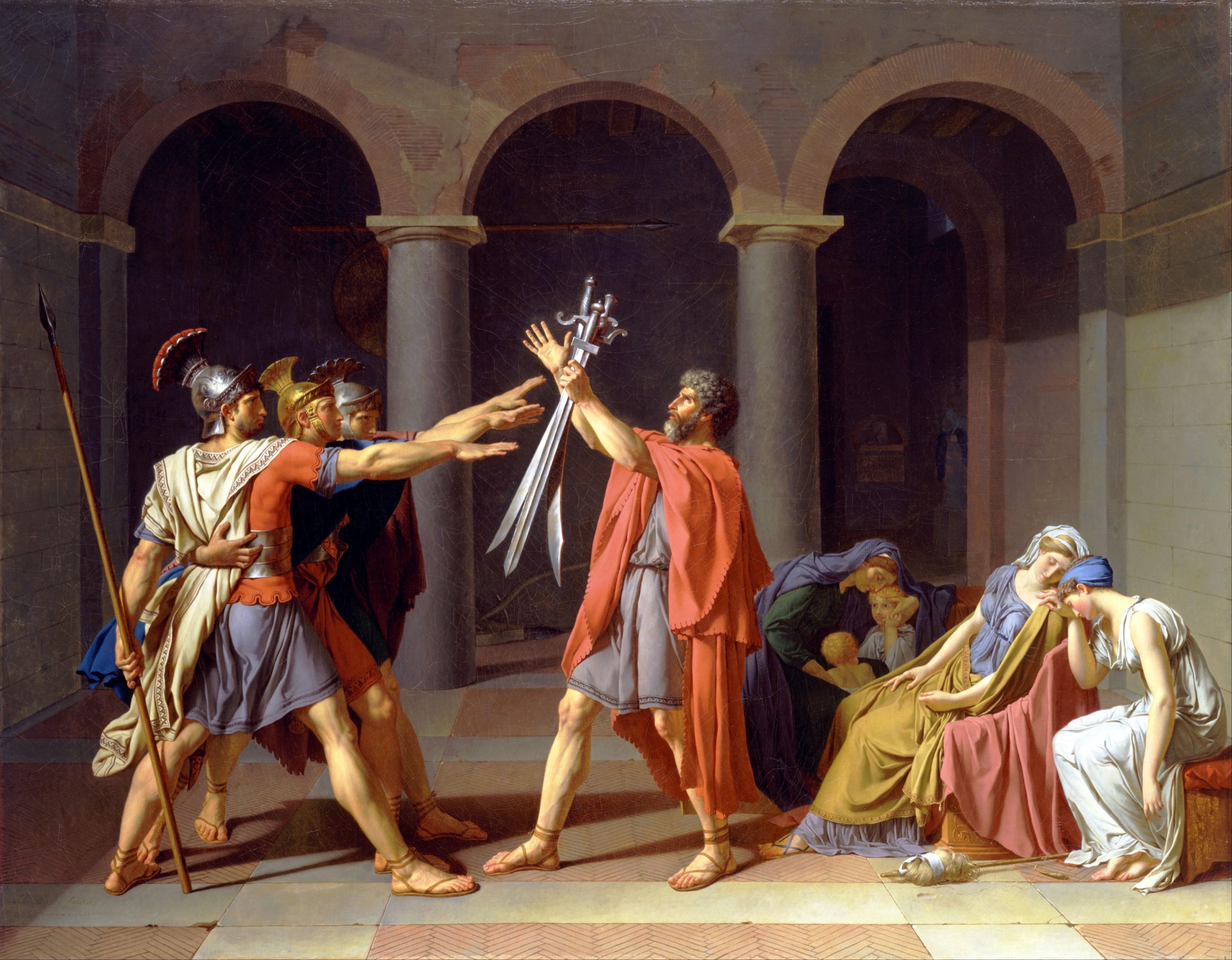
That is also why the work helps explain later political painting. Put it beside The Third of May 1808 and the distance becomes obvious. Goya paints terror, moral shock, and the body under violence. David paints chosen steadiness at the edge of death. Both works are ethically charged, but they ask the viewer to face different kinds of courage.
Explore more
Then try the art quiz.
Primary sources
Frequently asked questions
Because David wants thought to remain active at the exact moment of death. The upward finger keeps the philosophical argument alive even as the body moves toward the hemlock.
David ages Plato on purpose. He turns him into a figure of memory and authorship rather than a strictly historical participant in the room.
Because it joins antique subject matter to exact contour, moral gravity, and a composition built to make conviction look public and clear.