
Artist Analysis
Francisco Goya
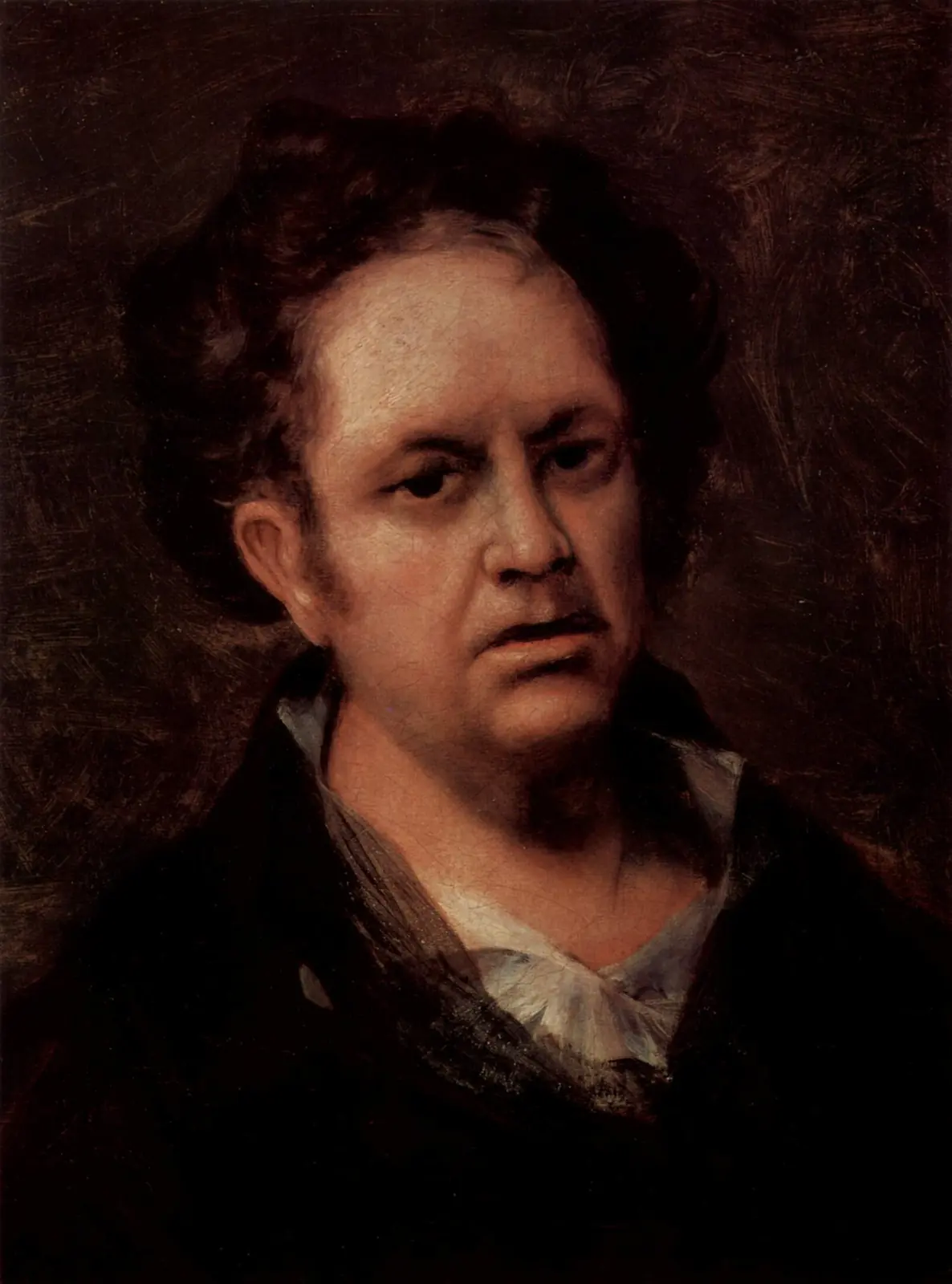
Goya understood power from inside, then painted the costs it hides. He is one of modernity's most acute witnesses, moving from court polish to images of fear, violence, and moral collapse without losing formal control.
Court access, illness, and political rupture
Goya's career begins inside institutions: trained in Zaragoza and later connected to the Spanish court, he mastered official portrait language before turning it against its own illusions. Working across monarchy, war, and repression, he observed power from both within and outside. Illness and deafness deepened that shift from ceremony to critique.
This trajectory is the key to reading him: not a simple move from "early style" to "late style," but a progressive redefinition of what painting can expose about violence and responsibility.
A visual rhetoric of ethical shock
Goya uses stark light, abrupt gesture, and compressed space to produce moral pressure rather than heroic resolution. Even in chaotic scenes, composition stays legible enough to guide the eye toward consequence, not spectacle. His brushwork can be rough, but the argument is precise.
Placed between Baroque inheritance and Romanticism, he transforms dramatic contrast into an instrument of modern skepticism.
The Third of May: witness against myth
The Third of May 1808 remains the clearest synthesis of his method. Goya stages state violence as a confrontation between vulnerable bodies and anonymous force. The central white shirt is not decorative spotlighting; it is an ethical beacon that forces attention onto civilian exposure rather than military glory.
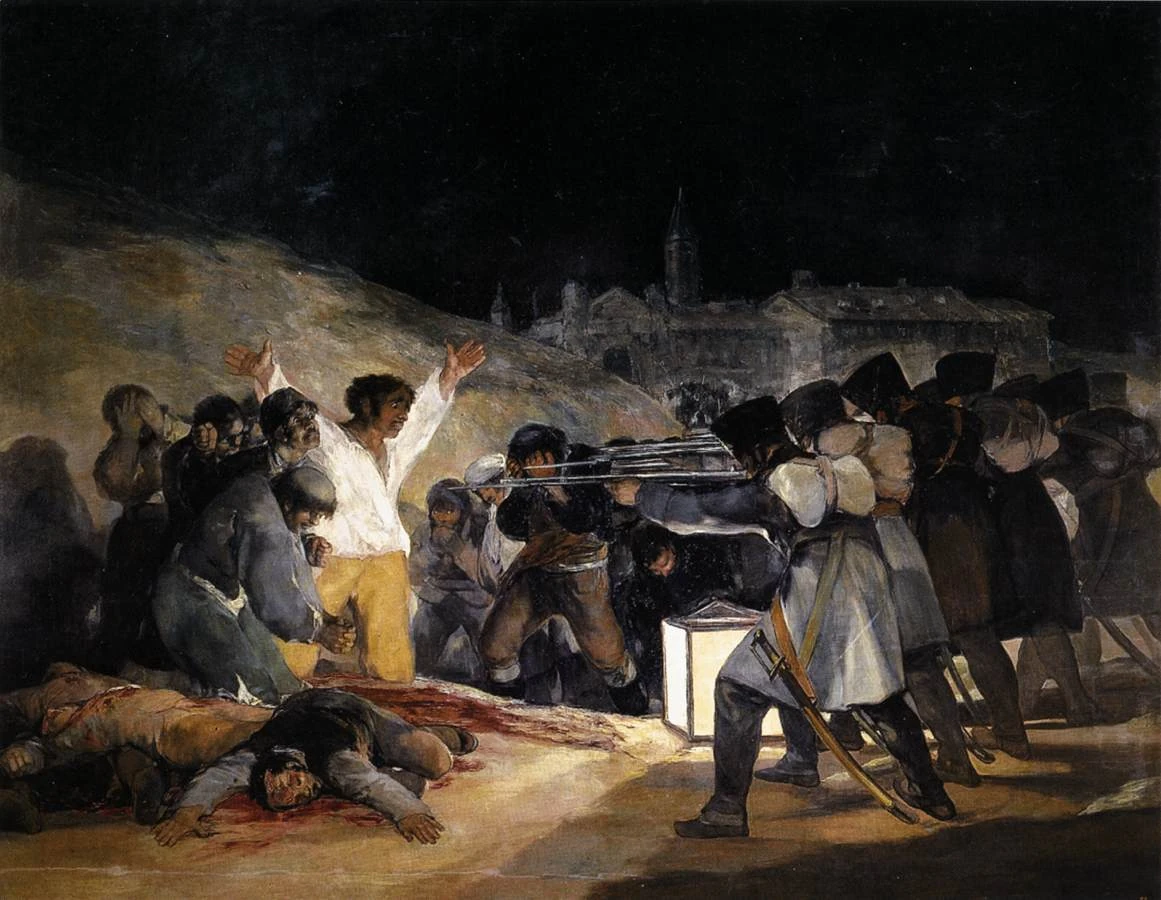
Comparing this work with Liberty Leading the People clarifies two different political contracts: Delacroix mobilizes, Goya indicts.
From public violence to private nightmare
The darker late counterpart is Saturn Devouring His Son, one of the Black Paintings made at the Quinta del Sordo. There the public execution ground disappears. Violence is no longer historical theater but private panic, stripped of narrative comfort and reduced to compulsion, fear, and flesh.
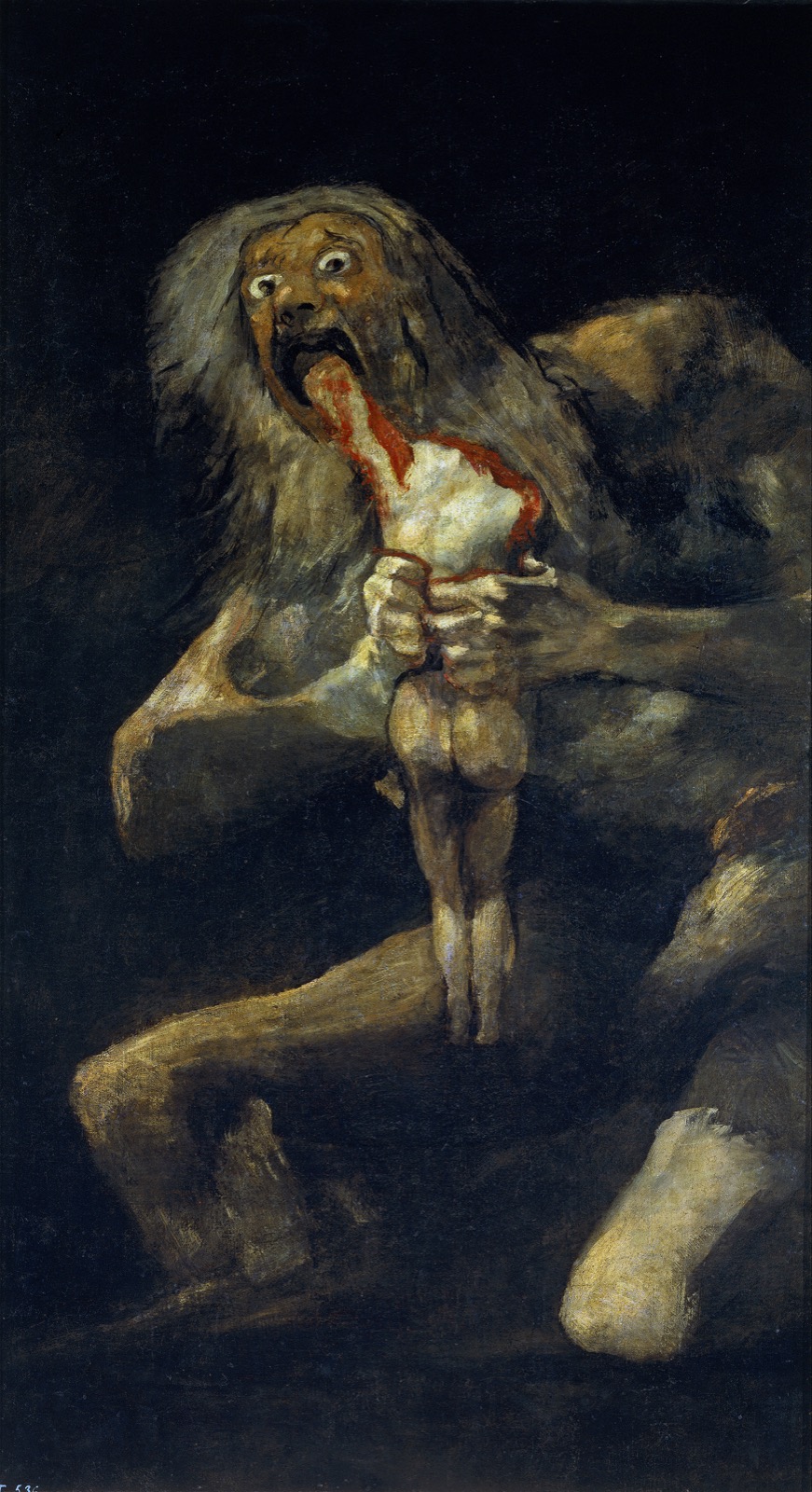
Read beside The Third of May 1808, the pair clarifies the breadth of Goya's modernity. One image confronts public murder; the other imagines power as appetite turned inward and mad.
From court painter to analyst of catastrophe
The hinge in Goya's career is not just style; it is position. He knows the ceremonial codes of monarchy from the inside, then turns that knowledge against illusion. In portraits and history scenes alike, he repeatedly asks who pays the political cost behind the official image. Faces remain individualized, but institutions are stripped of automatic legitimacy.
That shift is why Goya still reads as modern in 2026. He does not trust spectacle to carry truth. Even in dramatic compositions, he introduces friction: awkward spacing, broken gesture chains, glaring light that refuses sentimental closure. The result is an image that resists propaganda while still delivering force.
Read him next to Delacroix and the contrast becomes precise. Delacroix often converts political energy into heroic momentum; Goya often converts it into ethical shock. Both are linked to Romanticism, but their contracts with the viewer differ radically. Add Théodore Géricault and The Raft of the Medusa to map a broader field of political pain in early modern Europe.
Why Goya's method travels across media
Goya's prints matter as much as his paintings because they show his analytical method in compressed form: serial thinking, variation, and repetition used to expose patterns of cruelty or folly. Instead of a single definitive statement, he builds cumulative pressure. That approach prefigures documentary logic and modern visual journalism.
Try this route in the library: read The Third of May 1808, then compare with Liberty Leading the People and The Calling of Saint Matthew. You can see two models of political painting: one that stages moral rupture and one that stages mobilizing myth, both indebted to earlier light-and-power dramaturgy. Understanding that split makes Goya less isolated and much more useful as a guide to how images handle violence.
A final practical cue: observe where Goya withholds resolution. He often leaves visual questions open - ambiguous faces, unstable distances, unresolved edges - so viewers must complete the ethical judgment themselves. That refusal of comfort is central to his modernity.
In that sense, his paintings do not close debate; they stage it, much as Rembrandt stages unresolved moral tension in The Night Watch.
His legacy is this durable method of ethical confrontation: images that remain intellectually active long after their original political moment.
Key works in Explainary
Associated movements
Continue with the art quiz to validate recognition, context, and comparison.