
Impressionism / Musée d'Orsay
La Gare Saint-Lazare
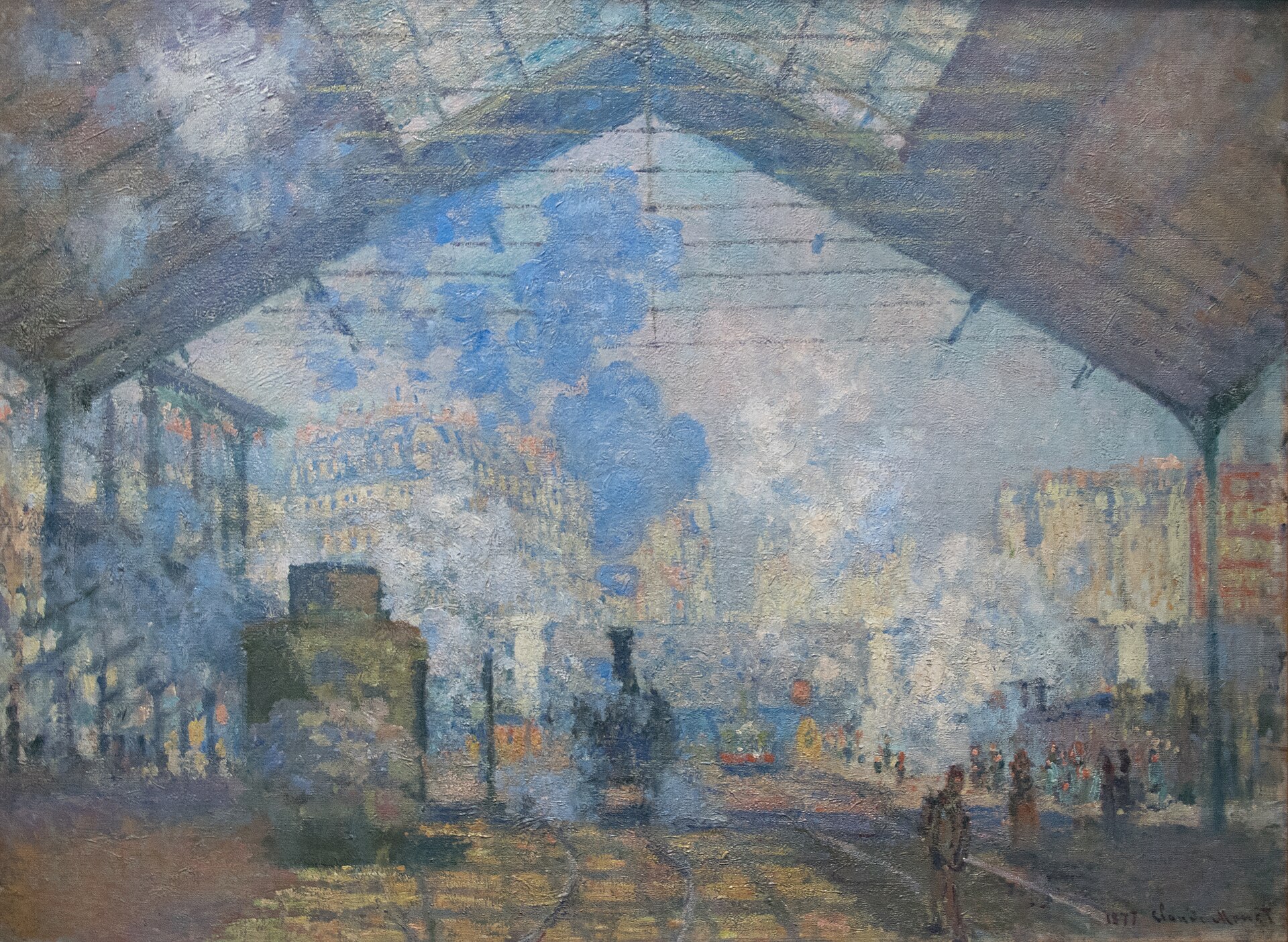
A cloud of blue steam rises under the iron roof, and the station seems to dissolve before the train can fully arrive. Painted in 1877, La Gare Saint-Lazare shows a Paris railway station filled with steam, iron, locomotives, platforms, and moving light. Monet does not present the place as a neat machine room. He turns modern industry into an Impressionist problem of atmosphere and perception.
The power of the painting comes from that instability. The locomotive is present, but not described like an engineering diagram. The roof is geometric, but softened by haze. Figures move through the lower edge like small marks. The station becomes less a place to identify than a condition to experience.
Quick Analysis of La Gare Saint-Lazare
The description of the painting is simple: a railway station, trains, an iron roof, platforms, and steam. Its interpretation is richer. Monet makes this modern motif an Impressionist experience: light disturbs form, steam erases outlines, cool colors organize space, and visible brushwork keeps sensation in motion. The station is not only represented; it becomes a way of seeing the modern city.
Possible Essay Question
Question: how does Monet turn an industrial railway station into an Impressionist painting?
Short answer: he does not tell a story about a train or passengers. He builds a composition in which steam, iron, light, color, and brushwork show modernity as an unstable atmosphere.
A modern subject inside the city
The Musée d'Orsay records La Gare Saint-Lazare as an oil on canvas from 1877, measuring 75 by 105 cm. Monet had recently left Argenteuil and moved into the Nouvelle Athènes district of Paris. After several years of painting riverbanks and suburban landscapes, he turned directly toward the modern city.
The railway station gave him exactly the subject he needed. It was urban, industrial, smoky, mobile, and public. According to Orsay, Monet asked permission to work inside the Gare Saint-Lazare. The result was a series of paintings from different viewpoints, including views of the vast hall. Returning to the same motif let him study variations of steam, light, angle, and atmosphere. The station became a laboratory of perception rather than a monument to machinery.
What the painting shows
The view opens under the station roof. At the top, the iron and glass structure creates a dark frame. In the center, a great burst of blue-white steam rises from the train area. Below it, locomotives, tracks, platforms, signals, and scattered figures appear through haze. Outside the station, pale buildings sit beyond the smoke like a city seen through weather.
The painting is built from oppositions: heavy iron and floating vapor, industrial structure and unstable light, modern traffic and almost abstract color. Monet lets the station keep its architecture, but the real action is the way steam changes every edge. The eye cannot hold the roof, train, crowd, and city separately for long; they merge into one moving atmosphere.
Composition, Color, and Brushwork
The composition is held by a few visible forces. The iron roof forms a dark armature at the top. The tracks and platforms lead the eye into depth. The central steam cloud opens the space like a luminous mass, while the dark locomotives anchor it near the ground. Nothing is perfectly stable: the lines remain present, but haze constantly takes them back.
The colors concentrate around blues, grays, milky whites, and a few deep blacks. This cool range gives the station the density of smoke rather than the clarity of architecture. Monet's brushwork remains visible: it does not polish the scene, but lets us feel the vibration of air, the dissolving steam, and the flashes of light on metal and glass.
Steam as Impressionist structure
This is not Impressionism as countryside leisure. Monet brings the same method into a railway station. He keeps a real motif in front of us, then lets air, smoke, and light do much of the compositional work. The painting remains anchored by tracks, roof beams, and locomotives, but its energy comes from what cannot stay fixed.
Monet's method is especially clear in the steam. It hides and reveals at once. It softens the machines, opens the space, catches blue light, and turns the roof into a kind of atmospheric vault. The modern train is therefore not only a subject. It produces the conditions through which the subject can be seen.
Modern life without anecdote
The station could have become a narrative scene: passengers arriving, workers loading, machines departing, the drama of travel. Monet avoids that. The figures are small, the details of class and destination remain indistinct, and the train is partly swallowed by vapor. Modern life appears as pressure on vision rather than as a story about particular people.
That choice makes the painting radical. Monet treats the railway as a serious visual subject without turning it into propaganda for progress. He neither celebrates the machine nor condemns it. He studies what the machine does to light, space, and attention. Industrial modernity enters painting as atmosphere.
Beside Manet's The Railway
The Railway by Édouard Manet makes the Saint-Lazare district a different kind of modern problem. Manet stays outside the station. He gives us a woman, a child, an iron fence, steam, and a blocked view. The train is hidden, and modernity becomes a matter of gaze, barrier, and social space.
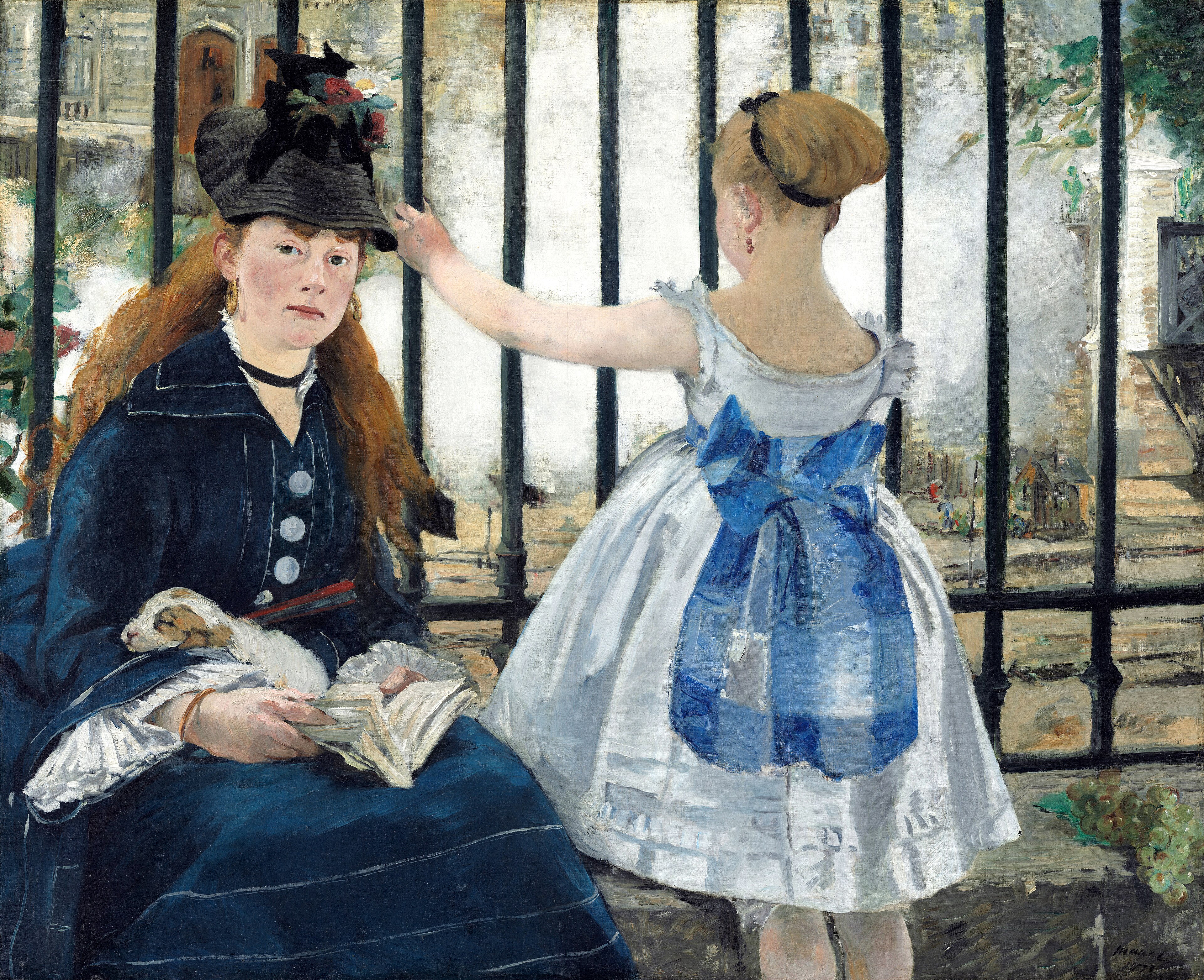
Monet moves through the barrier and into the station itself. The social drama becomes less explicit, but the visual drama intensifies. Manet asks what modern infrastructure does to looking from the street. Monet asks what steam, iron, and light do to painting from inside the machine age.
Where to look first
- Start with the steam in the center. It is the painting's real engine.
- Move upward to the iron roof. The geometry is there, but the haze refuses hard clarity.
- Look down to the locomotives and tracks. The machines are present as dark masses rather than precise diagrams.
- Follow the tiny figures along the platforms. They keep the scene human without turning it into anecdote.
- Step back to the whole image. The station becomes a field of blue, gray, vapor, metal, and movement.
Why the painting still feels modern
La Gare Saint-Lazare remains compelling because it makes the modern city visible as a problem of perception. The station is not only a place where trains arrive. It is a place where smoke interrupts architecture, speed disturbs stable vision, and light changes the meaning of metal.
The painting also sharpens what Monet had been doing since Impression, Sunrise. In Le Havre, mist, smoke, water, and orange light make a harbor feel newly unstable. At Saint-Lazare, the same logic enters the city. Monet turns a railway station into a living atmosphere, and makes industrial Paris look as fleeting as weather.
Seen this way, the station is not a backdrop for modern life. It is the mechanism that makes modern vision luminous, unstable, and hard to hold.
The station is modern not because Monet describes its machines, but because he paints the air they create.
Continue from Monet
Primary sources
Frequently asked questions
A Paris station with locomotives, platforms, iron architecture, steam, light, and small figures.
Monet makes a modern railway station a serious painting subject and puts steam, iron, and light at the center of Impressionism.
Yes. It belongs to Monet's 1877 Saint-Lazare group, painted from several viewpoints.
In the Musée d'Orsay, Paris.
Manet stays outside the station; Monet moves inside and makes steam the visual event.
Because light, steam, visible brushwork, and changing atmosphere become the real subject.
Central steam, iron roof, receding tracks, and dark locomotives.