
Realism
The Railway
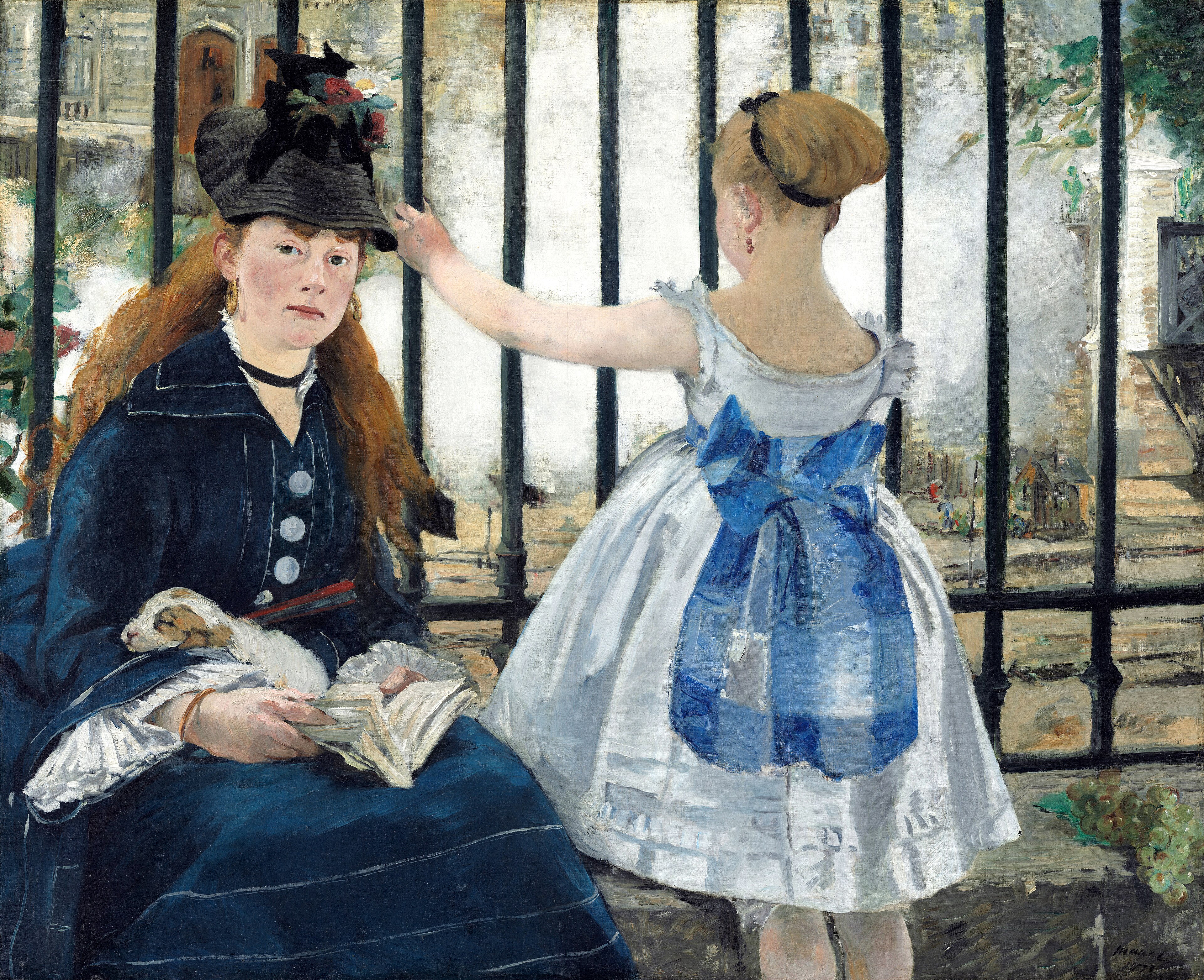
Manet paints modern Paris by making the train disappear. In The Railway, the Gare Saint-Lazare is present as smoke, iron, noise, obstruction, and divided attention. The locomotive never enters the picture. That absence gives the painting its force: industrial modernity is no longer a spectacle in the distance; it presses against everyday life.
A railway scene without a train
Édouard Manet painted The Railway, also known as Le Chemin de fer or Gare Saint-Lazare, in 1873. The setting is the newly transformed Quartier de l'Europe near the Gare Saint-Lazare in Paris, where Manet lived and worked during the 1870s. The National Gallery of Art identifies the painting as oil on canvas, 93.3 x 111.5 cm, now in Washington.
The picture looks simple at first. A seated woman in a dark blue dress faces the viewer. A child in a white dress turns away and grips the iron railing. Behind the bars, steam rises from the railway cutting below. A bunch of grapes sits on the ledge. In the upper right, the Pont de l'Europe appears at the edge of the composition. Instead of explaining these details, Manet sets them beside one another and leaves the viewer to connect them.
Manet's method: make modernity indirect
Manet's method is to refuse the obvious subject. A railway painting could have centered the engine, the platform, or the crowd. He chooses the effects instead: steam that hides, iron that blocks, a child drawn toward movement, and a woman who does not turn around. The painting wants the viewer to feel modern infrastructure through its consequences rather than admire it as an object.
Victorine Meurent returns, but the drama changes
The seated woman is Victorine Meurent, Manet's model for Le Déjeuner sur l'herbe and Olympia. Her presence matters because the painting continues Manet's long investigation of the returning gaze. In the earlier scandals, that gaze makes the viewer socially visible. Here it does something quieter and colder. Victorine looks out from a public city space, composed and unreadable, while the child looks away into the industrial zone behind the fence.
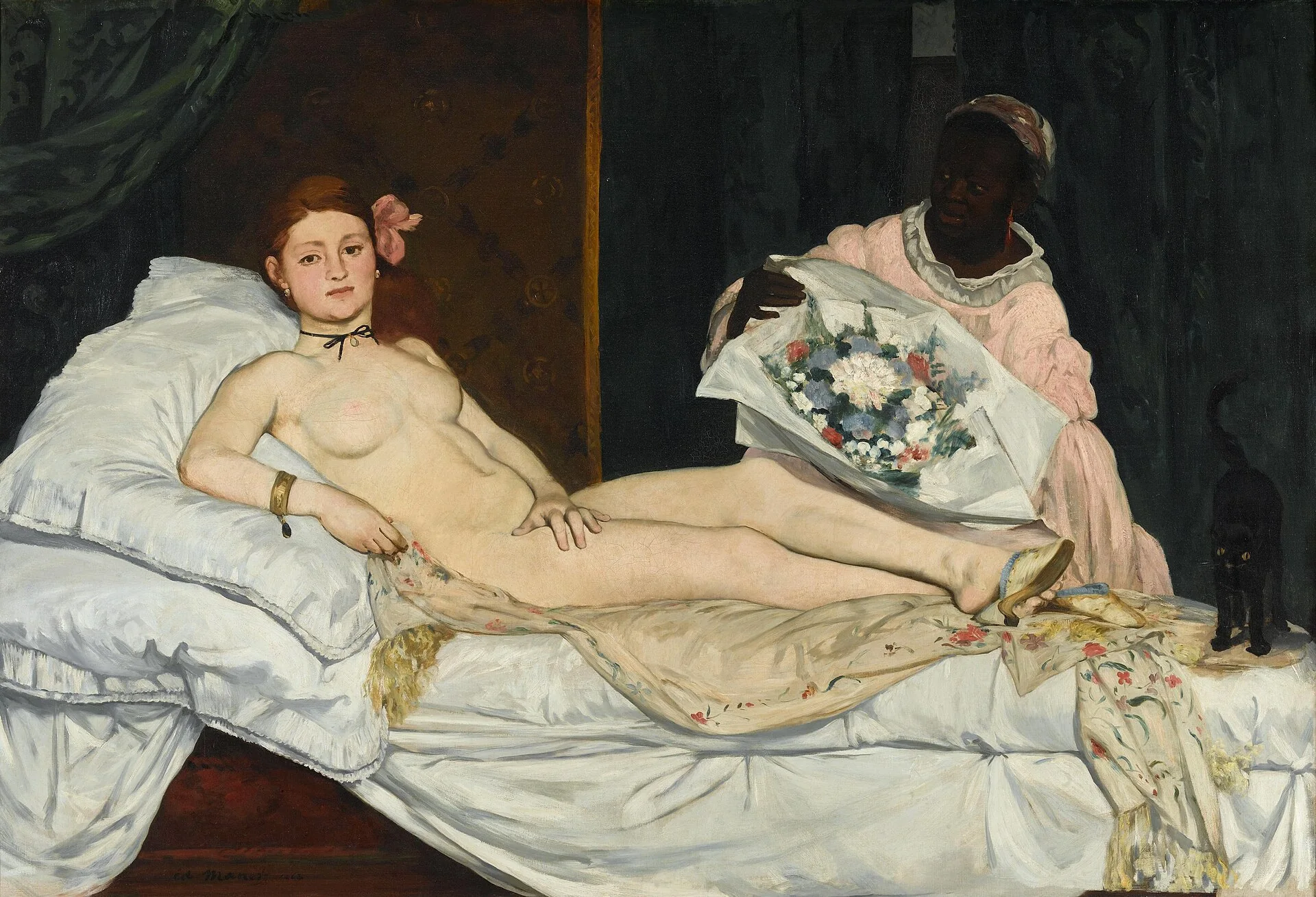
The relationship between the two figures remains deliberately uncertain. Mother and daughter, governess and child, older companion and younger charge: the painting withholds the answer. That uncertainty is not a puzzle to solve; it is part of the social atmosphere. Manet paints proximity without intimacy. Two bodies share the same narrow ledge, yet their attention moves in opposite directions.
The fence is the subject
The black railing cuts the painting from side to side. It is not background architecture. It divides the picture into two worlds: the dressed figures in front and the railway below, mostly hidden by steam. The bars make modern infrastructure visible as a boundary before it appears as a machine.
This is why the painting feels so different from a triumphant image of progress. Manet does not give us a heroic locomotive. He gives us a barrier, a child pressing toward it, a woman who does not turn around, and a cloud of vapor that erases the view. Modernity arrives as interruption, not parade.
Two ways of looking
The painting trains the eye through contrast. The woman faces us; the child faces the railway. The woman's dark dress anchors the foreground; the child's white dress catches light against the bars. The woman's face is available but closed; the child's face is hidden but her curiosity is legible through posture. Manet makes looking itself the event.
The grapes on the ledge sharpen this tension. They are edible, bright, almost domestic, yet placed beside iron, steam, and a public transport system. A small still-life detail sits inside a scene of urban acceleration. The city does not replace private life; it compresses it into a new kind of public nearness.
From Realism to Impressionism, without becoming either formula
The Railway belongs to the world of Realism because it makes contemporary social life serious without mythic disguise. It also stands next to Impressionism: steam, modern transit, open city spaces, and everyday leisure all become central subjects for painters around Manet. Yet Manet is not simply an Impressionist. He remains a Salon painter, builds the picture with models and studio decisions, and turns atmosphere into social structure rather than pure optical sensation.
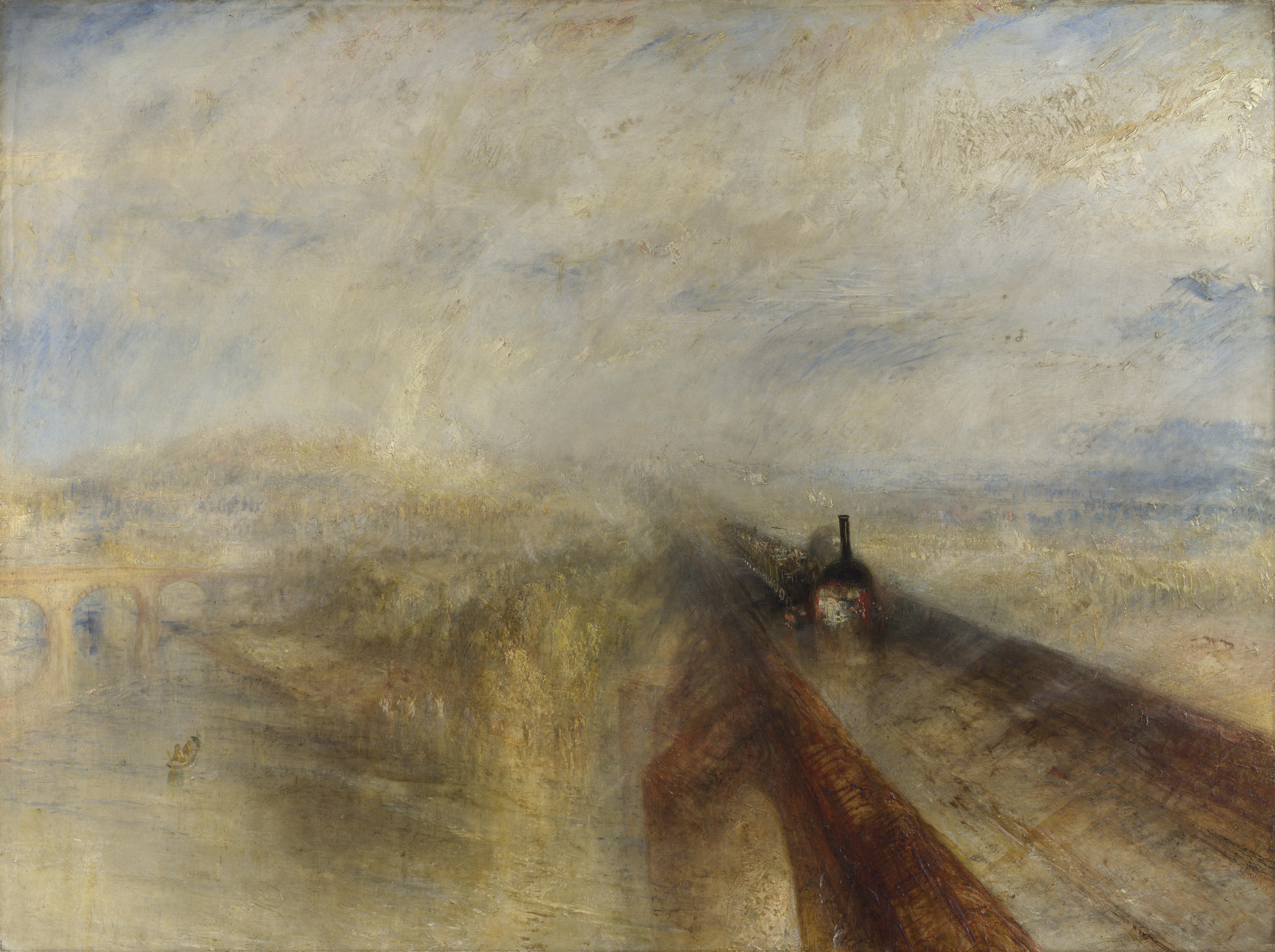
The contrast with Turner's Rain, Steam and Speed clarifies Manet's originality. Turner makes the locomotive a rushing force. Manet hides the train and lets its effects reorganize the human scene. The two paintings share a railway subject, but they ask different questions: what does speed look like, and what does modern infrastructure do to looking?
Manet between Olympia and the Folies-Bergère
The painting sits between two recurring Manet questions. From Olympia, it keeps the frontal gaze and the refusal to soften social exposure. Toward A Bar at the Folies-Bergère, it points to a later world of public spaces, service, spectatorship, and unstable positions for the viewer.
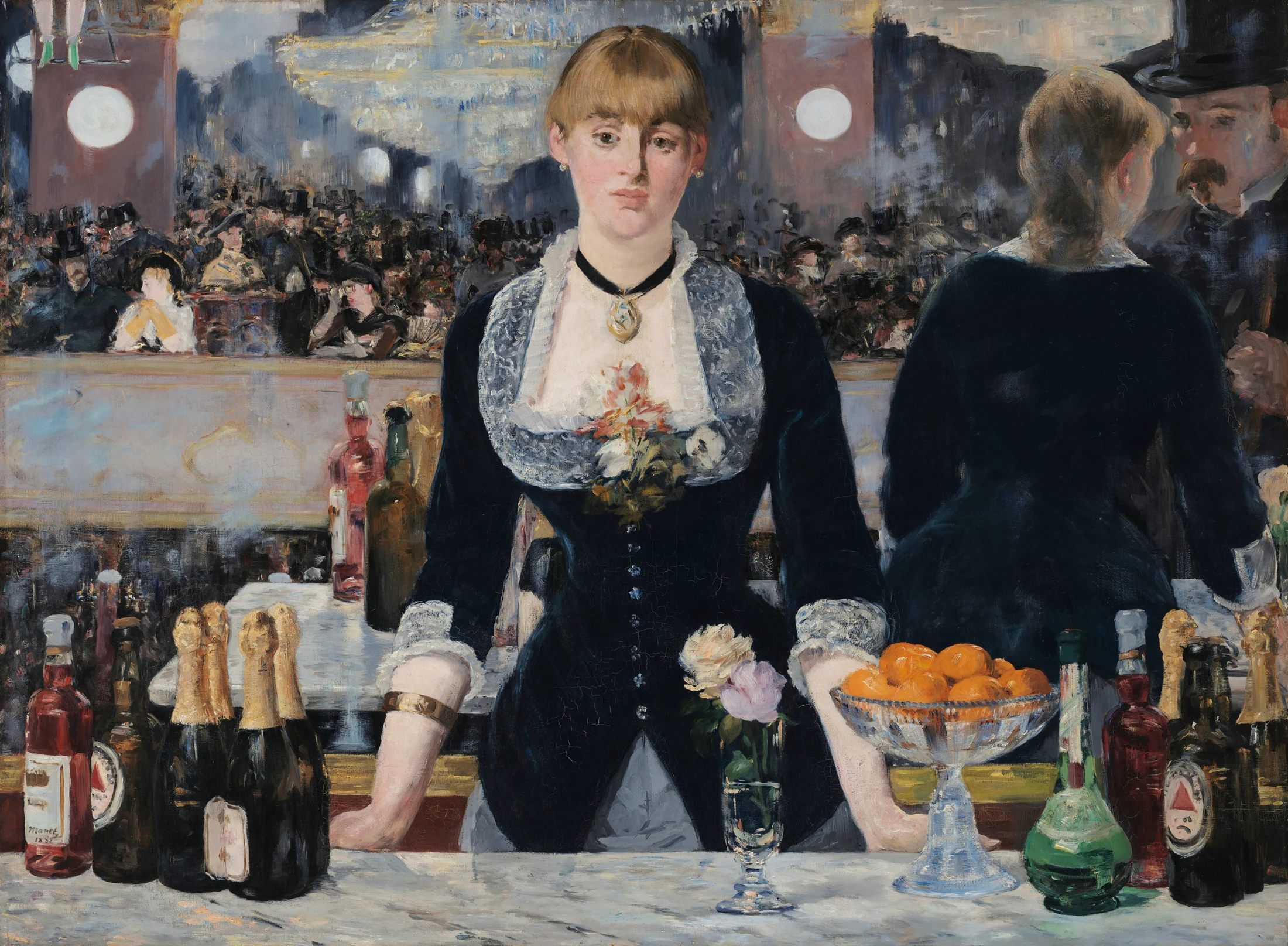
Read this way, The Railway is not a minor urban scene. It is Manet testing how little narrative a modern picture needs. A fence, a plume of steam, a returned gaze, a turned back, and one uncertain relationship are enough to make the city legible.
How to read the painting
Begin with the train you cannot see. Then follow the bars, because they organize nearly every relation in the painting. After that, compare the two figures: one meets your gaze, the other looks through the fence. Finally, ask how the city enters the scene. It does not enter as a skyline or a machine. It enters as pressure on attention.
For a broader route through modern looking, move from Le Déjeuner sur l'herbe to The Railway, then to A Bar at the Folies-Bergère. The sequence follows Manet from scandal in a staged landscape to the hard social geometry of the modern city.
Related works
Test yourself with the quiz
Then try the art quiz.
Primary sources
- National Gallery of Art: The Railway
- National Gallery of Art: Manet, Monet, and the Gare Saint-Lazare
- Musée d'Orsay: Manet, Monet, and the Gare Saint-Lazare
- The National Gallery, London: Monet, The Gare St-Lazare
- National Gallery of Art: Édouard Manet
- Wikimedia Commons: image file and public-domain metadata
Frequently asked questions
The Railway is about modern Paris near the Gare Saint-Lazare. Manet shows a seated woman, a child turned toward an iron fence, steam from the tracks below, and no visible train.
The Railway, painted in 1873, is in the collection of the National Gallery of Art in Washington.
The seated woman is Victorine Meurent, Manet's frequent model, who also appears in Le Déjeuner sur l'herbe and Olympia.
By hiding the train, Manet turns modern industry into atmosphere, obstruction, and social pressure. Steam, iron, and looking become more important than mechanical description.
It stands near Impressionism but does not belong to it in a strict sense. Manet stayed tied to the Salon and built the painting in the studio, while sharing the modern urban subjects that interested younger Impressionists.