
Impressionism
Haystacks
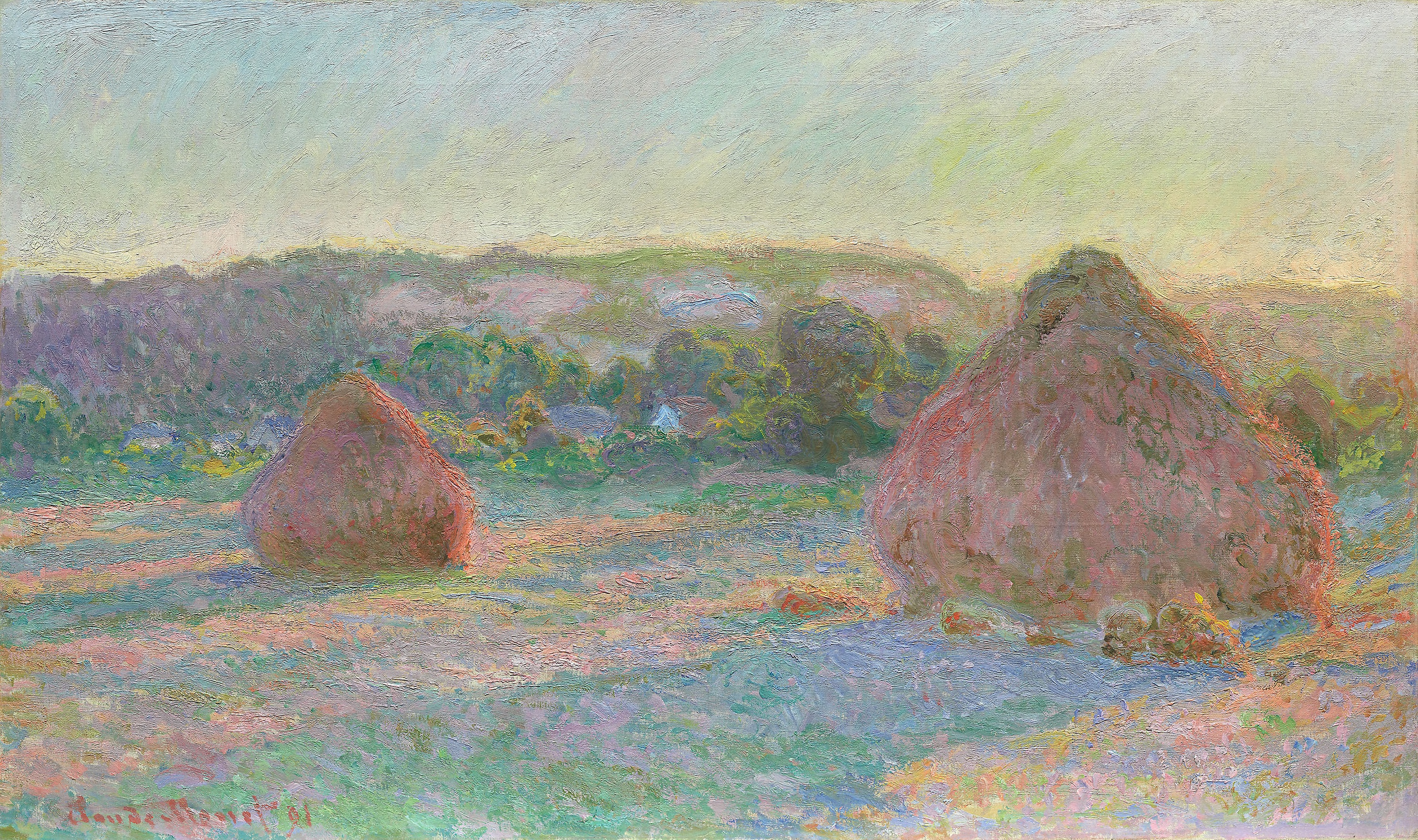
A stack of wheat barely moves; in Claude Monet's hands, it reveals hour, season, and the density of air. The force of Haystacks lies in that paradox. The motif stays put, massive, familiar, almost plain. Around it, light, frost, thaw, shadow, and the painter's attention keep changing.
A stack, not a backdrop
Haystacks is the common English name, but the Art Institute of Chicago gives this painting the more precise title Stacks of Wheat (End of Summer). The distinction is visual, not pedantic. Monet is not painting casual piles of hay; he is painting large stacks of harvested wheat or grain in the fields near Giverny, where he lived from 1883 onward.
The Art Institute notes that the stacks could rise fifteen to twenty feet and stood near the artist's farmhouse. Their scale gives the motif a bodily presence. Two rounded volumes, a horizontal field, a distant band of trees and houses, and a warm sky are enough for Monet to build an entire landscape.
Monet makes comparison unavoidable
Between 1890 and 1891, Monet did not treat the stacks as a single view. He made them into a sequence of experiments. He began several canvases, returned to the motif when the light changed, then refined the harmonies in the studio. Repetition lets one question sharpen: what remains when hour, season, and weather alter almost everything else?
In May 1891, fifteen paintings from the series were shown at Galerie Durand-Ruel in Paris. The public no longer faced one finished scene. It had to compare. A lower sun, colder snow, rosier air, a more violet shadow: each variation becomes legible because a stable form returns from canvas to canvas.
How to spot Monet's method quickly
Start with the stack shapes. They are fixed enough for the eye to remember them, but not described with hard contour. Then look at the ground shadows, which lengthen the field and pull time into the image. Finally, compare the temperature of the sky, the straw, and the distant landscape. The painting is not built from objects first and effects second. It is built from relationships of color and light.
The brushwork works the same way. Short strokes make the surface vibrate without dissolving the forms. Orange, ochre, violet, green, and blue do not simply fill a scene; they set its temperature. The stacks remain recognizable, but their presence depends on the luminous envelope around them.
End of summer: warmth becomes measurement
Stacks of Wheat (End of Summer) is not one of the snow effects that made the series famous. It is a late-summer painting. The stacks keep the warmth of straw, their tops rise into the sky, and the field and trees hold the composition close to the horizontal. Nothing happens in narrative terms. The painting gains precision through small shifts of tone.
The season in the title gives the image its tension. Harvest is done, abundance is stored, winter is approaching but not yet present. Monet paints that passage without anecdote: time appears in color, shadow length, and the warmth of the sky.
Three variations that explain the series
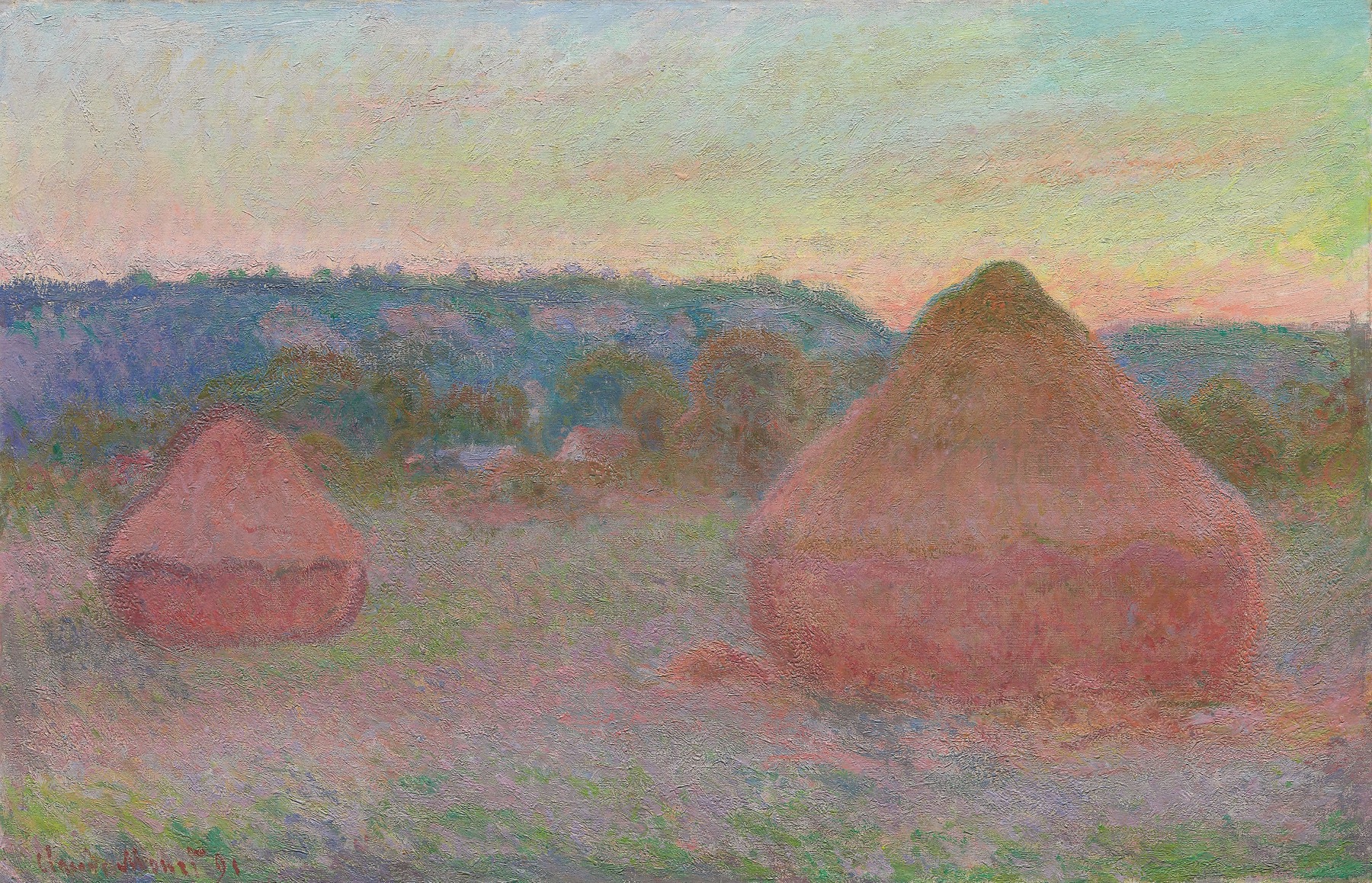
Placed beside other versions, the end-of-summer canvas no longer reads as an autonomous rural landscape. In Stacks of Wheat (End of Day, Autumn), the same paired forms sit in lower light. The field warms, the horizon thins, and the stacks become surfaces collecting evening.
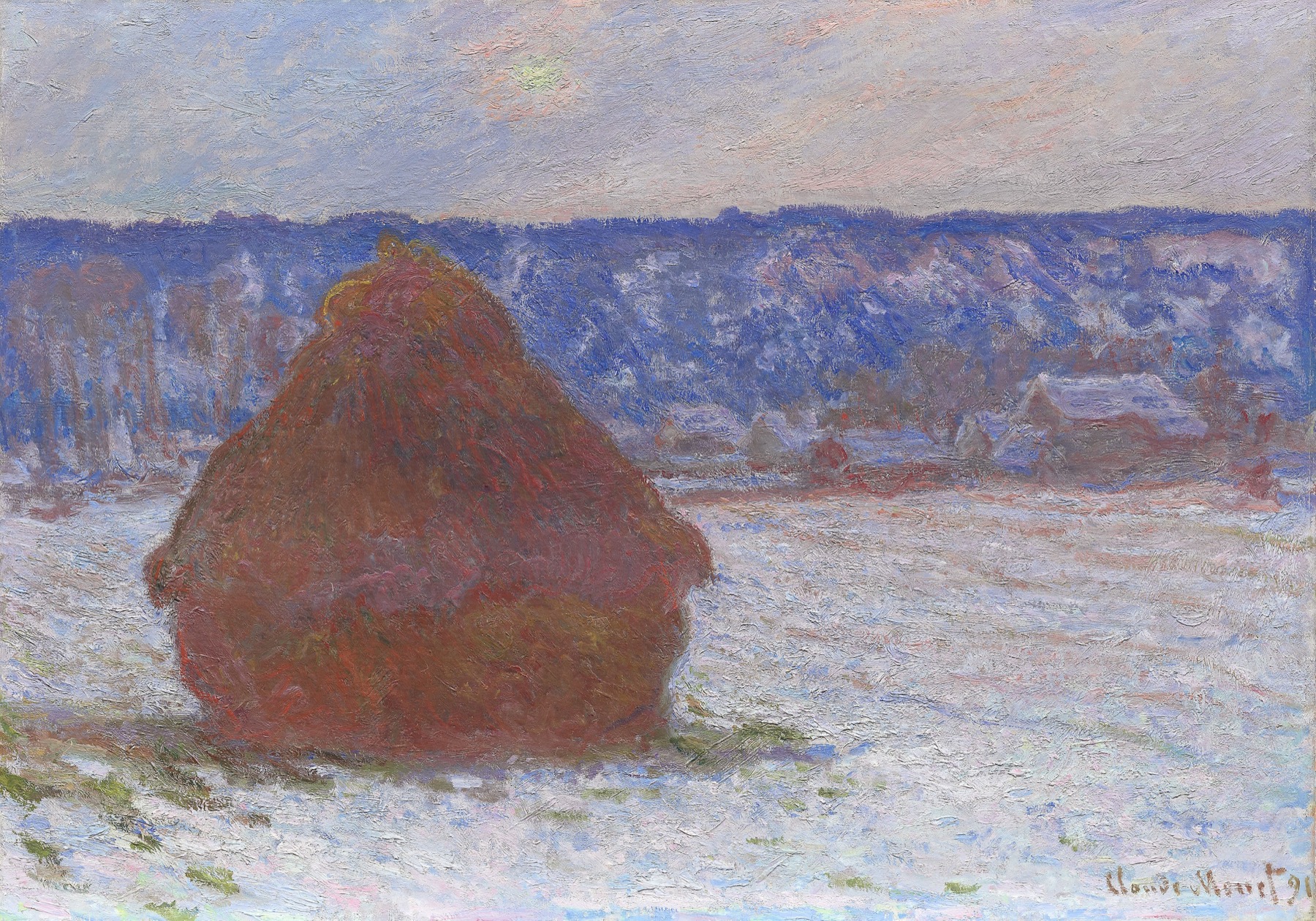
The snow paintings move the experiment toward cold. In Stack of Wheat (Snow Effect, Overcast Day), the stack becomes a darker mass against a pale field. The light is neither dramatic nor theatrical; it spreads through snow, distant trees, and blue-gray air. Monet keeps the motif identifiable, then lets weather change nearly the entire color range.
Stack of Wheat (Thaw, Sunset) introduces a more ambiguous tension. Snow remains on the ground, but the horizon already carries evening warmth. Pink, yellow, blue, and violet register an unstable moment between cold season, thaw, and sunset.
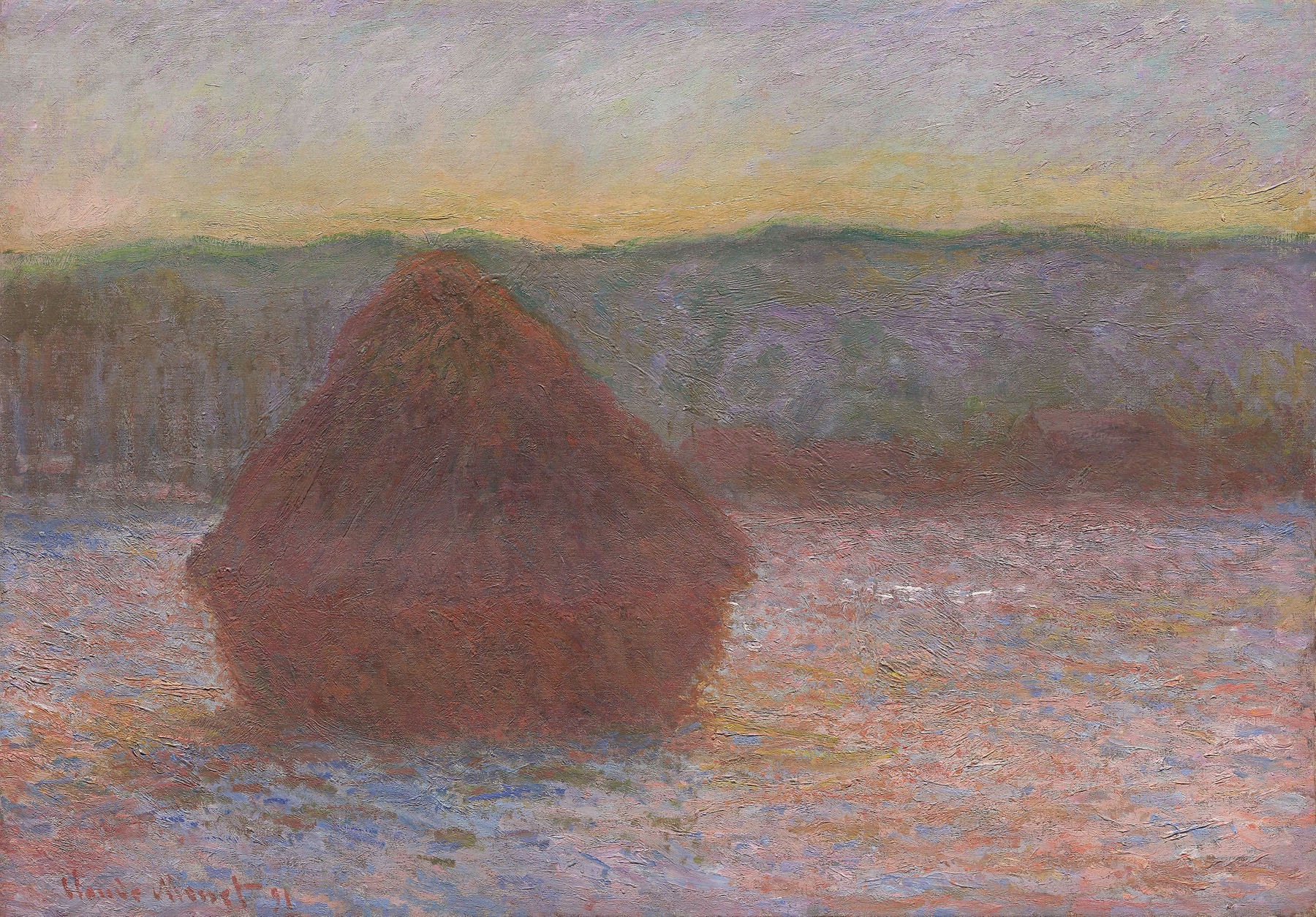
These variants explain the series more clearly than a single reproduction can. Monet is not repeating a favorite subject. He gives himself a visual instrument: one stable form that can measure light, temperature, and the thickness of air.
Between Étretat and Water Lilies
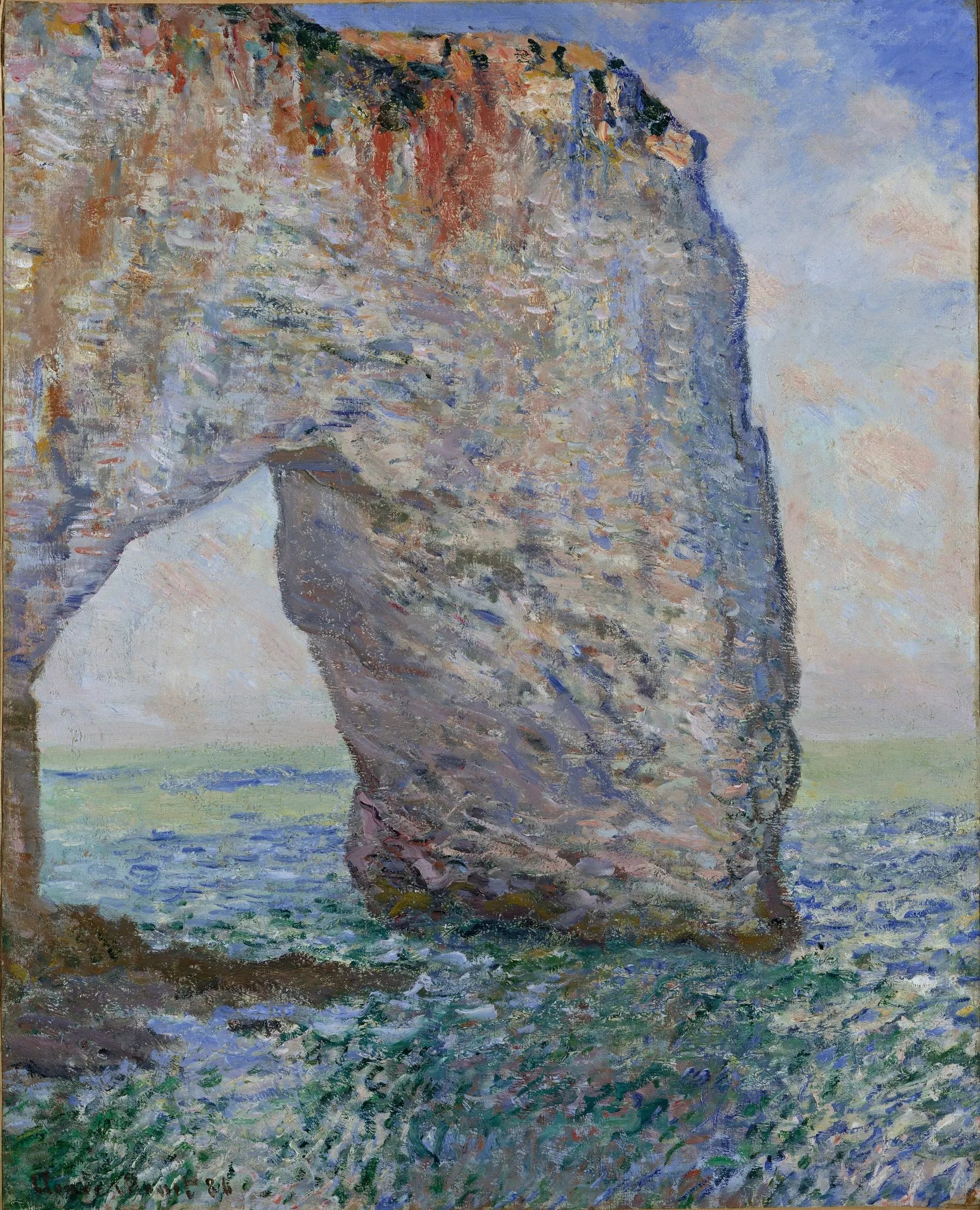
The Étretat cliffs had already offered Monet an ideal structure: solid coast, shifting tide, unstable weather. Haystacks move that logic inland. Cliff becomes stack, sea becomes field, but the principle remains the same: a fixed form makes variation visible.
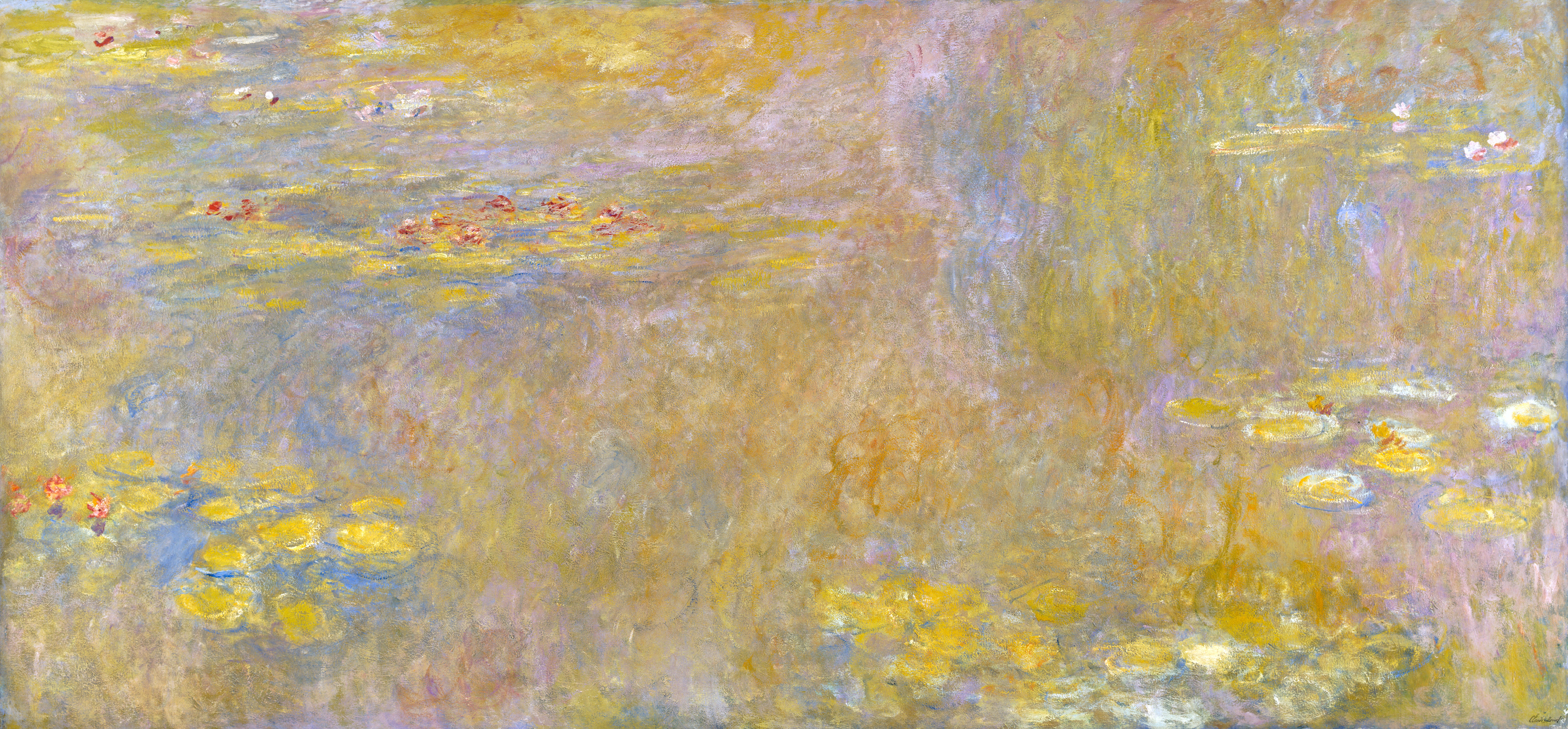
Water Lilies later pushes this logic toward a less stable motif. In the stack paintings, the object holds firm while light changes. In the late pond paintings, the armature itself loosens: water, reflected sky, foliage, and floating flowers exchange roles. Haystacks prepares the passage from compact motif to almost immersive painting.
A rural motif used like a laboratory
The stacks can look timeless, but Monet is not painting nostalgia for rural life. He chooses a simple, recognizable motif, neutral enough to bear repeated variation. A stack lets the viewer see hour without a clock, weather without explanation, and season without story.
The Art Institute also notes the symbolic charge of grain stacks, tied to sustenance and survival. That resonance gives the motif weight without turning the series into a moral lesson. Monet keeps anecdote at a distance and sets a visual limit: how far can the same form change while still remaining identifiable?
What the series changed
A single canvas invites appreciation. A series forces comparison. The 1891 exhibition made that shift visible: variation no longer accompanies the subject; it becomes the subject. That logic anticipates part of modern art, from comparative museum displays to photographic sequences and works built through repetition.
Seen beside Impression, Sunrise, the Haystacks show Monet in another rhythm. The harbor view compresses one atmospheric instant. The stacks stretch that problem across many canvases. The motif is humble, but the method expands what painting can do.
When you see one Haystack
If you see one Haystack alone, mentally rebuild the series around it. What hour does the painting hold? What season works on the color? Where does the form still resist atmosphere? Imagine the same stack under snow, thaw, sunset, or frost. The absent versions make the present canvas more precise.
For the clearest Monet route on Explainary, move from Impression, Sunrise to The Manneporte, then to Haystacks and Water Lilies. The path follows one idea gaining strength: hold a motif in place to make visible what passes through it.
Related works
Test yourself with the quiz
Then try the art quiz.
Primary sources
- The Art Institute of Chicago: Stacks of Wheat (End of Summer)
- The Art Institute of Chicago Online Scholarly Catalogue: Stacks of Wheat, 1890/91
- The Art Institute of Chicago: Stacks of Wheat (End of Day, Autumn)
- The Art Institute of Chicago: Stack of Wheat (Snow Effect, Overcast Day)
- The Art Institute of Chicago: Stack of Wheat (Thaw, Sunset)
- The Met: Haystacks (Effect of Snow and Sun)
- The Met: Claude Monet and Impressionism
- The National Gallery: Claude Monet
- Wikimedia Commons: image file and CC0/public-domain metadata
Frequently asked questions
Monet's Haystacks, more precisely his Stacks of Wheat series, are paintings made around 1890-1891 near Giverny. They use the same rural motif to test changing light, season, weather, and color.
Museum sources describe the core Stacks of Wheat group as roughly twenty-five to thirty canvases. In 1891, Monet exhibited fifteen of them together at Durand-Ruel in Paris.
The stacks gave Monet a stable form. By returning to it under different conditions, he could make hour, season, frost, sunset, and atmospheric color visible as the real subject of the paintings.
The common English title is Haystacks, but many museums use Stacks of Wheat or Grainstacks. The French title Les Meules also points to stacks of harvested grain rather than casual piles of hay.
Stacks of Wheat (End of Summer), painted in 1890-1891, is in the collection of the Art Institute of Chicago.
They helped define serial painting as a modern method. Monet asked viewers to compare canvases and read variation itself as meaning.