
Impressionism
The Manneporte near Étretat
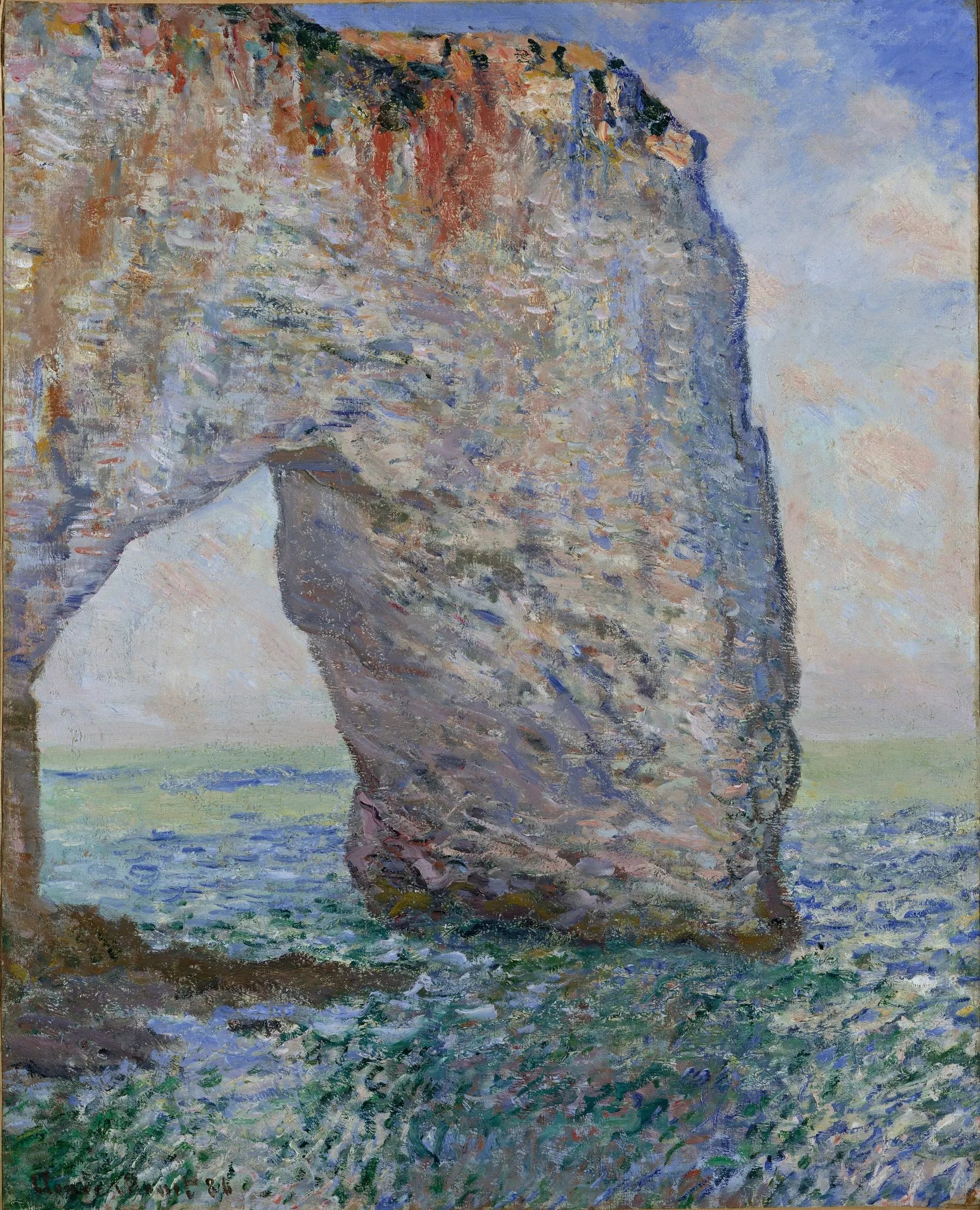
In this 1886 Etretat canvas, Monet turns a familiar cliff into a laboratory for perception. Instead of treating landscape as a one-off view, he uses the same motif to test how light, humidity, and distance alter what painting can describe.
Historical context: Etretat in 1886
Monet painted this work during a later phase of his Normandy campaigns, when the Etretat motif was already central to his method. The historical context is important: by 1886, he was no longer proving that modern landscape could break from Salon finish; he was refining a comparative process across closely related canvases.
There is no grand narrative commission behind this image. Its context is methodological: repeated observation, fast weather shifts on the coast, and a market in which serial practice could circulate as modern painting rather than topographic record.
What the artwork shows
The painting shows the Manneporte rock formation near Etretat, with sea and sky compressed into a narrow band of close tonal values. Monet depicts the cliff as stable mass but keeps water and atmosphere in motion, so the scene represents both permanence and flux at the same time.
What makes this depiction concrete is edge behavior: contours are softened where air thickens and sharpened where mass must hold. The scene is still legible as landscape, but description is deliberately reduced so relation carries more of the meaning.
Monet's intention and method
Monet's intention here was not simply to paint an attractive coastal view. He wanted to measure how perception changes under shifting conditions while the motif stays constant. That aim explains the serial logic across Etretat works: same site, different light structures, different chromatic pressures.
His method is analytical. He sought to make comparison visible on canvas, so each version becomes evidence in a larger inquiry about time, weather, and seeing.
Formal analysis: composition, light, and paint handling
Compositionally, the cliff anchors the frame while cloud and water dissolve boundaries. Light is not used as spotlight but as an integrating medium: sea and sky drift toward each other, then separate again through value contrast and directional brush rhythm.
Paint handling reinforces that structure. Monet avoids hard descriptive contour, relying on pressure differences between adjacent zones. From close range the image feels airy and unstable; from distance it locks into a coherent architecture.
At Etretat, Monet uses repetition as a tool for visual evidence, not routine.
Reception and legacy
This canvas matters because it clarifies a broader shift in modern art: motifs can function as variables in a process, not as fixed subjects. Later artists, photographers, and designers inherit that logic when they use repeated sampling to reveal structure inside change.
Read in that lineage, The Manneporte near Etretat is less a scenic endpoint than a working node in Monet's long research on atmosphere and visual attention.
Compare with related works
Related works
For stronger method context, read How to Understand a Painting and compare with The Manneporte (Etretat) to track what changes between closely related canvases.
Primary sources
- The Met: collection records for Monet's Manneporte works
- Musee Marmottan Monet: Claude Monet resources
- National Gallery: Claude Monet
- Tate: Claude Monet overview
- Fondation Claude Monet at Giverny: biographical context
Use the art quiz to test whether you can identify Monet's Etretat works from composition and light alone.
Frequently asked questions
The 1886 version pushes atmospheric integration further: edges dissolve more, tonal intervals tighten, and the motif functions more clearly as part of Monet's serial method.
Start with the cliff silhouette, then compare how sea and sky are separated without hard contour. That contrast reveals Monet's method of keeping structure while letting atmosphere move.