
Romanticism / History Painting
Last Words of the Emperor Marcus Aurelius
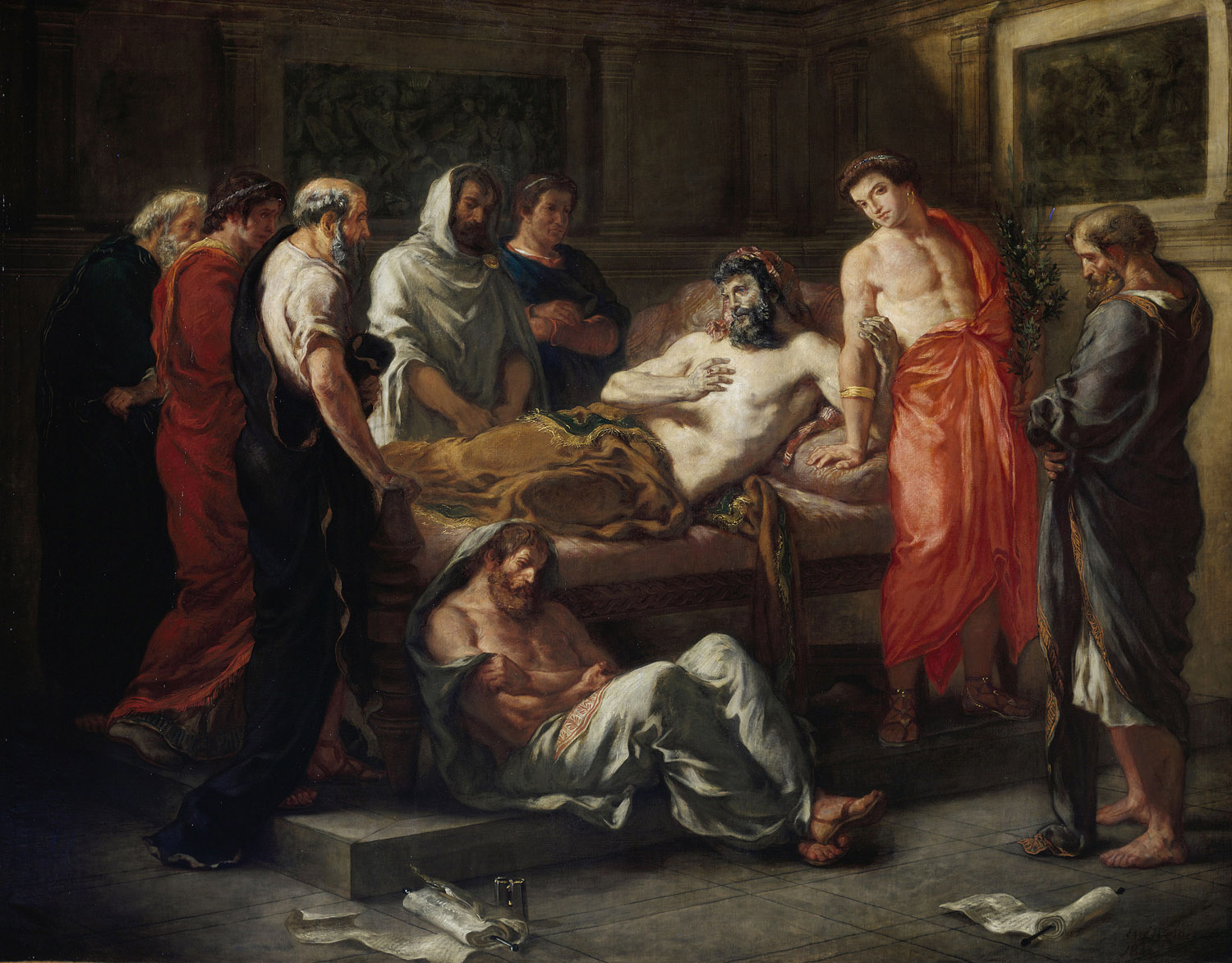
A dying emperor grips the arm of the son who will inherit his power and reject the discipline he represents. Eugène Delacroix painted Last Words of the Emperor Marcus Aurelius in 1844. The large oil on canvas, now in the Musée des Beaux-Arts de Lyon, shows the final hours of the Roman emperor Marcus Aurelius beside his son Commodus. The subject is ancient, but the painting is not calm antiquity. It is a room where virtue, succession, exhaustion, and color pull against one another.
The arrangement is legible at once. Marcus Aurelius lies half-naked on the bed, pale and weakened. Commodus stands beside him in bright red drapery, young, beautiful, and almost insolent. Around them, older men gather in darker tones. They look like philosophers, counselors, witnesses, and mourners at once. The room is heavy, and Delacroix makes the transfer of power feel less like ceremony than like a moral fracture.
The fracture drives the painting. A neoclassical treatment might have turned Marcus Aurelius into a clean moral example. Delacroix keeps the classical subject, but he lets Romanticism disturb it from inside. The image does not tell the viewer what to think in one simple sentence. It makes the future look vivid and troubling while wisdom fades into shadow.
Who were Marcus Aurelius and Commodus?
Marcus Aurelius ruled the Roman Empire from 161 to 180 CE and became famous not only as an emperor, but as a Stoic thinker. His Meditations helped fix his later reputation as the “philosopher-emperor”: a ruler associated with discipline, duty, self-command, and moral seriousness. In Delacroix's painting, that reputation shapes the scene. Marcus is not just an old man dying in bed. He stands for a model of power governed by thought.
Commodus, his son, carried almost the opposite reputation. He became sole emperor after Marcus's death and was remembered by many ancient and later writers as vain, violent, theatrical, and destructive. Modern historians are more cautious about turning him into a simple villain, but his name still evokes the failure of inherited power. Delacroix builds the painting on that symbolic contrast: the father is physically weak but carries moral weight; the son is bright, alive, seductive, and already troubling.
The historical transition is therefore essential. The painting is not simply about death; it is about succession. A regime of Stoic discipline gives way to a ruler associated with spectacle and appetite. Delacroix does not need to paint future tyranny. He paints the room where the wrong kind of future becomes visible.
What is shown
Marcus Aurelius is the visual and historical center, but he is not the most visually alive figure. His body is exposed, reclined, and weakened by illness. His hand reaches toward Commodus, as if the last act of rule were also a last attempt at instruction. Yet the son does not bend into filial grief. He stands upright, turned outward, wrapped in red, already separate from the dying world around the bed.
Delacroix uses that opposition with precision. The old emperor carries moral authority but little physical force. Commodus carries youth, beauty, and color, but his posture feels detached. The philosophers and witnesses close the space, yet they cannot control what will happen next. Roman history is compressed into one room: a philosopher-emperor dies, and the successor who will undo the ideal is already present.
The Musée des Beaux-Arts de Lyon notes the painting's refusal of moral simplification. The young man in red brings life and movement, while the older philosophers remain in shadow. The image is not a lesson about good and bad rulers. Delacroix makes danger attractive, and virtue fragile.
A classical subject under Romantic pressure
Delacroix deliberately chooses a classical subject. Marcus Aurelius belongs to Roman history, Stoic philosophy, and the tradition of the exemplary ruler. The deathbed format also looks back to earlier history painting, including the models associated with Poussin and Jacques-Louis David. The large scale, the antique clothing, and the assembled witnesses all announce high historical ambition.
His method is to keep that classical framework readable while making its authority unstable. The scene still has a bed, witnesses, antique drapery, and a moral subject, but color and posture prevent the image from settling into a clean lesson.
But Delacroix does not use that tradition to restore order. The composition feels unstable. The bed cuts across the picture, the figures lean in from different sides, the light catches flesh and fabric unevenly, and the dark architecture presses down on the room. The painting keeps the dignity of history painting while making its moral center tremble.
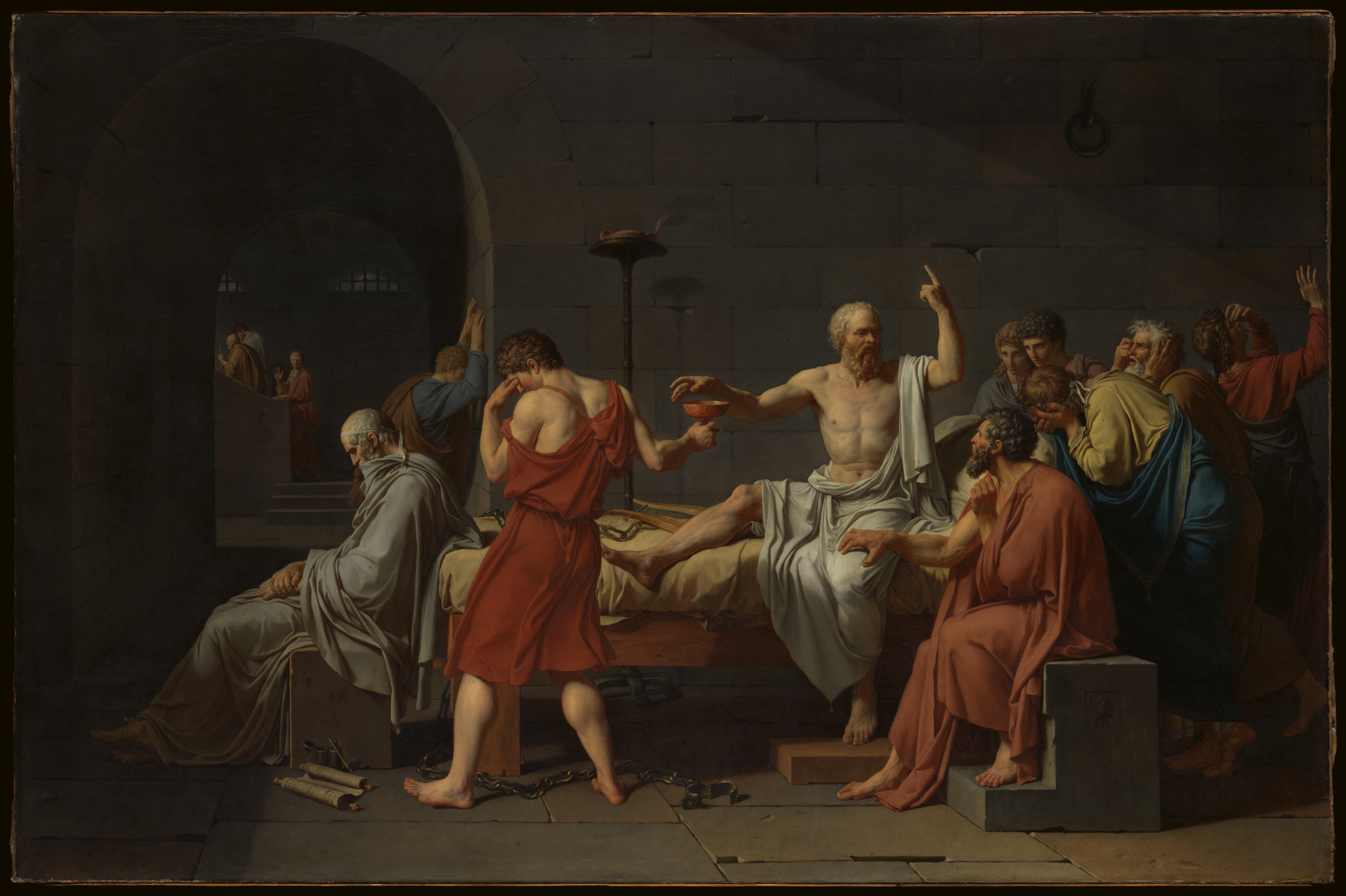
The contrast with The Death of Socrates shows what Delacroix refuses. David also paints an ancient death surrounded by witnesses, but his picture is built around firm moral clarity: Socrates points upward, reaches for the cup, and turns death into a demonstration of reason. Delacroix keeps the ancient deathbed, then replaces certainty with hesitation, red attraction, shadow, and uneasy inheritance.
The work belongs naturally beside Delacroix's Liberty Leading the People. One painting turns modern revolution into a public surge; the other turns ancient succession into a private crisis. In both, Delacroix makes history legible through color, pressure, and bodies in conflict.
Commodus in red controls the room
The eye goes to Commodus because Delacroix wants it to. His red drapery is the brightest sign of life in the picture. It cuts through the somber room and competes with the pale body of Marcus Aurelius. The future of Rome is therefore not hidden in the background. It stands in the light, attractive and dangerous.
That red is not merely decorative. It is an argument about succession. Marcus Aurelius represents discipline, philosophy, and the burden of rule. Commodus represents inheritance without the same gravity. The painting does not need to show tyranny directly. It shows the moment before power moves into the wrong hands.
Delacroix makes political decline visible before it has happened: the wrong heir is already the most alive color in the room.
The surrounding men intensify that reading. Their bodies form a ring of concern, but the ring is ineffective. They witness the transition; they do not stop it. The painting's drama lies in that helplessness.
Baudelaire saw the color before the public did
The painting was shown at the Salon of 1845 and received a cool response from many critics. Charles Baudelaire, however, defended it strongly. The Lyon museum recalls his praise of the canvas as splendid, sublime, and misunderstood, and his admiration for Delacroix's color.
Baudelaire's reaction points to the real engine of the work. The painting is not powerful because it illustrates a Roman anecdote. It is powerful because color organizes the conflict. Red cloth, pale flesh, muted robes, dark architecture, and subdued light make ethical tension visible before the viewer sorts out every figure.
The Louvre's preparatory drawing for the work confirms that Delacroix studied the figures carefully. The final painting may look emotionally charged, but the emotion is built. Gesture, drapery, posture, and placement are all worked through in advance. Romantic intensity here depends on discipline.
How to read it at the museum
Start with the hand of Marcus Aurelius on Commodus's arm. That contact is the hinge of the painting. Then compare the red of Commodus with the dimmer robes of the philosophers. Next, look at the faces: grief, suspicion, fatigue, detachment. The painting becomes sharper when you stop treating it as a simple deathbed and read it as a scene of inheritance.
Ask not only "Who is dying?" but "What survives after him?" Delacroix answers through the arrangement of bodies. The emperor's body weakens; the son's color intensifies; the witnesses gather; the room darkens. History painting becomes a way to show the moment when moral authority and political power separate.
Continue with the profile of Eugène Delacroix, the guide to Romanticism, and the analysis of Liberty Leading the People. Then test your eye with the art quiz.
Explore more
Primary sources
- Musée des Beaux-Arts de Lyon: Last Words of the Emperor Marcus Aurelius
- Louvre: preparatory drawing for Last Words of the Emperor Marcus Aurelius
- Britannica: Marcus Aurelius
- Britannica: Commodus
- The Met: Delacroix and French painting
- The Met: Romanticism
- Britannica: Eugène Delacroix
- Wikimedia Commons file metadata
Frequently asked questions
Last Words of the Emperor Marcus Aurelius is an 1844 oil painting by Eugène Delacroix, now in the Musée des Beaux-Arts de Lyon. It shows the dying Roman emperor Marcus Aurelius beside his son Commodus.
The painting is in the Musée des Beaux-Arts de Lyon. It was sent by the French state in 1860 and is on long-term deposit from the Centre national des arts plastiques.
Commodus's bright red drapery gives him visual life and movement while the philosophers around Marcus Aurelius sink into darker tones. Delacroix makes the future of power look seductive and troubling at once.
Yes. Although the subject is classical, Delacroix treats it through Romantic color, unstable moral tension, heavy atmosphere, and dramatic contrast rather than through calm neoclassical clarity.