
Romanticism
Saturn Devouring His Son
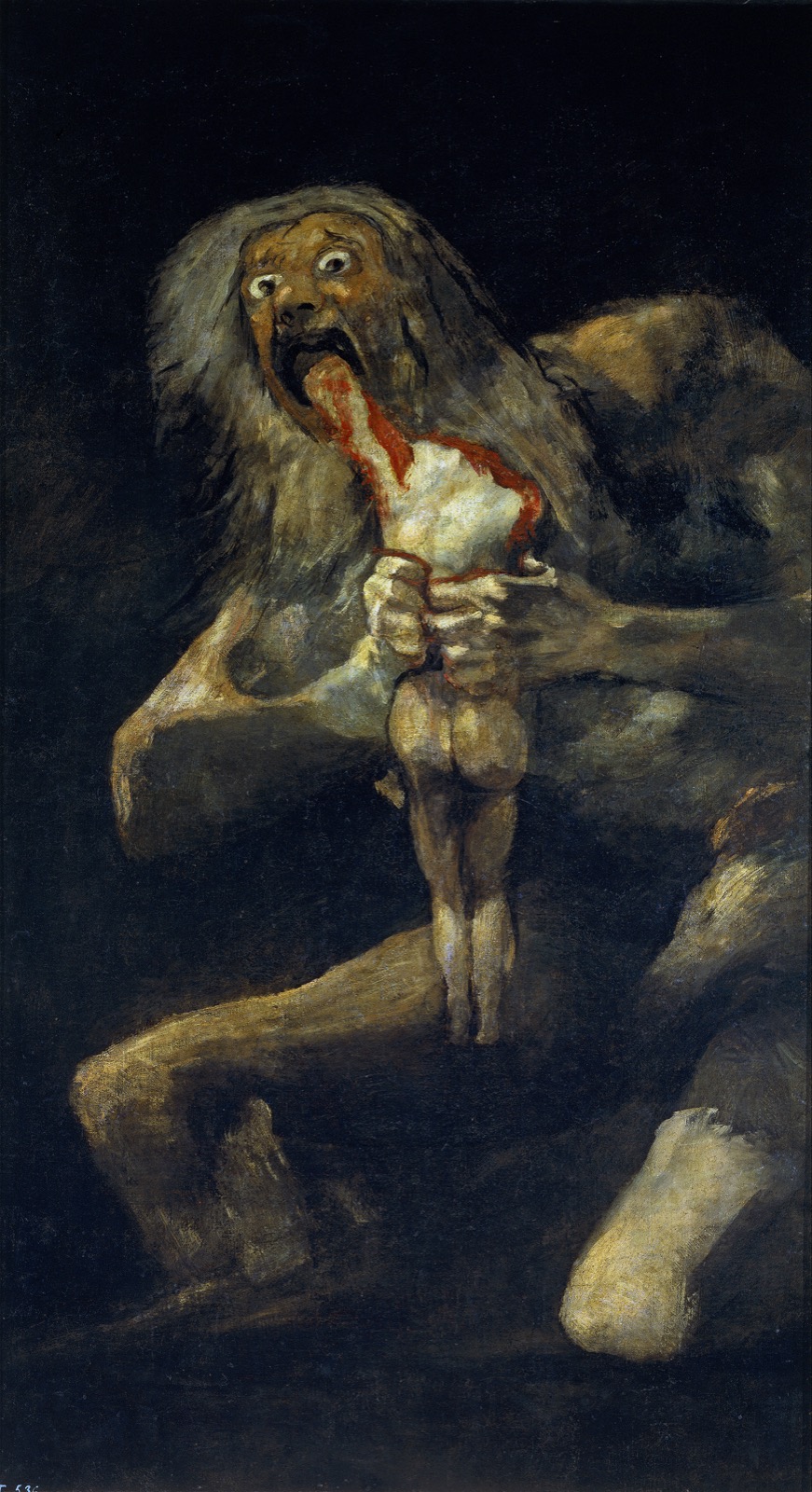
This painting does not ease you in. Goya makes myth feel like an emergency happening in the dark. Saturn Devouring His Son is one of the most unforgettable images in Western art because it gives almost nothing to stand on: no stable setting, no noble anatomy, no classical distance. Even a reader with no prior knowledge can grasp the essentials quickly. A crazed figure tears into a body. Everything else follows from that shock: the work belongs to Goya's late career, to the Romantic age at its darkest edge, and to the group now called the Black Paintings.
Start with what is actually in front of you
A huge figure emerges from blackness, knees bent, eyes wide, gripping a mutilated body. The paint is rough, the light harsh, and the space so compressed that the scene feels less staged than trapped. Goya does not give Saturn the grandeur of an ancient god. He gives him panic, animal force, and a body that seems to lunge out of the wall.
That is the first useful point. The painting works before interpretation. You do not need to know the myth to feel what it does: violence, fear, and loss of control have been pushed to the front without any decorative padding.
- Look first at the eyes: they create the sense of madness before you read any story.
- Then look at the hands, which clutch rather than pose.
- Notice how little background Goya gives you; the void is part of the painting's pressure.
- Only after that return to the torn body and the title, which connect the image to the myth of Saturn or Cronus devouring his children.
This is one of the Black Paintings, not a Salon picture
According to the Museo del Prado, Goya painted this work between about 1820 and 1823 on the walls of his house, the Quinta del Sordo, outside Madrid. That context changes the reading immediately. This was not a public commission designed for a court, church, or official exhibition. It belonged to a private environment in which Goya could work with unusual freedom, darkness, and severity.
The technical story matters too. The image began as a mural and was later transferred to canvas in the nineteenth century, a process that damaged the surface but also helped preserve the work. So what you see today in the Prado is already a survivor. The violence belongs not only to the subject, but to the object's own history.
The myth is there, but Goya strips it bare
In classical myth, Saturn or Cronus devours his children because he fears losing power. Goya keeps that core idea but removes almost every familiar buffer. There is no stable narrative setting, no courtly costume, no monumental architecture, and no polished heroic body. The myth becomes less a tale from antiquity than a raw image of power turning against life itself.
That is why the painting remains so open to interpretation. Some readers see political terror after war and restoration. Others see old age, madness, time, or the fear of succession. The work supports these readings precisely because it refuses to settle into a single allegorical code. It stays primitive and modern at once.
Goya paints panic, not classical anatomy
The artistic method is essential here. The brushwork is blunt. The body is simplified rather than idealized. Flesh catches the light in abrupt flashes, while the background almost swallows the figure whole. Goya is not trying to convince you that this scene is anatomically complete or mythologically elegant. He wants the image to hit first and explain itself second.
This is a good example of why Goya matters beyond one famous shock image. He learned from Baroque lighting and dramatic contrast, but he used those tools to create moral and psychological pressure rather than theatrical finish. The result is one of the clearest bridges between earlier painting traditions and modern forms of nightmare, expression, and psychic unease.
Read it beside The Third of May 1808
The strongest comparison inside Explainary is The Third of May 1808. In that earlier masterpiece, Goya turns public execution into an ethical image of state violence. In Saturn Devouring His Son, the public world collapses into something more private, hallucinatory, and interior. The method changes, but the seriousness does not. In both cases, he makes violence impossible to read as spectacle alone.
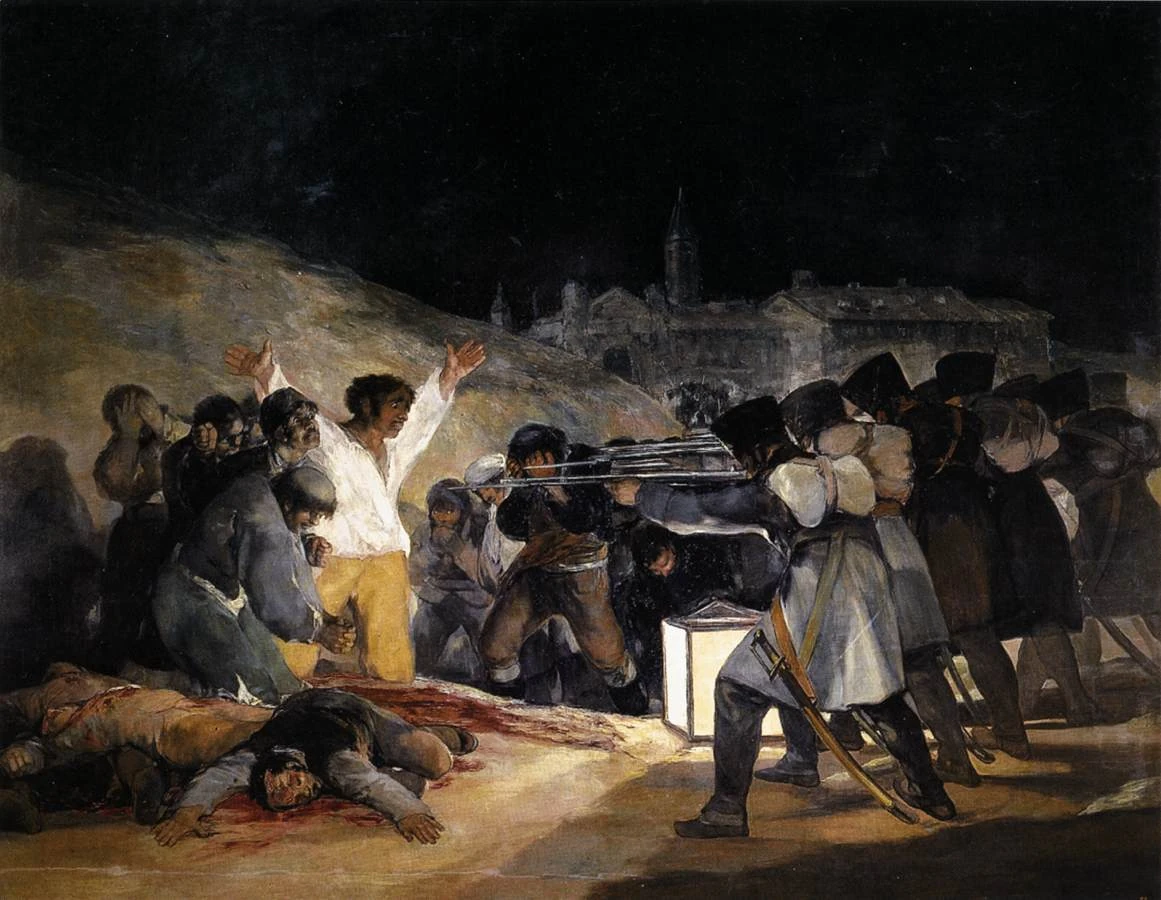
If you want the broader artist logic, continue to the profile of Francisco Goya. The connection between court portraiture, war imagery, and the Black Paintings becomes much clearer once you see how often Goya pushed images away from reassurance and toward confrontation.
Why the painting became a modern reference point
The Prado notes that the Black Paintings became crucial to Goya's modern reputation, and that is easy to understand. Later artists saw in them an unprecedented freedom: painting detached from public decorum, stripped down to fear, force, and compulsion. That is one reason Expressionists and Surrealists found Goya so useful. He showed that a work could be historically grounded and psychologically extreme at the same time.
That legacy is not about influence in a vague sense. It is about permission. Saturn Devouring His Son gave later art a model for images that are unresolved, violent, and mentally unstable without losing formal force.
Where to go next
The best reading path is tight: start with The Third of May 1808, then move to the artist page on Francisco Goya, then widen out to Romanticism. That sequence makes it easier to see how Goya moves from public history to private darkness without ever abandoning moral pressure.