
Romanticism
The Raft of the Medusa
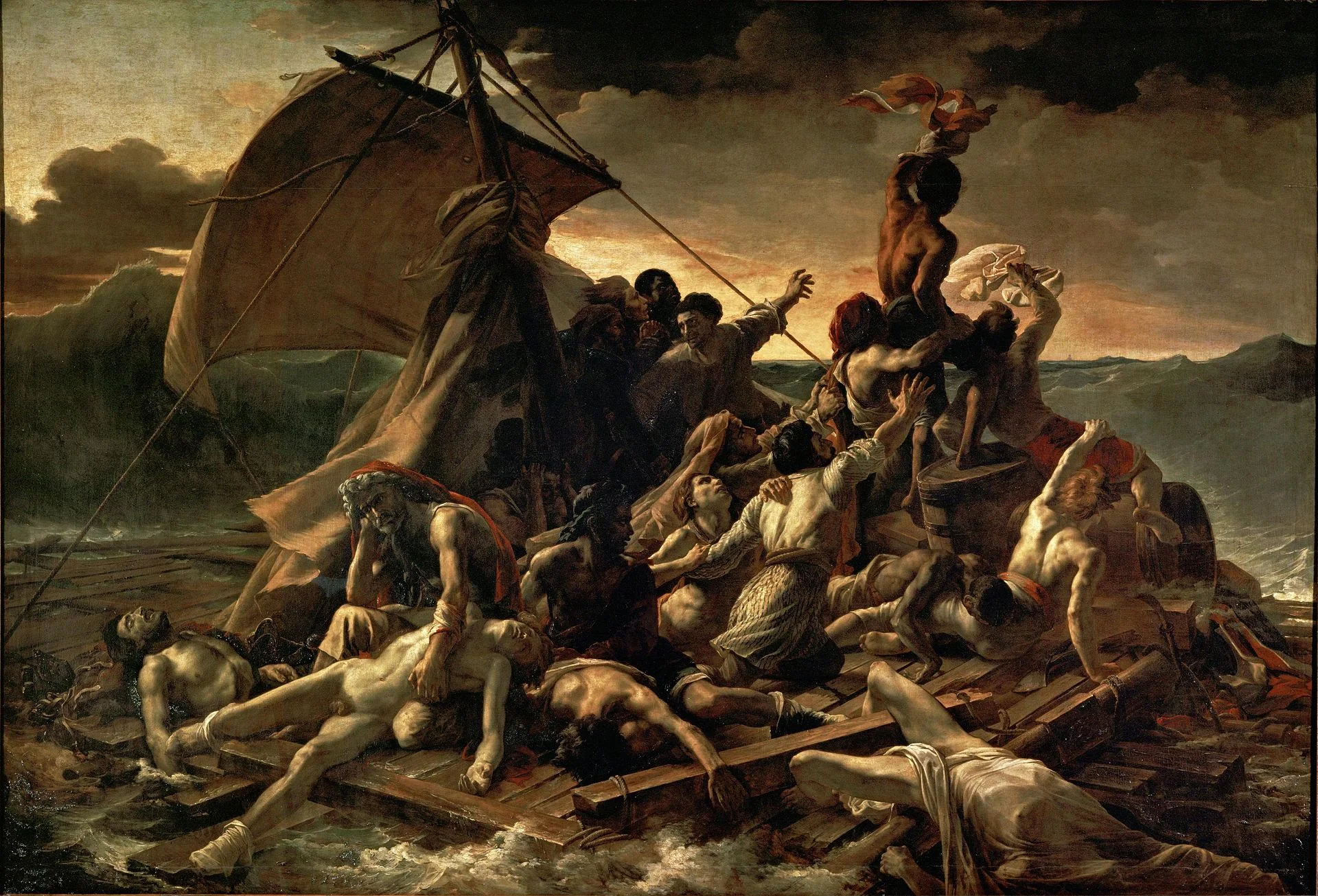
Géricault turned a recent French state scandal into one of the most consequential political paintings of the nineteenth century. The Raft of the Medusa is not simply dramatic; it is an argument about power, abandonment, and public responsibility.
From shipwreck report to Salon scandal
The painting was made in 1818-1819 and exhibited at the Salon in 1819, shortly after the 1816 wreck of the frigate Meduse off West Africa. The shipwreck became a national controversy because survivors accused the command structure and state appointment system of incompetence.
Géricault chose this contemporary subject at a moment when history painting usually favored distant myth or heroic state narratives. That choice alone shifted the terms of what large public painting could do.
The exact moment Géricault chooses to freeze
The scene does not show rescue completed; it shows a suspended moment before certainty. Survivors occupy a makeshift raft with dead and dying bodies in the foreground, while a tiny ship appears on the horizon. The emotional logic is clear: massive suffering, minimal chance.
Painting as inquiry, not melodrama
Géricault's intention was to make catastrophe readable as political evidence. He interviewed survivors, studied reports, and built extensive preparatory studies so the final image would feel materially credible as well as emotionally forceful.
That method explains why the painting still reads as modern. It combines documentary ambition with formal control, instead of relying on rhetorical heroics.
A composition that assigns responsibility
The composition is built on two competing diagonals: one descends toward corpses and exhaustion, the other rises toward men signaling possible rescue. Light does not provide stable consolation; it alternates between revelation and dread. Scale is crucial: bodies dominate, the rescue ship is almost vanishing.
In this canvas, composition is the politics: hope exists, but it is structurally minor.
Why the painting still unsettles viewers
At the Salon, the work was debated as both artistic breakthrough and political provocation. Its long afterlife reaches beyond Romanticism into modern traditions of crisis imagery, documentary ethics, and state critique.
Readers in 2026 still return to it because it demonstrates how visual form can assign responsibility without reducing victims to spectacle.
Why scale is part of the argument
The painting's physical size is part of its argument. Standing before it, viewers do not consume a distant anecdote; they are confronted by near life-scale bodies occupying the same visual field as they do. That bodily relation changes interpretation: the scene reads less like illustration and more like shared exposure.
Salon display conditions also mattered historically. In a crowded exhibition environment, large canvases competed for attention. Géricault used this economy of attention strategically: monumental format, directional force, and concentrated contrasts ensured that the painting would hold viewers long enough for its political charge to register.
Read it beside Goya and Delacroix
Compare this painting with The Third of May 1808 and Liberty Leading the People. Goya centers execution and witness; Delacroix constructs allegorical mobilization; Géricault keeps viewers inside unresolved survival.
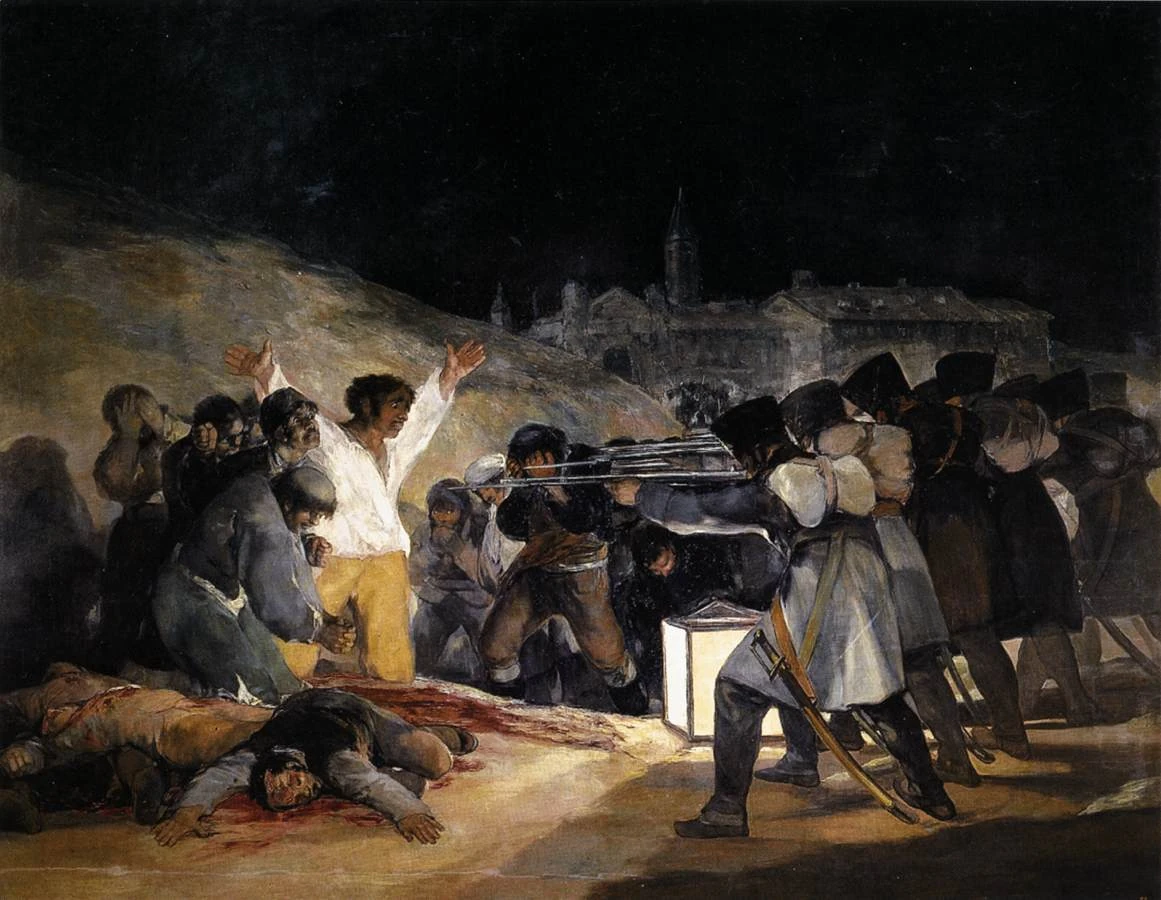
- Track where your eye goes first and where it gets blocked.
- Measure the disproportion between raft mass and rescue visibility.
- Read body arrangement as social structure, not only anatomy.
- Notice how uncertainty is maintained instead of resolved.
Explore more
Related works
Primary sources
- The Met: Géricault and French Romanticism
- Art Institute of Chicago: The Raft of the Medusa (after Géricault)
- The Getty: collection search on Géricault
- The National Gallery: research links on Géricault
- Smithsonian American Art Museum: Géricault research links
After this analysis, use the art quiz to test whether you can identify Géricault's structural logic quickly among nearby works.