
Impressionist and Neo-Impressionist Artist
Camille Pissarro
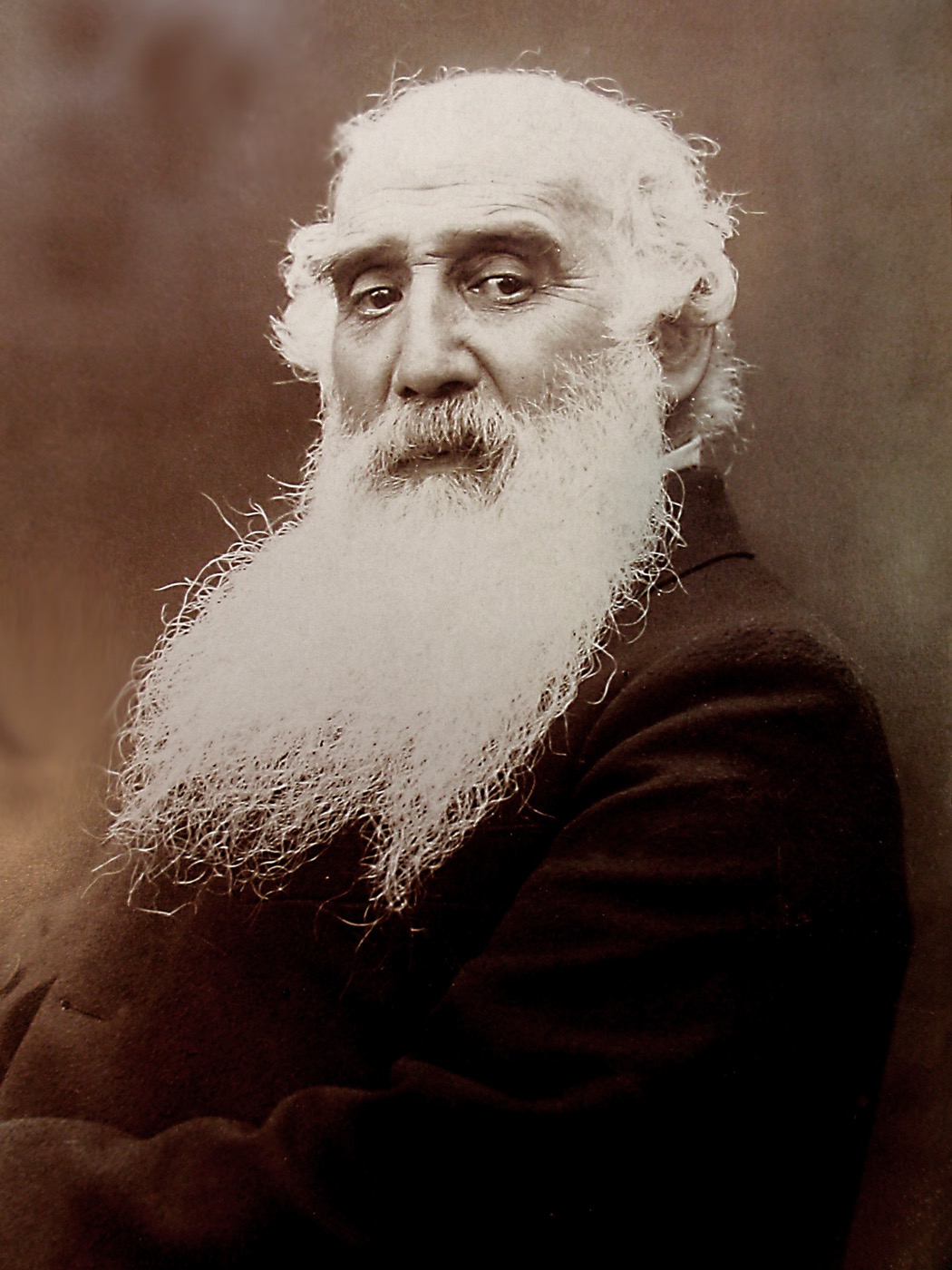
Pissarro is the Impressionist elder who briefly lets Seurat's points interrupt his own freedom. Born on St. Thomas and active in France, he became a central figure in Impressionism, then tested Neo-Impressionist divisionism in the 1880s before moving away from it. That arc makes him one of the clearest artists for explaining what pointillism is, and what it is not.
He matters because he links movements rather than belonging neatly to one category. Pissarro paints rural roads, orchards, laborers, villages, city boulevards, and changing weather with an ethical attention to ordinary life. When he adopts pointillism, the method enters that older world of Impressionist observation and becomes a practical test.
A founder who kept experimenting
Pissarro was the only artist to exhibit in all eight Impressionist exhibitions. That fact gives him unusual weight. He was not the loudest stylistic revolutionary, but he helped hold the group together through friendship, debate, and persistence. Monet, Degas, Cézanne, Gauguin, Seurat, and Signac all connect to him in different ways.
His career begins far from Paris, in the Danish West Indies, and moves through Venezuela, France, the Franco-Prussian War, Pontoise, and Éragny. That mobility matters because his art keeps returning to ordinary environments rather than theatrical spectacle. Fields, orchards, roads, and workers are not background material. They are the social world through which painting tests perception.
Apple Harvest as the hinge
Apple Harvest is the key page for seeing his pointillist experiment. Painted in 1888, it turns a rural harvest into a field of separate color touches. Under the tree, shadow is not a single dark value. It is built from adjacent reds, blues, greens, lavenders, yellows, and oranges.
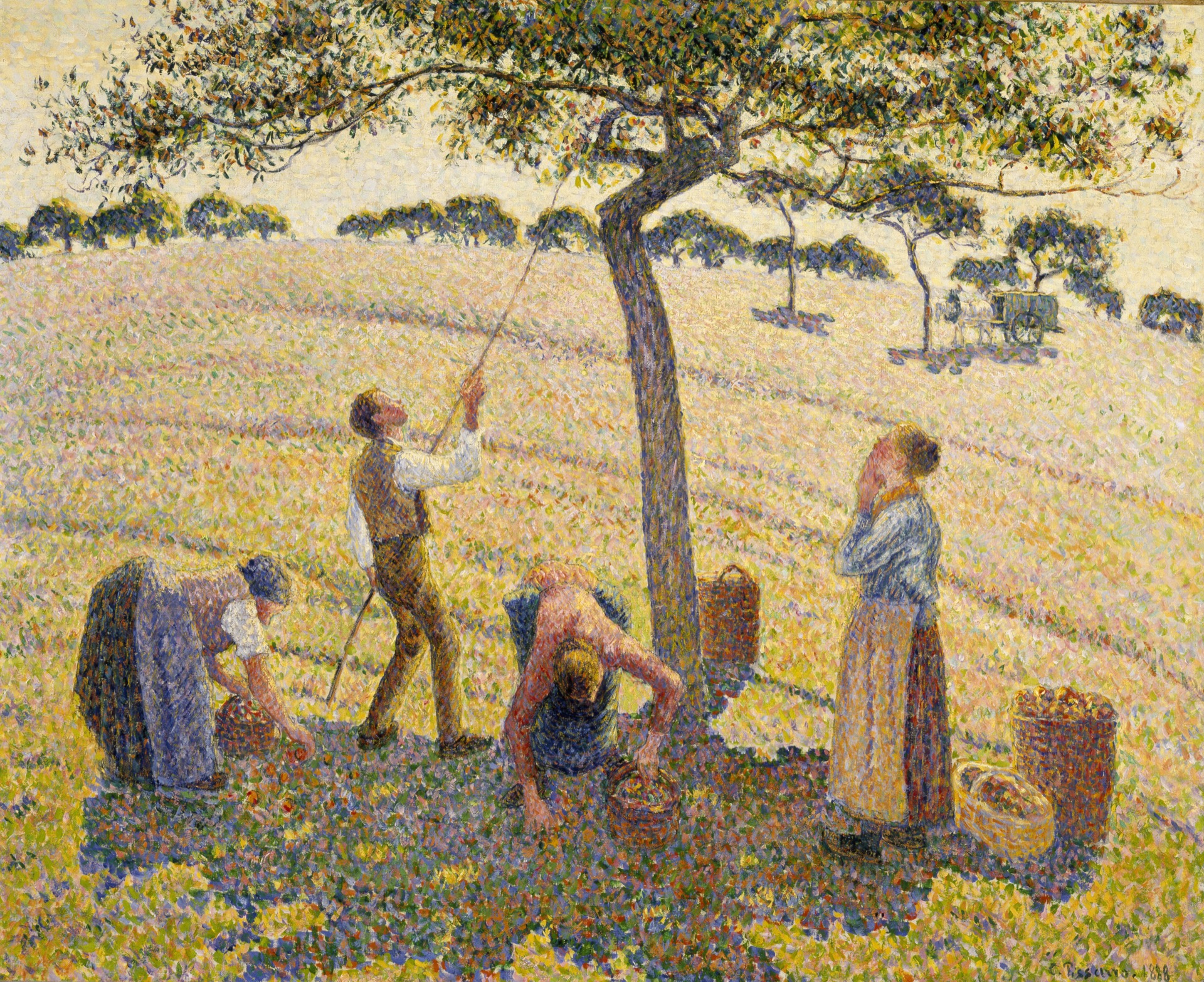
The painting is not a rejection of Impressionism. It is a pressure test. Pissarro tries the clarity of Seurat's system while keeping a subject rooted in work, landscape, weather, and bodily movement. Any global reading of pointillism needs that tension between discipline and lived immediacy.
Pissarro and the younger Neo-Impressionists
Pissarro's support helped Seurat and Signac enter the final Impressionist exhibition in 1886. That exhibition made generational conflict visible. Older Impressionists had fought for broken color and independent display; younger Neo-Impressionists now argued that color could be organized more scientifically and systematically.
Pissarro was open enough to try the method seriously. He and his son Lucien explored divisionist touch, and for several years the point gave Pissarro a way to intensify color while controlling the surface. But he was never fully absorbed by the doctrine. The technique cost time, and its thinness could work against the density he wanted from paint.
Rural labor, politics, and looking
Pissarro's rural images are often gentle, but they are not empty pastorals. He was sympathetic to anarchist ideas, and his art repeatedly treats ordinary labor with calm dignity rather than sentimental drama. Peasants in his paintings work, rest, walk, gather, and occupy the landscape without becoming picturesque props.
That social attention changes how pointillism behaves in his hands. In La Grande Jatte, Seurat organizes public leisure into a modern social grid. In Pissarro, divided color often serves labor and shared rural space. The method becomes less ceremonial and more grounded.
Between Monet and Seurat
Pissarro is most useful when placed between Monet and Seurat. Monet makes changing light the central problem of painting. Seurat slows perception into a planned system. Pissarro knows both impulses. He wants the shimmer of lived conditions and the sharper color logic that pointillism promises.
That middle position also clarifies the difference between Impressionism, Neo-Impressionism, and the broader field of Post-Impressionism. Pissarro's late work does not move in one straight line. It tests several answers to the same problem: how can painting remain faithful to modern perception without losing structure?
Legacy for a pointillism article
For an Explainary article on pointillism, Pissarro gives the counterweight to simple definitions. He shows that pointillism is not only a look made of dots. It is a method debated inside the avant-garde, adopted by painters with different temperaments, and measured against older habits of touch, speed, and observation.
His legacy is therefore double. As an Impressionist, he helps legitimate unstable perception as serious painting. As a temporary Neo-Impressionist, he demonstrates the attraction of disciplined color and the difficulty of maintaining it. Apple Harvest holds that double legacy in one orchard.
How to read Pissarro
Look for attention before spectacle. Pissarro rarely depends on dramatic incident. He builds meaning through repeated work, weather, roads, gardens, and the way people inhabit ordinary space. In the pointillist works, move close enough to see the color units, then step back to judge whether the scene still feels lived rather than diagrammed.
That test gives Pissarro his place. He is not the purest pointillist, and that is precisely why he is useful. He makes the method visible as a choice with benefits and costs.
Continue with related pages
Then use the art quiz to see whether Pissarro's transitional pointillism reads differently from Monet's Impressionist light and Seurat's planned color system.