
Pointillism and Impressionism
Apple Harvest
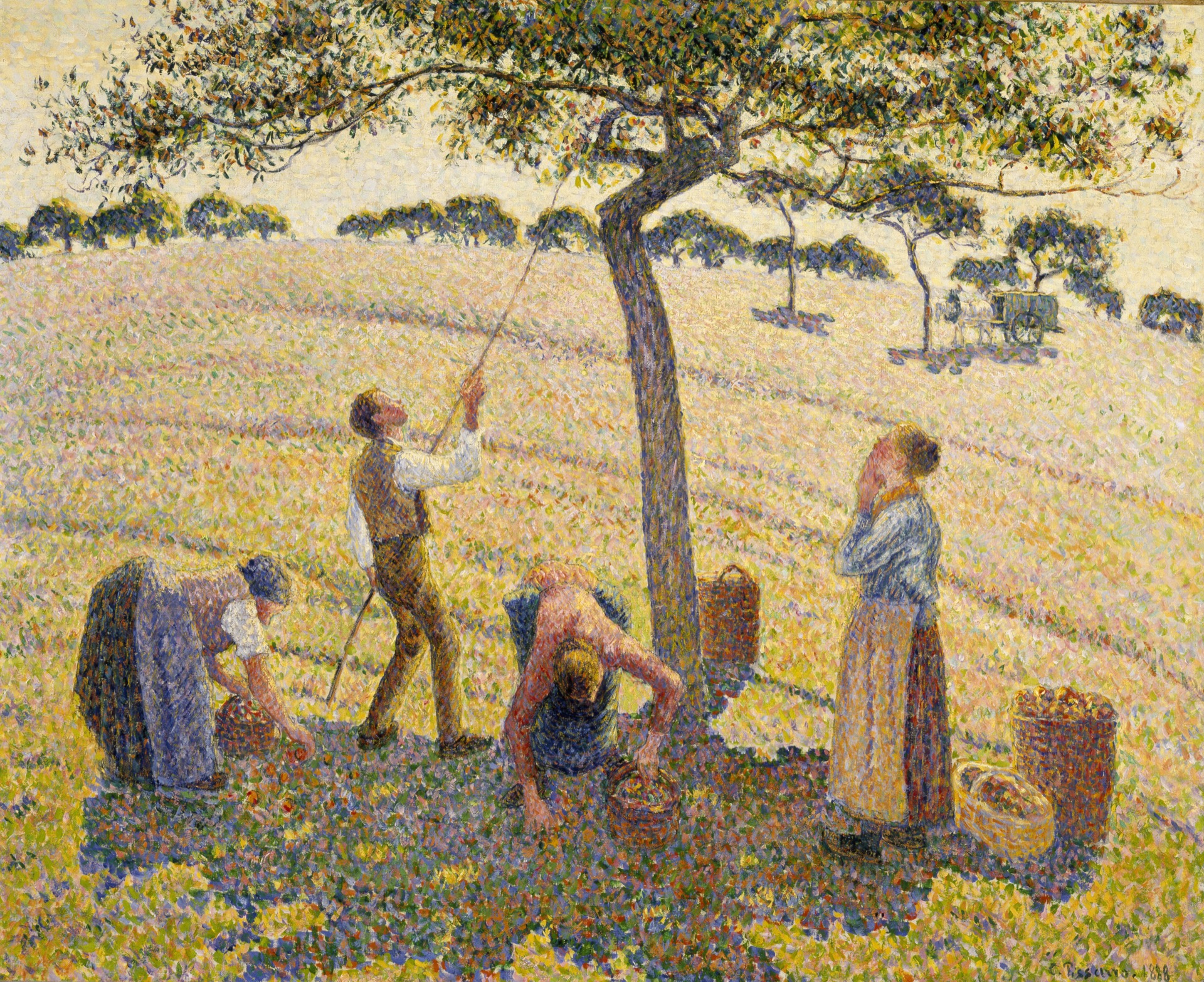
Under an apple tree, Pissarro makes rural labor shimmer with hundreds of separate touches, but the scene still breathes like Impressionism. Apple Harvest is one of the best works for understanding pointillism as a transition: it accepts Seurat's divided color, then tests whether that system can keep the freshness, movement, and social warmth that Pissarro valued.
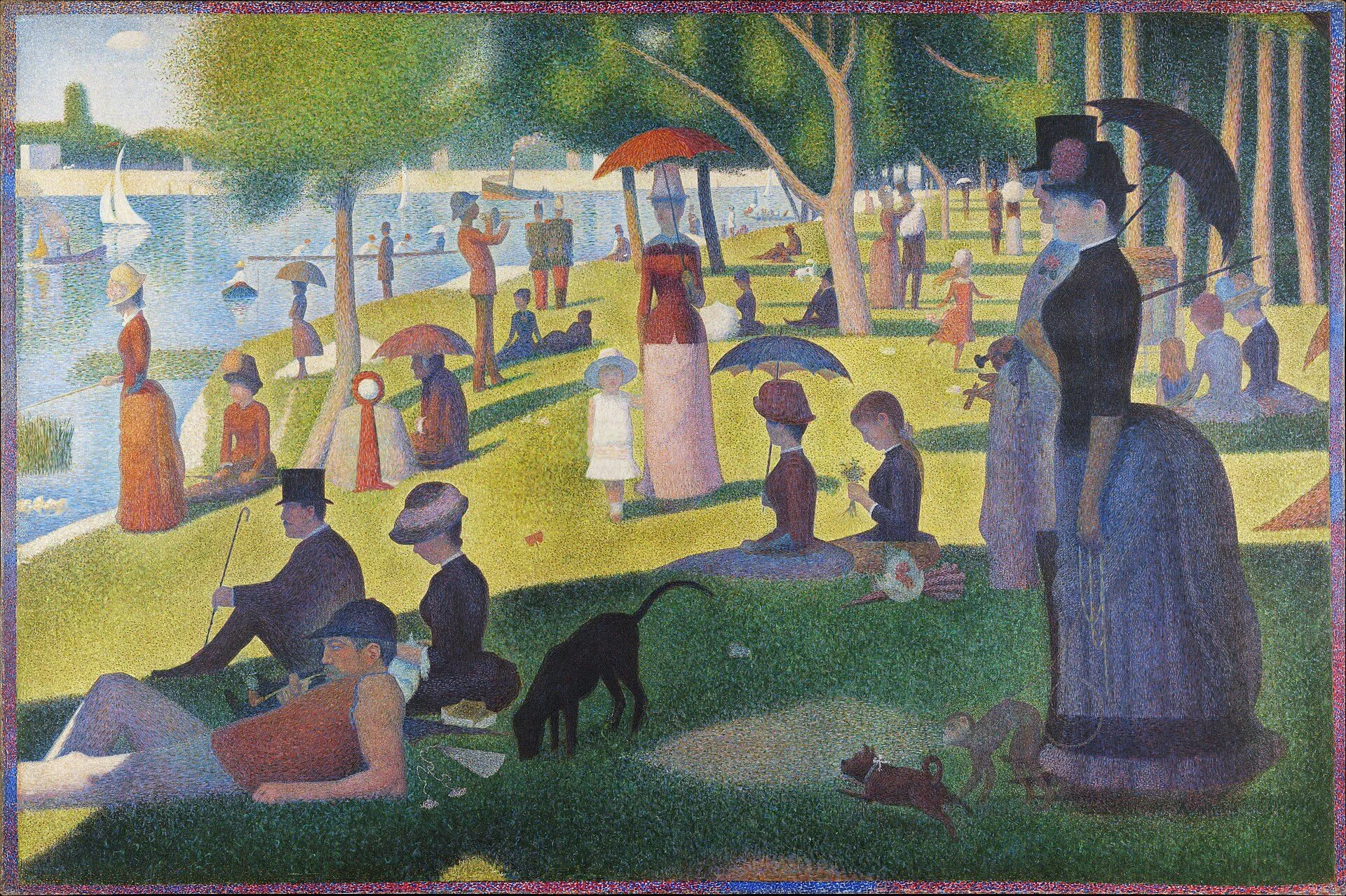
For a future answer to "what is pointillism?", this painting is essential because it complicates the story. Seurat gives the method its strict model in La Grande Jatte. Signac turns it into public theory and graphic force. Pissarro shows what happens when an older Impressionist adopts the point, admires its purity, and worries about its limits.
A familiar subject under a new method
Pissarro returned to apple gathering several times. The subject was not exotic or theatrical. It belonged to the rural world around Éragny, where he settled in the 1880s and where peasants, gardens, orchards, paths, and fields became central to his late work. In Apple Harvest, that familiar world is rebuilt through a newer color discipline.
The Dallas Museum of Art's conservation account stresses that the 1888 painting follows earlier versions of the apple-picking subject. This matters: Pissarro was not choosing pointillism for novelty alone. He was returning to known material with a different optical instrument, asking whether Seurat's procedure could sharpen a rural motif without draining it of lived immediacy.
What is visible first
The composition gathers around the shadowed apple tree. Figures bend, reach, and carry baskets. Sunlit grass pushes into the scene from the back, while the deep shade beneath the tree concentrates the painting's densest color activity. The subject is ordinary work, but the structure is carefully staged: bodies circulate around the tree like parts of a shared rural rhythm.
The pointillist surface changes the meaning of that labor. No figure dominates. The marks distribute attention across grass, leaves, cloth, fruit, skin, and shadow. The harvest becomes a field of related actions rather than a heroic scene. That social modesty is very Pissarro.
Pointillism without surrendering Impressionism
Pissarro adopted the Neo-Impressionist method in the second half of the 1880s, after encountering Seurat and Signac. But his version is never simply obedient. The dots and flecks remain active, varied, and restless. They do not freeze the picture into a diagram. They keep nudging it back toward sensation.
That tension makes the painting powerful. A strict pointillist reading would emphasize unmixed color, optical mixture, and the viewer's eye blending separate units at a distance. An Impressionist reading would emphasize light, weather, and momentary perception. Apple Harvest keeps both alive. It is systematic enough to teach the method and loose enough to show why Pissarro eventually found the point too slow and thin for his temperament.
The color inside the shadow
Look closely at the central shadow. It is not a brown or black mass. It contains reds, blues, greens, pinks, lavenders, oranges, yellows, and subdued cool tones, all set beside one another so that darkness becomes chromatic rather than dead. The effect is not naturalistic in the old sense, but it feels optically alive.
This is where pointillism becomes more than a visible texture. The technique changes the grammar of shadow. Instead of using darkness as absence, Pissarro fills it with color relations. The viewer reads shade as an event made by neighboring tones.
Why Pissarro matters to pointillism
Pissarro was not a minor adopter. He was the only artist to exhibit in all eight Impressionist exhibitions, and his support helped give the young Neo-Impressionists visibility at the final Impressionist exhibition in 1886. His pointillist period therefore sits at a hinge in modern painting: one generation testing the next generation's method in public.
His doubts are as useful as his adoption. Pissarro wanted purity of color, but he also wanted thickness, spontaneity, and direct sensation. Apple Harvest lets us see the attraction and the problem at once. Pointillism offers a cleaner color logic; Impressionism keeps asking for speed, bodily touch, and freshness.
A global pointillism map
Placed beside the other pointillist pages, the painting completes a useful map. La Grande Jatte explains the founding system. Signac's Opus 217 explains theory, portraiture, and graphic modernity. Van Rysselberghe's Portrait of Alice Sèthe explains Belgian interior life. Cross's The Evening Air explains the Mediterranean decorative turn. Pissarro explains the bridge back to Impressionism.
That bridge is vital. Pointillism is not just "painting with dots." It is a method for dividing color, planning perception, and testing how a picture comes together in the viewer's eye. Pissarro shows the method at the moment it enters an older painter's practice and becomes a question rather than a doctrine.
Pissarro makes pointillism argue with Impressionism in the open air.
Explore more
Related works
Then use the art quiz to test whether you can separate Pissarro's transitional pointillism from Seurat's stricter system and Cross's decorative mosaic.
Primary sources
- Dallas Museum of Art: Apple Harvest conservation essay
- Dallas Museum of Art: exhibition label for Apple Harvest
- Dallas Museum of Art: The Harmony of Labor lecture record
- National Gallery of Art: Camille Pissarro
- Musée d'Orsay: Camille Pissarro artist record
- The Met: Impressionism
- Tate Art Terms: Neo-Impressionism
- Wikimedia Commons: public-domain image record