
Artist Guide
Gustave Caillebotte
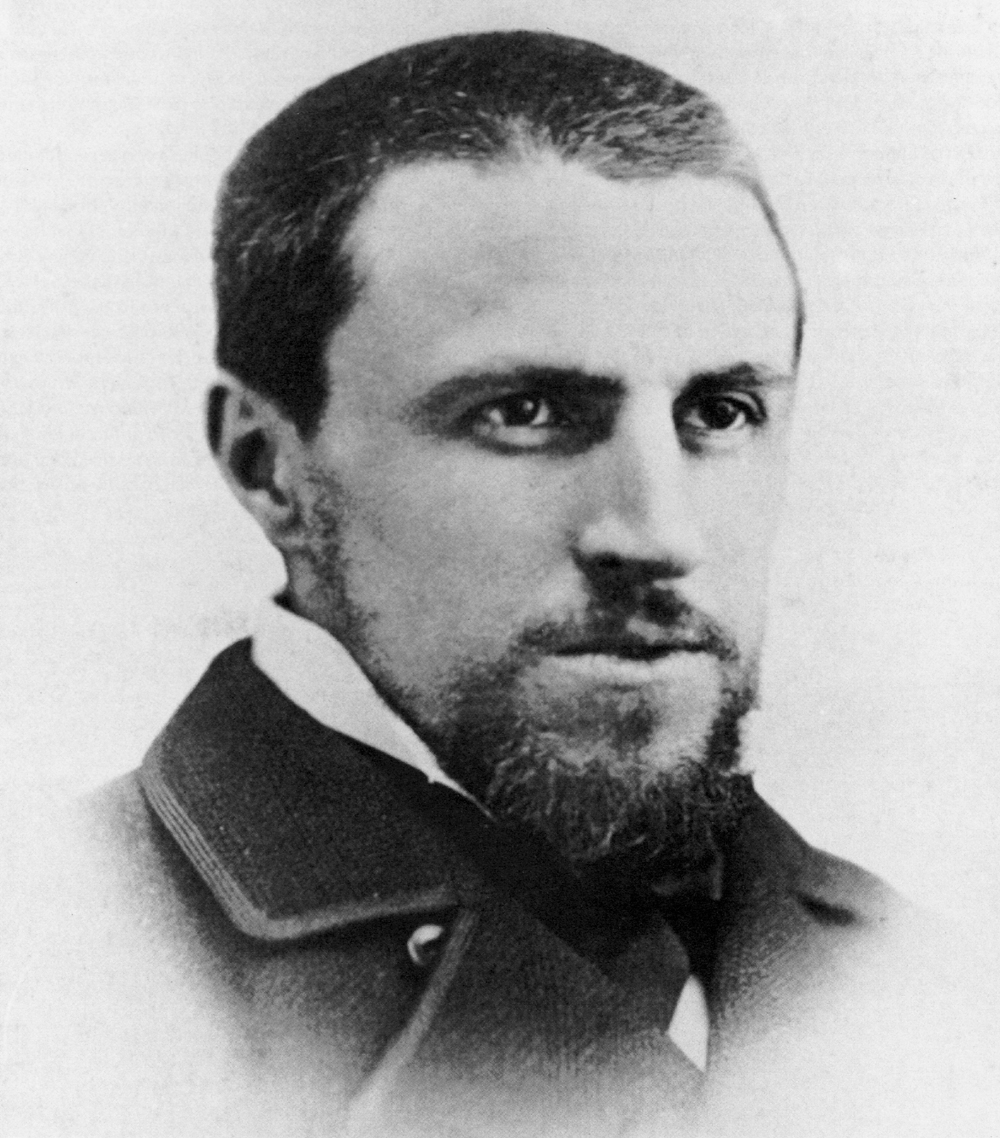
Caillebotte gave Impressionism one of its least misty and most modern faces. Where Monet often tests atmosphere and Renoir tests sociability, Gustave Caillebotte tests distance, urban geometry, and the strange impersonality of public life. He belongs firmly to Impressionism, yet his pictures often feel harder, quieter, and more structurally severe than the stereotype of the movement allows.
Training, career, and the late turn toward painting
Caillebotte was born in Paris in 1848 into a wealthy bourgeois family, and that background mattered in two ways at once. It gave him financial independence, but it also placed him directly inside the social world he would later paint with such sharp detachment. Before committing to art, he studied law, earned an engineering qualification, and served during the Franco-Prussian War. His formation was therefore unusually mixed: technical, civic, and only then pictorial.
After those early studies, he worked under the academic painter Leon Bonnat and entered the orbit of the artists who would soon redefine modern painting. The break was not immediate conversion but recalibration. Caillebotte did not simply abandon discipline for painterly freedom. He carried disciplinary habits into a new language. That helps explain why his best pictures feel so exact without collapsing into academic finish.
Modern Paris from the inside
Caillebotte's great subjects are not heroic history or pastoral escape. They are floors being scraped, men leaning from balconies, bridges, regatta scenes, suburban gardens, and above all the rebuilt city of Paris. His modernity lies less in flamboyant brushwork than in subject choice and viewpoint. He takes contemporary life seriously as material for major painting.
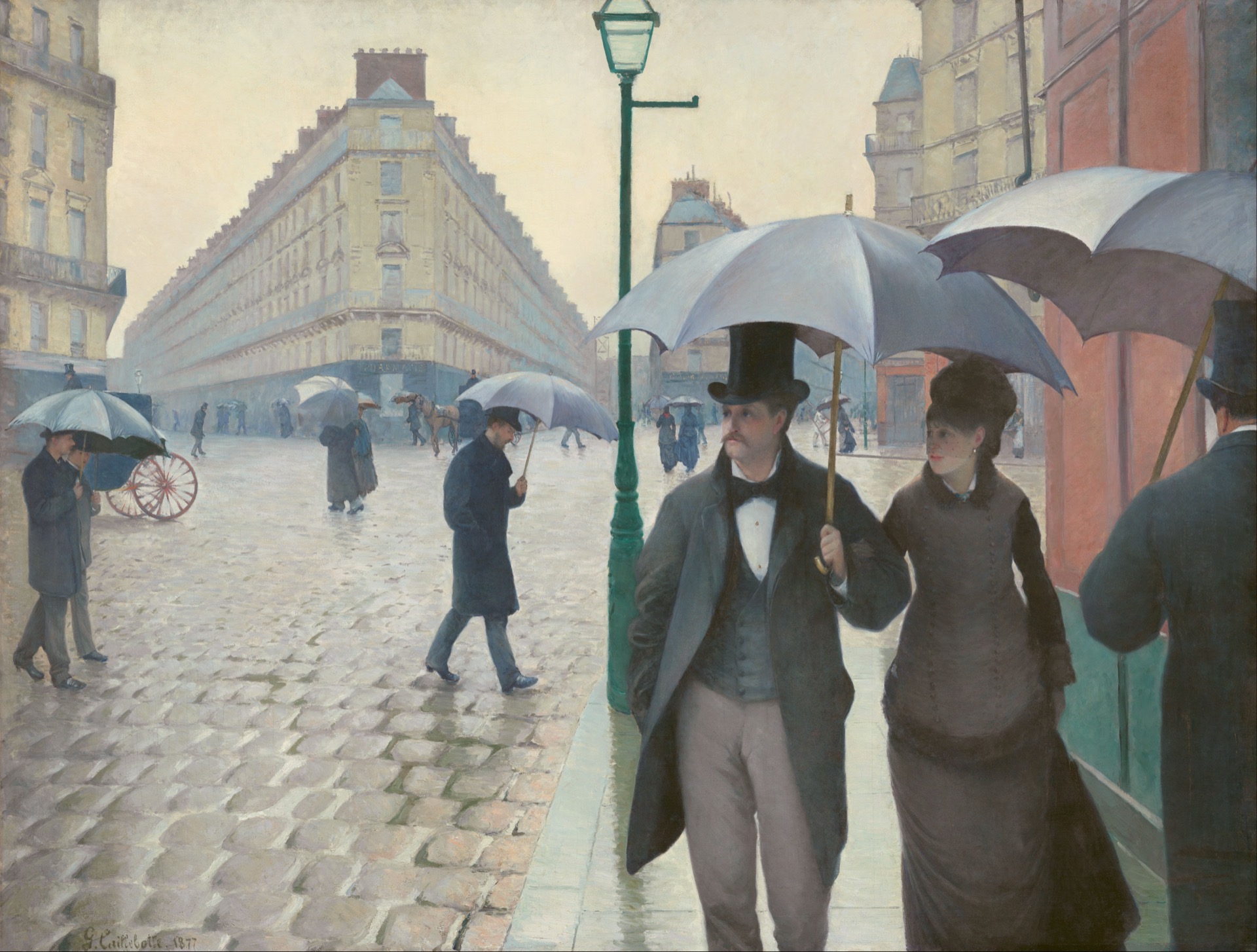
The clearest single case is Paris Street; Rainy Day. Exhibited in 1877, it turns a broad Haussmannian intersection into a study of distance, circulation, and urban anonymity. The picture is monumental, but its monumentality comes from structure rather than rhetoric. Caillebotte organizes wet pavement, umbrellas, façades, and passing bodies into a field where modern public life becomes legible without becoming sentimental.
An Impressionist with harder edges
This is why Caillebotte is so useful inside any reading of Impressionism. He proves that the movement is not reducible to shimmering surfaces. Compare him with Claude Monet: Monet typically measures changing atmospheric conditions, while Caillebotte often measures the built environment that channels modern life. Compare him with Renoir's Bal du moulin de la Galette: Renoir's crowd warms and softens; Caillebotte's city spreads people apart.
Yet his paintings are not anti-Impressionist. They share the movement's interest in unstable conditions, contemporary subjects, and direct visual experience. What changes is emphasis. Caillebotte trusts perspective, cropping, and interval more than chromatic softness. His art often feels close to photography in its sudden cutoffs and off-center balance, but it never becomes mechanical. The eye is always guided by judgment.
Patron, organizer, and collector
Caillebotte's importance is larger than his own canvases. He helped finance independent exhibitions and supported fellow painters materially at crucial moments. His collection eventually included major works by the Impressionists, and his bequest to the French state became a decisive act in the public legitimation of the movement. In other words, he shaped Impressionism not only as a painter but as a patron and institutional force.
That role matters because it changes how we read his career. Caillebotte was not a minor participant who happened to paint a few masterpieces. He was central to the conditions under which the group could survive, show, and later enter museum history. The afterlife of Impressionism owes something to his judgment as well as his brush.
Petit-Gennevilliers and the late expansion of his method
From the early 1880s, Caillebotte's life at Petit-Gennevilliers opened another side of his work. He painted gardens, the Seine, and boating scenes with the same analytical intelligence he had earlier brought to Paris boulevards. Horticulture and yachting were not sidelines. They expanded his interest in how modern people occupy managed environments, whether urban, suburban, or sporting.
That broader range helps explain his renewed place in recent scholarship and exhibitions. He is now seen less as the odd man inside Impressionism and more as one of the painters who reveal how diverse the movement actually was. His art is modern not because it abandons order, but because it discovers new subjects and new distances for order to describe.
Legacy and posthumous influence
Caillebotte's legacy is double. As a painter, he expanded the formal range of Impressionism by proving that modern life could be rendered through hard perspective, abrupt cropping, and a cooler social temperature. As a collector and donor, his posthumous influence reached even further: the bequest of his Impressionist collection helped anchor the movement in French public museums and changed how later generations encountered Monet, Renoir, Degas, and their peers.
That legacy also explains his uneven reputation. For decades his impact as patron overshadowed his own canvases, which contributed to his relative obscurity. The major retrospective and scholarly revival of the late twentieth and twenty-first centuries reversed that imbalance. Today his influence is clearer: he is not a peripheral curiosity inside Impressionism, but one of the artists who most sharply defined what modern urban painting could be.
Reading paths from Caillebotte
A strong route is simple: start with Paris Street; Rainy Day, then move to Impressionism, then compare Caillebotte's public detachment with Renoir's social warmth and Manet's modern tension. The art quiz works well afterward if you want to test whether Caillebotte's spatial signature now stands out immediately.
Primary sources
- Musee d'Orsay: Gustave Caillebotte (1848-1894)
- Musee d'Orsay: Caillebotte, Painting Men
- The Art Institute of Chicago: Gustave Caillebotte, A Man of Many Hats
- The Art Institute of Chicago: Gustave Caillebotte, Painting His World
- National Gallery of Art: Gustave Caillebotte, The Painter's Eye
- National Gallery of Art: artist page
- Wikimedia portrait file metadata