
Realism
A Bar at the Folies-Bergère
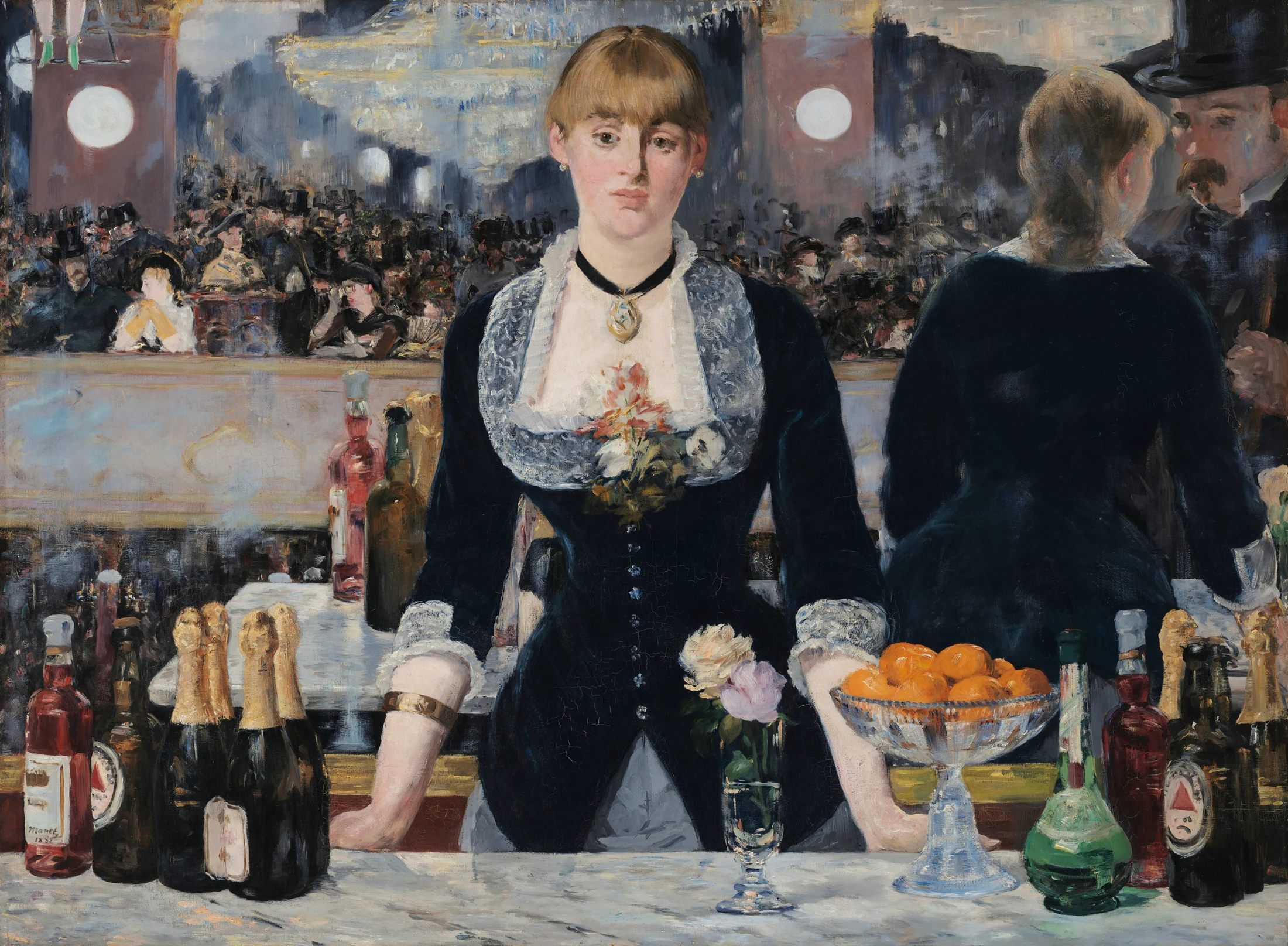
At first it looks like a crowded night out. Two seconds later, the painting turns strange. Manet's A Bar at the Folies-Bergère is one of the clearest entrances into modern art because it gives you both pleasures at once: an instantly legible scene and a visual structure that refuses to settle. You see bottles, oranges, a barmaid, a mirror, and a fashionable crowd. Then the reflection starts to slide, the space stops behaving, and the whole image becomes a study of how modern life is seen.
Start with what is plainly there
A young barmaid stands behind a marble counter. In front of her sit champagne bottles, liqueurs, flowers, and a bowl of oranges. Behind her stretches the mirrored life of the Folies-Bergère, one of the most famous entertainment venues in late nineteenth-century Paris. The crowd is busy, bright, and unstable. In the upper left, the green boots of a trapeze artist suddenly enter the frame.
That quick inventory matters because Manet wants the painting to begin as a recognizable public scene. You do not need prior knowledge to enter it. This is not mythology, history painting, or rural nostalgia. It is urban leisure, commerce, spectacle, and labor compressed into one interior.
- Look first at the barmaid's face: calm, tired, and hard to read.
- Then scan the counter, where luxury goods are arranged almost like a still life.
- Only after that move to the mirror, where the whole scene becomes unstable.
- Do not miss the trapeze artist's legs in the upper left: a quick sign that the venue is loud and theatrical even when the barmaid herself stays still.
The historical setting matters
The Folies-Bergère was not a quiet bar. It was a music hall where Parisian nightlife, performance culture, class display, and commercial exchange all met. According to the Courtauld collection record, Manet made sketches on site but painted the work in his studio, where a barmaid named Suzon posed for him. That detail explains a lot. The painting is rooted in observed modern life, but it is carefully constructed rather than casually documentary.
This is also Manet's last major painting, completed in 1882, a year before his death. It therefore reads as a late summation. Where Le Déjeuner sur l'herbe turned a picnic into scandal and Olympia turned a nude into a public confrontation, this work turns urban entertainment into a puzzle about spectatorship, transaction, and isolation.
The barmaid is the still center
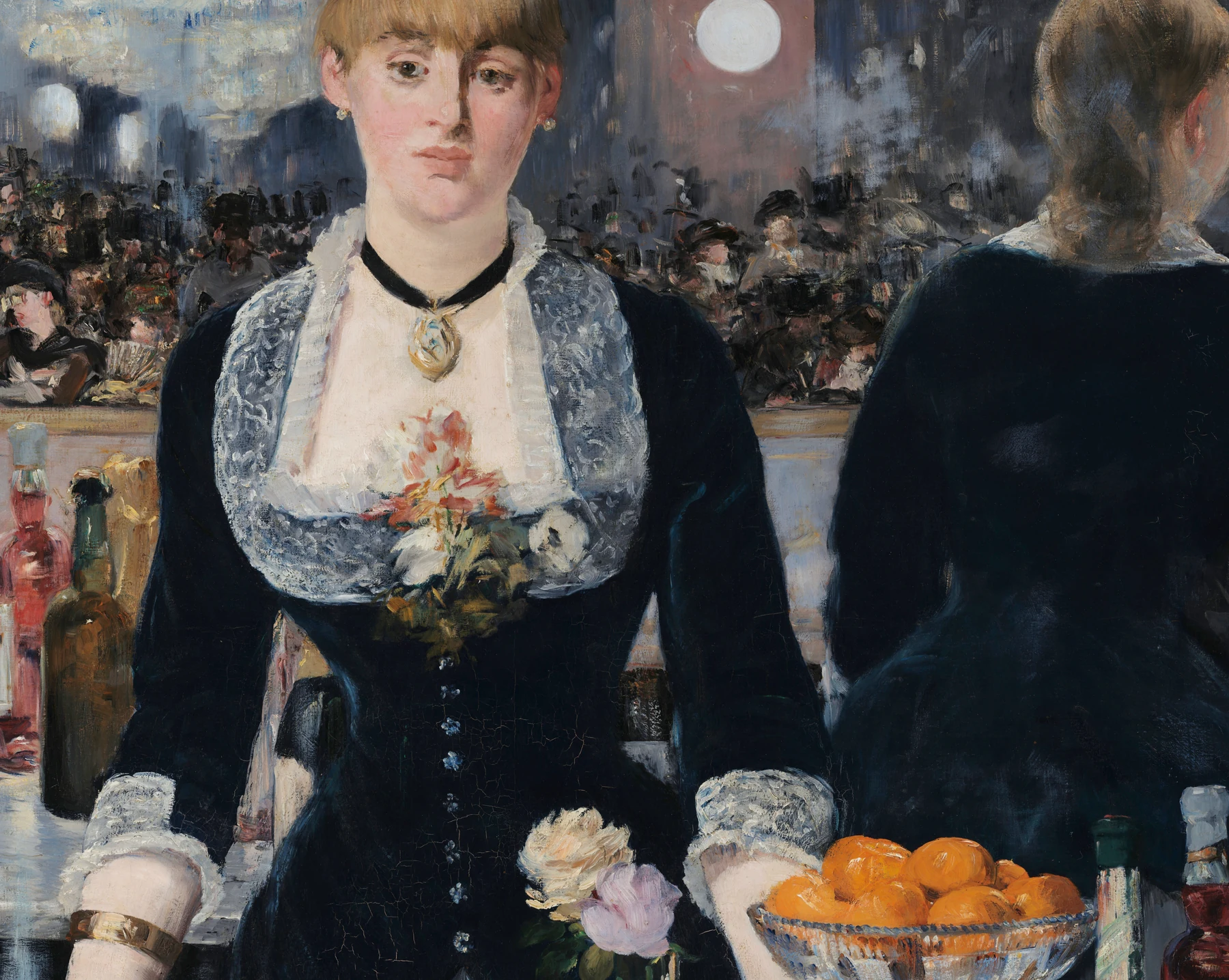
Everything around her flickers, but she does not. That is the first artistic decision that makes the picture memorable. The crowd behind her is active, the mirror is busy, the goods on the counter invite consumption, yet the woman at the center remains inward and almost withdrawn. She is present as a worker inside the spectacle, not as a participant in its pleasure.
That tension is why the painting feels deeper than a clever mirror trick. Manet sets up a glamorous public world, then gives its central figure an expression that resists glamour. The scene promises sociability, but the face interrupts it.
Why the mirror feels wrong
Most first-time viewers notice the same thing: the reflection does not line up the way they expect. The barmaid's reflected body is shifted to the right. The top-hatted customer seems to occupy the viewer's place. Some of the bottles do not align neatly either. Britannica calls the composition disorienting, and that is exactly right. The point is not to solve a tidy optical puzzle and move on. The point is to feel that modern looking has become unstable.
Scholars have long debated the geometry, but the important thing for a general reader is simpler. Manet does not use the mirror to reassure you that space is coherent. He uses it to split the scene in two: the woman you face directly and the social exchange that appears displaced behind her. The viewer stands somewhere between customer, observer, and participant.
The painting is also about commerce
The still life along the bar is not decorative filler. Bottles, glass, flowers, and fruit establish the counter as a zone of transaction. The woman is not simply framed by objects; she is framed by goods. That is why the work belongs so naturally with Realism. Manet is not documenting the venue piece by piece. He is showing how modern public life runs through display, money, service, and attention.
The painting therefore keeps one of Manet's deepest themes alive: images are never neutral containers. They organize relationships. Here, the relation is triangular. There is the woman behind the bar, the customer implied by the reflection, and the viewer who occupies nearly the same visual position. The painting makes that triangle impossible to ignore.
A late answer to Olympia
Inside Manet's own work, Olympia provides the direct contrast. There too, a female figure faces the viewer while social exchange hums around the edges. But the mood has changed. Olympia is confrontational and frontal. A Bar at the Folies-Bergère is cooler, sadder, and more spatially complex. It does not attack the viewer head-on; it lets the viewer drift into a compromised position inside the reflected crowd.
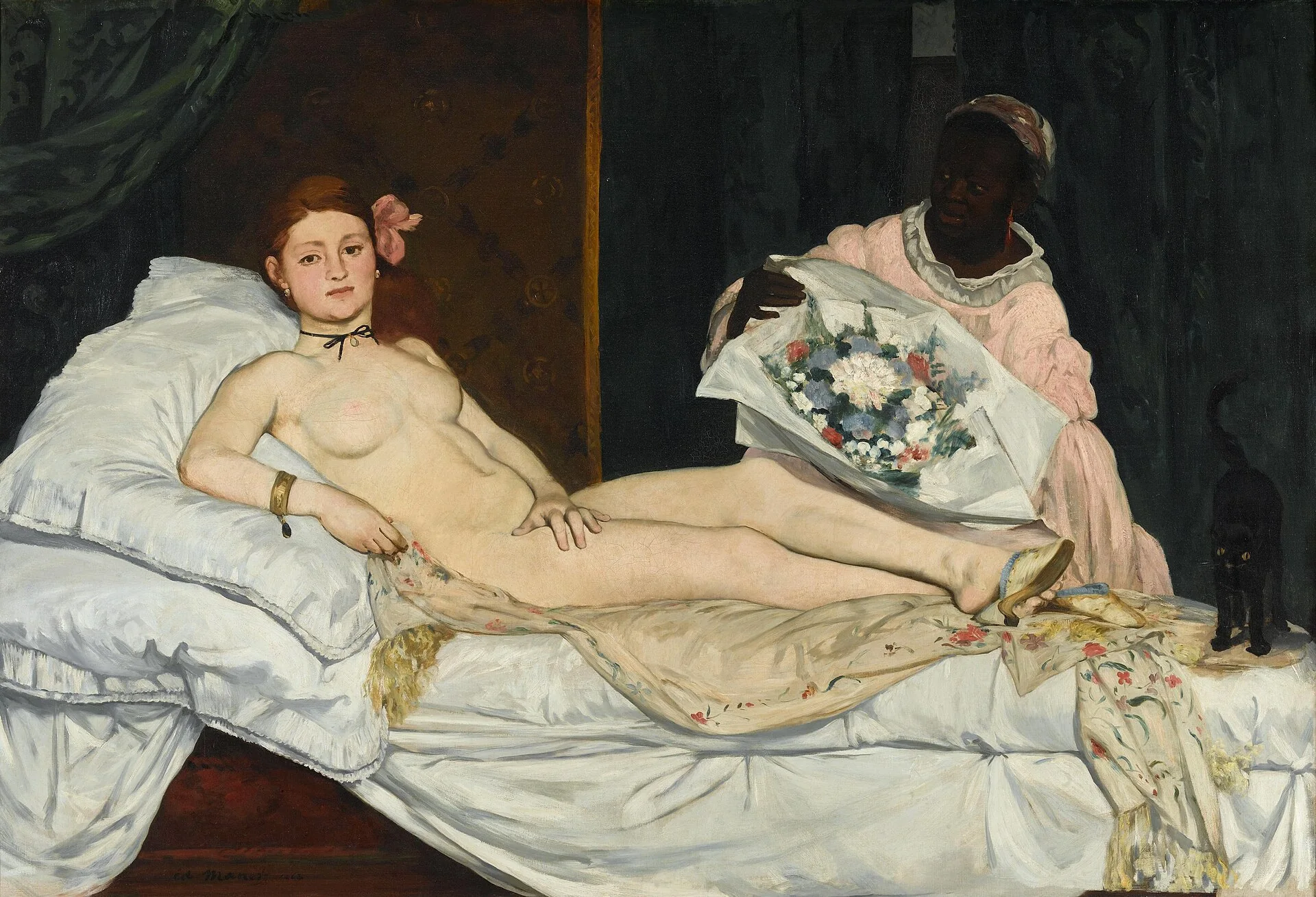
That is what makes the late painting such a strong capstone. The public scandal of 1863 and 1865 has not disappeared; it has become more structurally sophisticated. Manet no longer needs a nude to expose the modern world. A bar, a mirror, and a look are enough.
Where to go next
Move backward and outward at the same time: Le Déjeuner sur l'herbe, Olympia, The Railway, then the broader artist page on Édouard Manet. From there, Realism and Impressionism show why Manet sits at the hinge of modern painting rather than neatly inside one label.
Explore more
Related works
Primary sources
Frequently asked questions
Manet shows a barmaid standing before a mirror at the Folies-Bergère. The goods on the counter, the crowd in reflection, and the implied customer all place her inside a world of spectacle and transaction.
The reflection is deliberately disorienting. Manet shifts the reflected figure to the right and lets the customer almost occupy the viewer's position, making the whole scene feel unstable rather than optically comfortable.
It is his last major painting and a late synthesis of his method. The work keeps the social tension of Le Déjeuner sur l'herbe and Olympia, but translates it into a more complex scene of modern urban life.