
Impressionism
Paris Street; Rainy Day
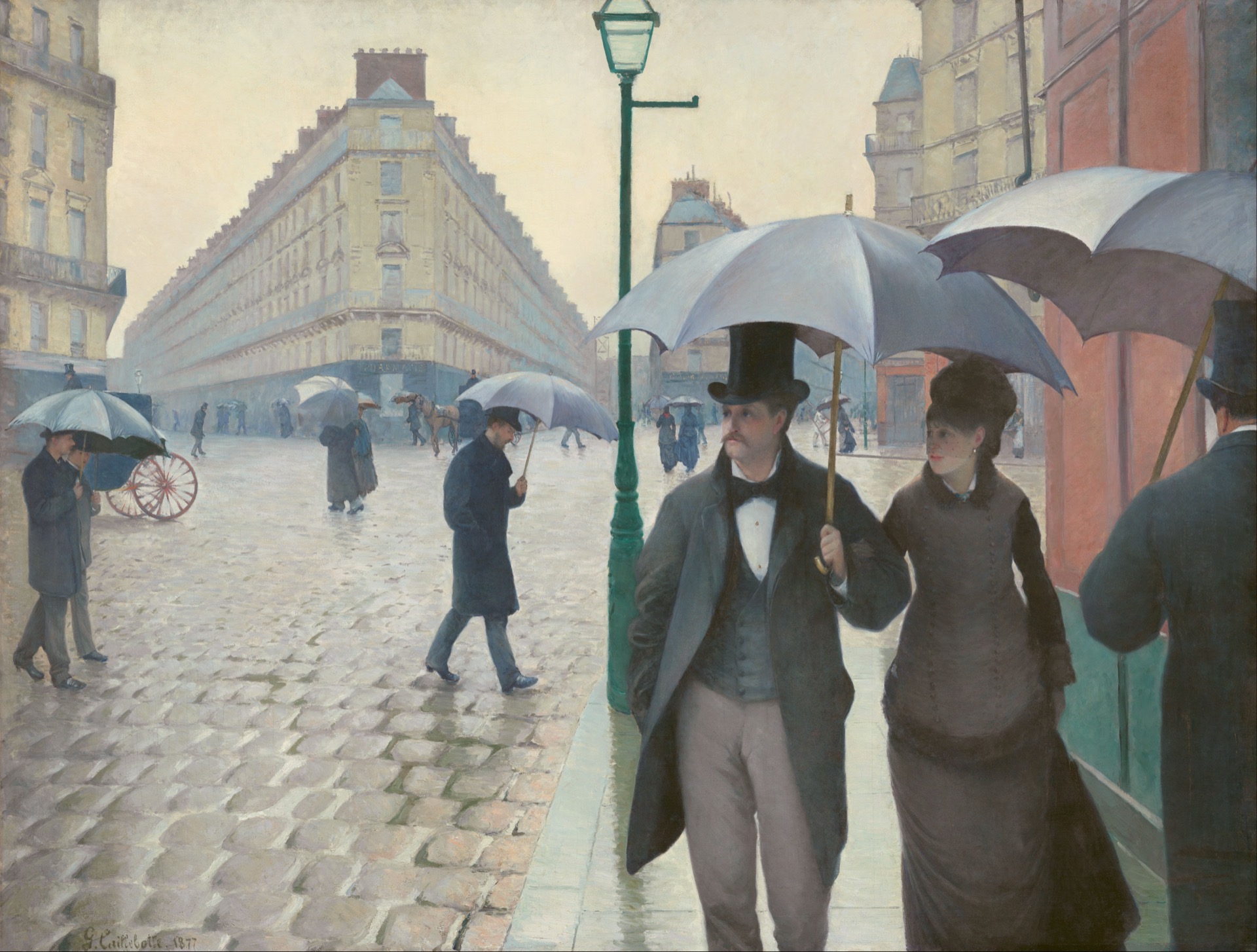
Caillebotte paints Paris in the rain as a city of distance, order, and passing strangers. In Paris Street; Rainy Day, the wet boulevard is not just atmosphere. It shapes how people move, how they keep apart, and how modern public life looks. The painting belongs to Impressionism, yet it gives the movement a colder and more structured edge.
A boulevard built for distance
The scene opens onto a broad intersection in rebuilt Paris. A fashionable couple advances toward the viewer under a large umbrella, while other pedestrians cross the slick pavement behind them in different directions. A lamppost near the center cuts the picture like an axis. On the left, the wedge of a Haussmannian building drives perspective sharply into depth; on the right, figures are cropped by the edge, as if the street continued beyond any stable frame.
What the painting shows is ordinary enough: people moving through a rainy day. What makes it unforgettable is the scale and control. The canvas is almost life-size, so the front couple occupies our space rather than remaining a distant anecdote. Caillebotte paints umbrellas, coats, stone, and reflections with enough precision to anchor the scene, but he avoids turning anyone into a sentimental protagonist. We read types, movements, and intervals before we read personal story.
Haussmann's Paris becomes the real armature
The historical context matters because this is not old Paris. Baron Haussmann's renovations had opened the city into wider boulevards, cleaner sightlines, and more regulated circulation. Caillebotte uses that new urban geometry as his compositional skeleton. The painting would lose much of its force in a medieval street. Here the avenue itself becomes modernity made visible: rationalized space, faster movement, mixed social classes, and a public realm where strangers share conditions without sharing intimacy.
That helps explain why the work mattered at the third Impressionist exhibition of 1877. The painting did not merely borrow an updated subject; it made urban redesign pictorially legible. Impressionism is often reduced to flickering nature and pleasant leisure. Caillebotte insists that the modern city belongs inside the same problem. Weather, architecture, and social circulation all register on the surface together.
Caillebotte's intention: structure first, anecdote second
Caillebotte's method is more severe than Monet's or Renoir's, but that does not make it less Impressionist. His intention is not to dissolve form into atmosphere. It is to test how atmosphere alters a rigorously constructed urban scene. Wet cobblestones brighten the foreground without turning reflective like a mirror. Umbrellas repeat across the picture as circular accents, slowing the eye and measuring distance. The perspective feels exact, yet it never settles into the dead certainty of architectural draftsmanship because people keep interrupting it.
That balance between geometry and flux is the key to the painting. If Caillebotte had leaned harder into anecdote, the work would become illustration. If he had leaned harder into optical vibration, it would lose the social chill that makes it modern. Instead he holds both together. The result is a picture about public life in which everyone is visible and no one is fully available.
From Renoir's dance floor to Caillebotte's boulevard
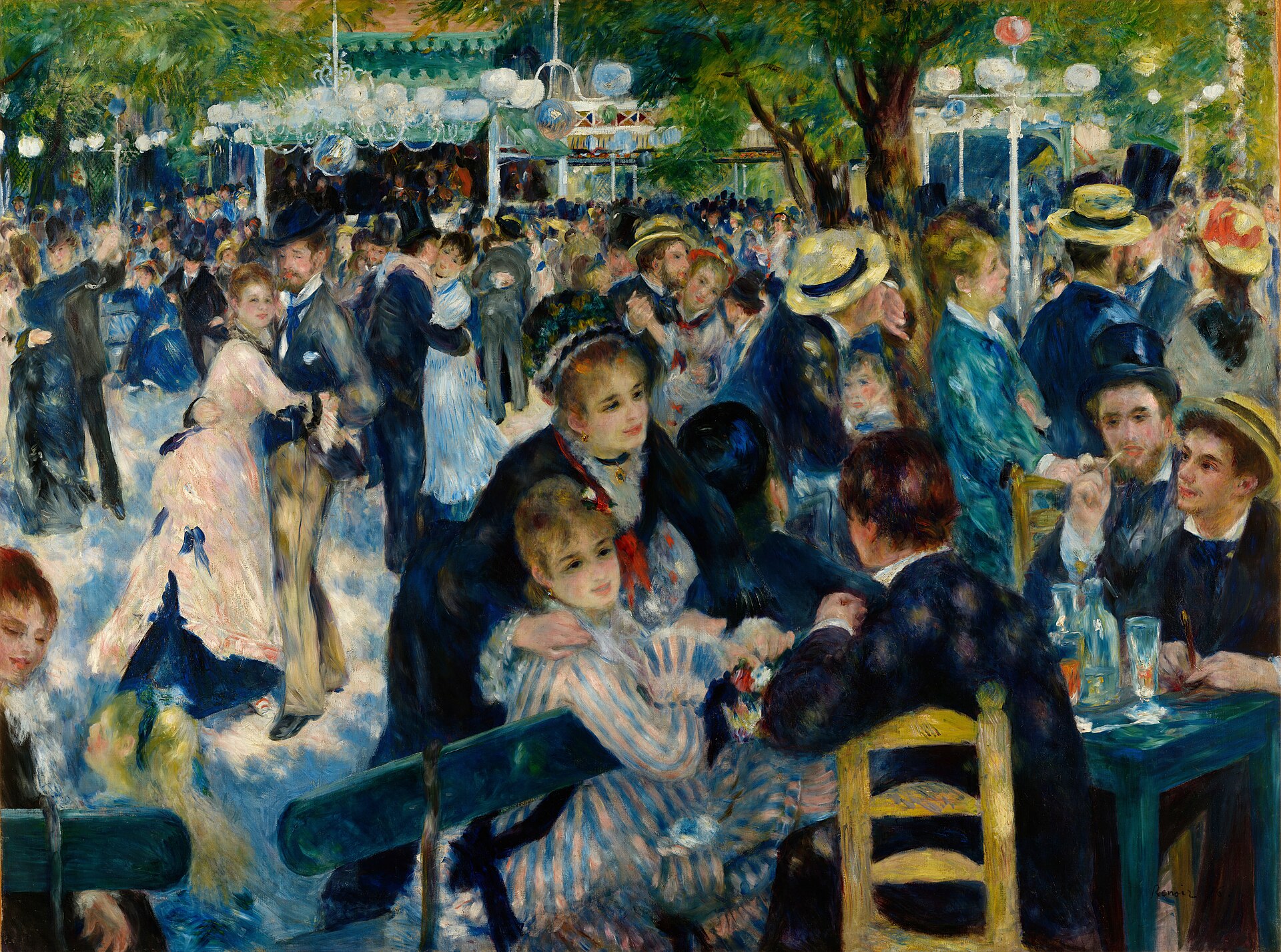
A useful comparison runs to Bal du moulin de la Galette. Renoir turns Parisian leisure into warm density: dappled light, bodies close together, sociability as atmosphere. Caillebotte paints another modern crowd but drains away that softness. His pedestrians occupy the same city, yet they move through it with reserve, each protected by cloth, etiquette, and distance. The difference shows how wide Impressionism really is.
Another route goes forward to A Bar at the Folies-Bergere, where Edouard Manet turns modern public life into a riddle of mirrors and spectatorship. Caillebotte is less destabilizing than Manet, but the kinship is real. Both painters refuse the old comfort that a public scene naturally yields a moral narrative. Modernity appears instead as a field of glances, surfaces, and uncertain relations.
Urban anonymity as the real subject
Paris Street; Rainy Day still reads as modern because it understands anonymity without melodrama. The cropped figure on the right feels almost photographic. The front couple seems close enough to identify, yet remains sealed off. The city is open and impersonal at the same time. That duality is now familiar to urban life, but Caillebotte gives it one of its sharpest nineteenth-century forms.
He also refuses the easy symbolism of rain. Nothing here suggests purification, tragedy, or romance. Rain simply changes how stone shines, how umbrellas multiply, how traffic spreads, and how strangers pass one another. That restraint is one reason the painting has aged so well. It does not decorate modernity; it studies its conditions.
Related works
Test yourself with the quiz
Keep exploring with the art quiz. If Paris Street; Rainy Day now feels distinctive to you, you should be able to separate Caillebotte's hard urban perspective from Monet's atmosphere and Renoir's social warmth.
Primary sources
Frequently asked questions
Because the painting still centers modern conditions rather than polished academic finish. Caillebotte gives those conditions a firmer geometry, but wet light, public movement, and urban atmosphere remain the real subject.
It shows pedestrians crossing a broad renovated Paris intersection under umbrellas. Caillebotte turns that ordinary moment into a study of class, distance, and anonymous public life.
The work depends on the new geometry of rebuilt Paris. Wide boulevards, open sightlines, and regulated circulation are not background details here; they are the painting's compositional armature.