
Northern Renaissance
Hans Holbein the Younger
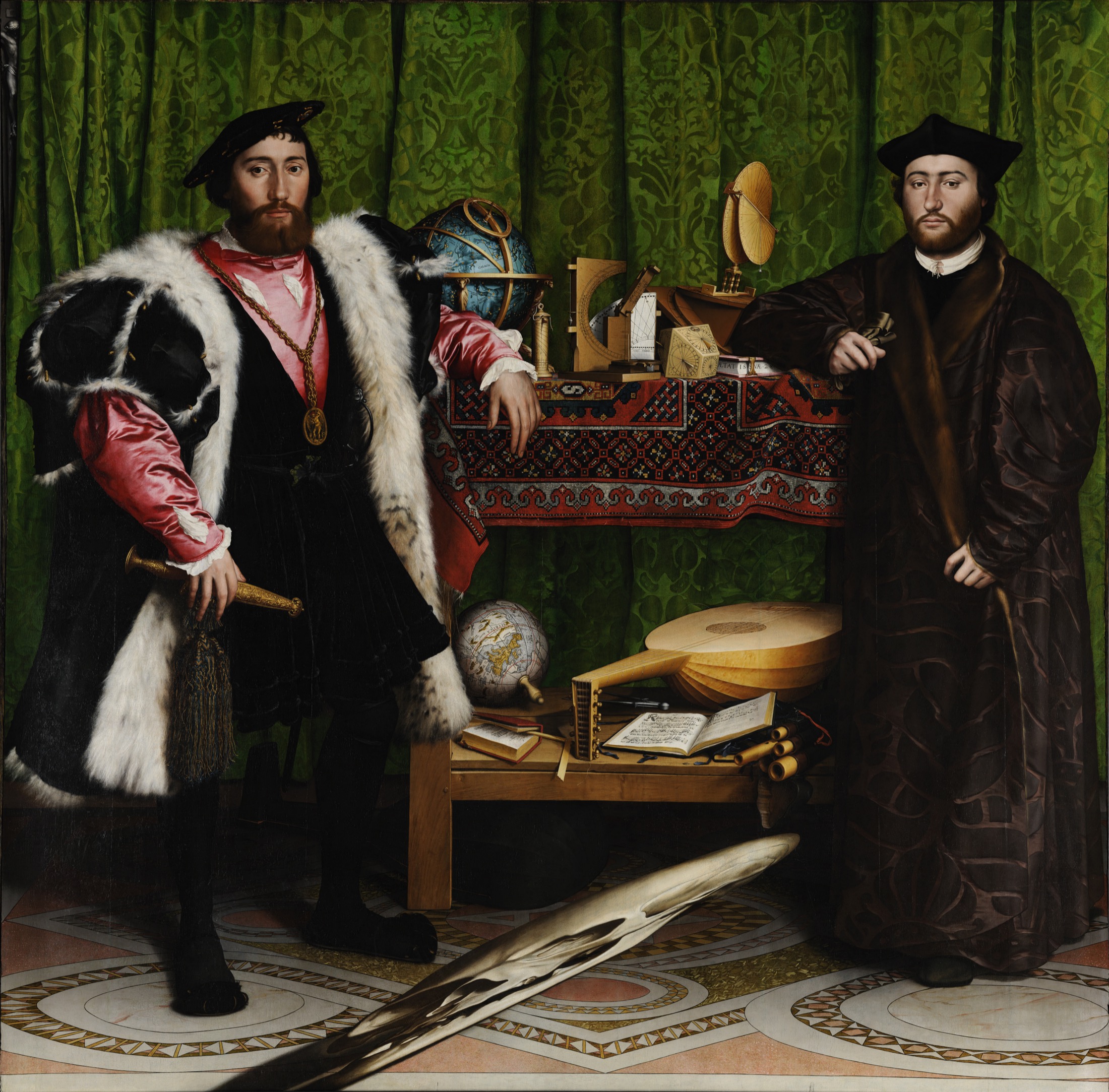
Holbein makes people look exact, and then makes that exactness politically dangerous. He is one of the sharpest portrait painters of the sixteenth century because he never treats likeness as mere resemblance. Clothes, books, gestures, inscriptions, furnishings, and silence all become part of the portrait. The result is a body of work that looks cool, controlled, and lucid while carrying enormous tension underneath.
From Augsburg to Basel: humanism and image culture
Born in Augsburg and trained in a family workshop, Holbein came of age in a world shaped by urban craft, print culture, and learned networks rather than by court ritual alone. Basel became decisive. There he worked among printers, scholars, reform-minded intellectuals, and patrons connected to humanist circles, including Erasmus. That setting mattered because it taught him that images could circulate as arguments as well as luxuries.
This early environment helps explain why Holbein's art feels so intellectually organized. He was not only a painter of faces. He designed title pages, worked in drawing and mural schemes, and learned how text, emblem, and image could reinforce each other. Portraiture for him was never isolated from broader systems of communication.
England and the Tudor court
When Holbein moved into the orbit of the English court, his precision found its most politically charged setting. Tudor England needed images that could stabilize rank, project authority, and negotiate religious upheaval. Holbein became indispensable because he could make power look immediate without making it crude. His portraits are disciplined enough for statecraft and vivid enough to remain psychologically alive.
That is one reason he matters so much historically. Many court painters flatter. Holbein organizes. His sitters are not dissolved into decorative pomp. They are built from exact contours, calibrated surfaces, and objects that tell you how they want to be read. The portrait becomes a negotiation between the sitter's status and the viewer's attention.
A method built from objects, not faces alone
Holbein's greatness is easiest to miss if you look only for expression. He often avoids melodrama. Faces can appear still, almost withholding. The real activity happens across the whole structure of the image: the fall of fur, the edge of velvet, the geometry of a sleeve, the placement of a letter, the logic of a table. That is where identity becomes legible.
This method makes him a crucial painter of the Northern Renaissance. Like Jan van Eyck, he knows that objects can think. But Holbein pushes that logic into a later and more overtly political world. His objects do not merely witness domestic life or devotional routine. They help stage diplomacy, confession, scholarship, and courtly competition.
The Ambassadors as a full statement
The Ambassadors is the clearest place to see the whole method at once. Two elite French figures stand amid astronomical instruments, books, music, textiles, and the famous anamorphic skull. Holbein makes every surface readable, then turns that readability into a larger problem about mortality, religion, and the instability of worldly order.
Read beside The Arnolfini Portrait, the difference becomes especially clear. Van Eyck turns an interior into witness. Holbein turns a staged public portrait into a map of European fracture. The continuity is Northern; the pressure is sixteenth-century and unmistakably political.
Historical position and legacy
Holbein's place in art history is unusually secure because he sits at several intersections at once: late humanism, the Reformation era, court image-making, and the long development of modern portraiture. He proves that exact description does not reduce complexity. On the contrary, precision can make ambiguity sharper. The more exact the object, the more deliberate its placement feels.
That legacy lasts because later portraiture repeatedly returns to his problem. How do you make a face, a costume, and a few objects carry an entire political world? Holbein's answer is discipline. He avoids theatrical overflow and lets arrangement do the work. That is why he still reads as modern: not because he resembles later art on the surface, but because he understands how images build authority.