
Northern Renaissance
The Ambassadors
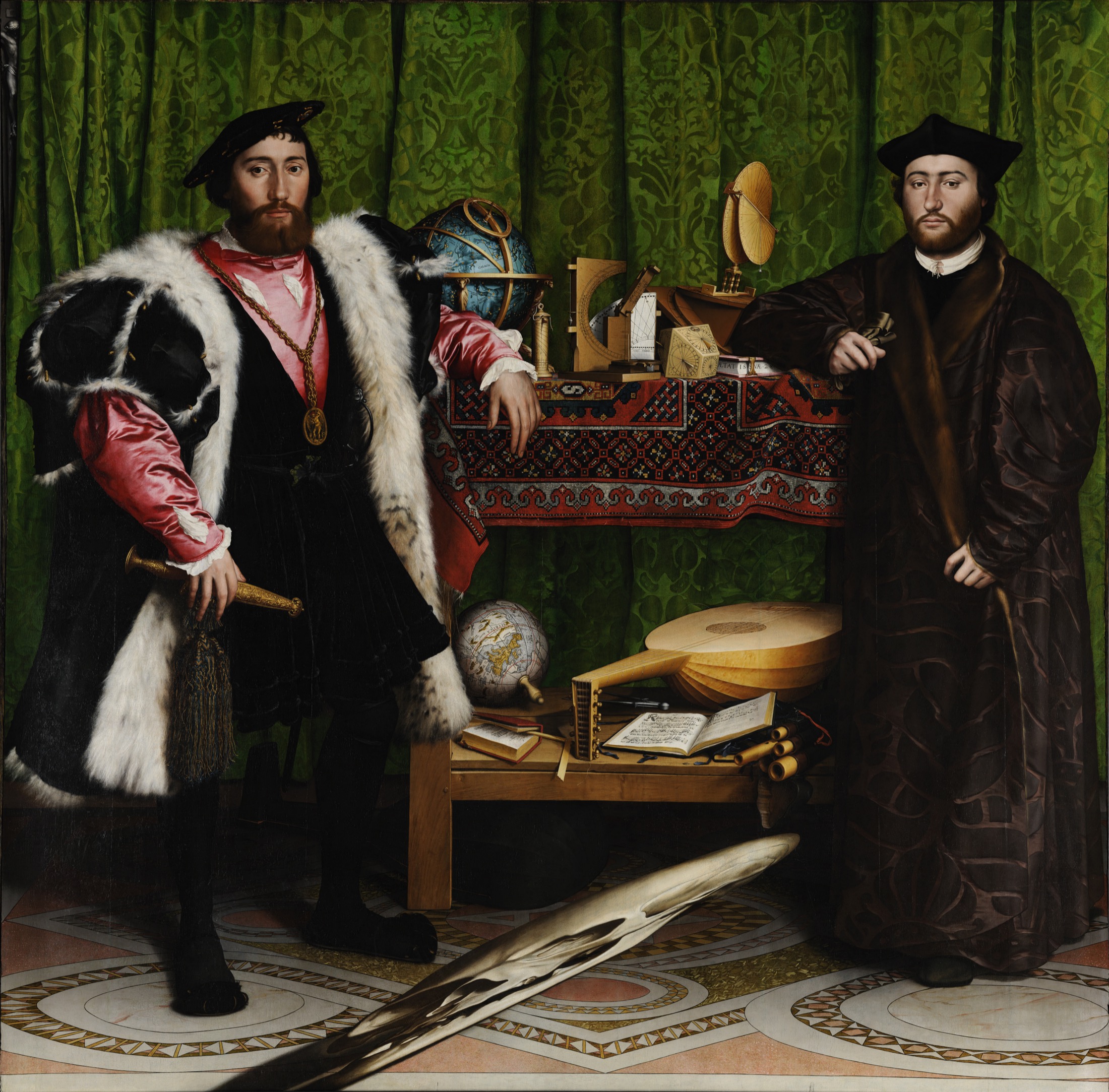
At first it looks like a triumph of wealth, learning, and diplomatic calm. Then the skull cuts across the foreground and the whole painting changes register. Hans Holbein the Younger made The Ambassadors in 1533, and it remains one of the clearest demonstrations that Renaissance realism can be both descriptive and intellectually staged. A beginner can read it quickly: two richly dressed men, shelves full of objects, a strange smear at the bottom. A slower reading discovers something more ambitious. Holbein turns portraiture into a structured argument about knowledge, religion, politics, and death.
Start with what is plainly there
Two men stand on either side of a double-tiered shelf. The man at left is more secular and worldly in bearing; the man at right is more clerical and restrained. Between them are globes, instruments, books, a lute, and other carefully painted objects. The carpet is luxurious. Their clothes are heavy, expensive, and exact. This is not decorative excess. It is social information delivered at full clarity.
That first inventory matters. Holbein wants the painting to begin as a display of standing and intelligence. Before you decode symbols, you register rank, education, and international reach. The picture establishes authority before it unsettles it.
- Look first at the men and their contrasting dress: one more courtly, one more clerical.
- Then scan the shelves from top to bottom: upper objects relate to the heavens, measurement, and time; lower objects belong more to earthly life, music, calculation, and daily culture.
- Only after that return to the long distorted shape in the foreground.
- Finally, search the upper left corner, where a partly hidden crucifix complicates the whole painting.
Who these men are and why 1533 matters
The sitters are generally identified as Jean de Dinteville, a French ambassador to the English court, and Georges de Selve, a bishop and diplomat. That matters because the painting is not a generic celebration of education. It was made in a year charged by diplomatic negotiation, dynastic uncertainty, and religious fracture. Henry VIII had broken with Rome. Europe was divided by reform and response. Holbein stages these men inside that unstable world, not above it.
This historical context helps explain the objects. They are not random markers of cultured taste. They belong to a world trying to measure, order, negotiate, and stabilize reality while political and religious consensus is failing. The painting therefore feels calm on the surface and tense underneath.
Read the shelves before chasing symbols
The upper shelf carries instruments linked to astronomy, geometry, and timekeeping. The lower shelf holds a terrestrial globe, a mathematical book, flutes, and a lute with a broken string. Holbein paints each item with astonishing care, but the point is not virtuosity alone. The objects create a hierarchy of knowledge: celestial order above, earthly practice below. At the same time, the broken string and the mixed musical references hint that harmony is under strain.
That is one reason the painting rewards structured looking. It does not scatter clues at random. It builds a system in which measurement, music, theology, and diplomacy are made to coexist, then slightly fail to align. The work becomes a portrait of a world that knows a great deal and still cannot secure itself.
The skull is not a side joke
The famous skull is painted in anamorphosis, a perspective distortion that resolves only from an oblique angle. It is one of the smartest visual shocks in art history because Holbein delays its meaning. Straight on, the skull looks like a visual accident. From the side, it becomes legible and brutal. That delay matters. Death does not sit politely on the shelf with the other objects. It cuts across the picture plane and interrupts everything.
This is not just a technical trick. It is a memento mori inserted into a painting that otherwise looks like a monument to mastery. Learning, rank, diplomacy, music, cosmology, textiles, and polished surfaces all remain in view, but the skull makes clear that none of them cancels mortality. Holbein makes the viewer perform the discovery physically, which is why the lesson lands so hard.
A hidden crucifix changes the argument
In the upper left, partly concealed by the green curtain, a small crucifix appears. It is easy to miss, and that is the point. The painting is not simply saying that worldly success ends in death. It is staging a larger Christian argument about judgment and redemption. The skull gives mortality; the crucifix gives a horizon beyond mortality. Together they prevent the picture from collapsing into either pure vanity display or pure despair.
That combination is historically sharp. In a Europe divided by confessional conflict, the painting holds together worldly knowledge and religious tension without pretending the conflict has been solved. It is one of Holbein's most disciplined achievements: nothing is overstated, but everything is under pressure.
Holbein's method and intention
Holbein's method is to make the painting look almost neutral before revealing how carefully it is staged. His intention is not to bury the viewer under private symbols. It is to let prestige, measurement, religion, and mortality occupy the same image until they start pressing against one another. That is why the surfaces are so exact and the composition so calm: control is part of the argument.
A useful Northern comparison: Van Eyck's Arnolfini room
A strong comparison inside Explainary is The Arnolfini Portrait. Jan van Eyck also fills an interior with highly legible objects, social codes, and questions about witness. But Van Eyck's room feels domestic, juridical, and devotional. Holbein's stage is larger, more public, and more geopolitical. The result is a shift from household testimony to international self-positioning.
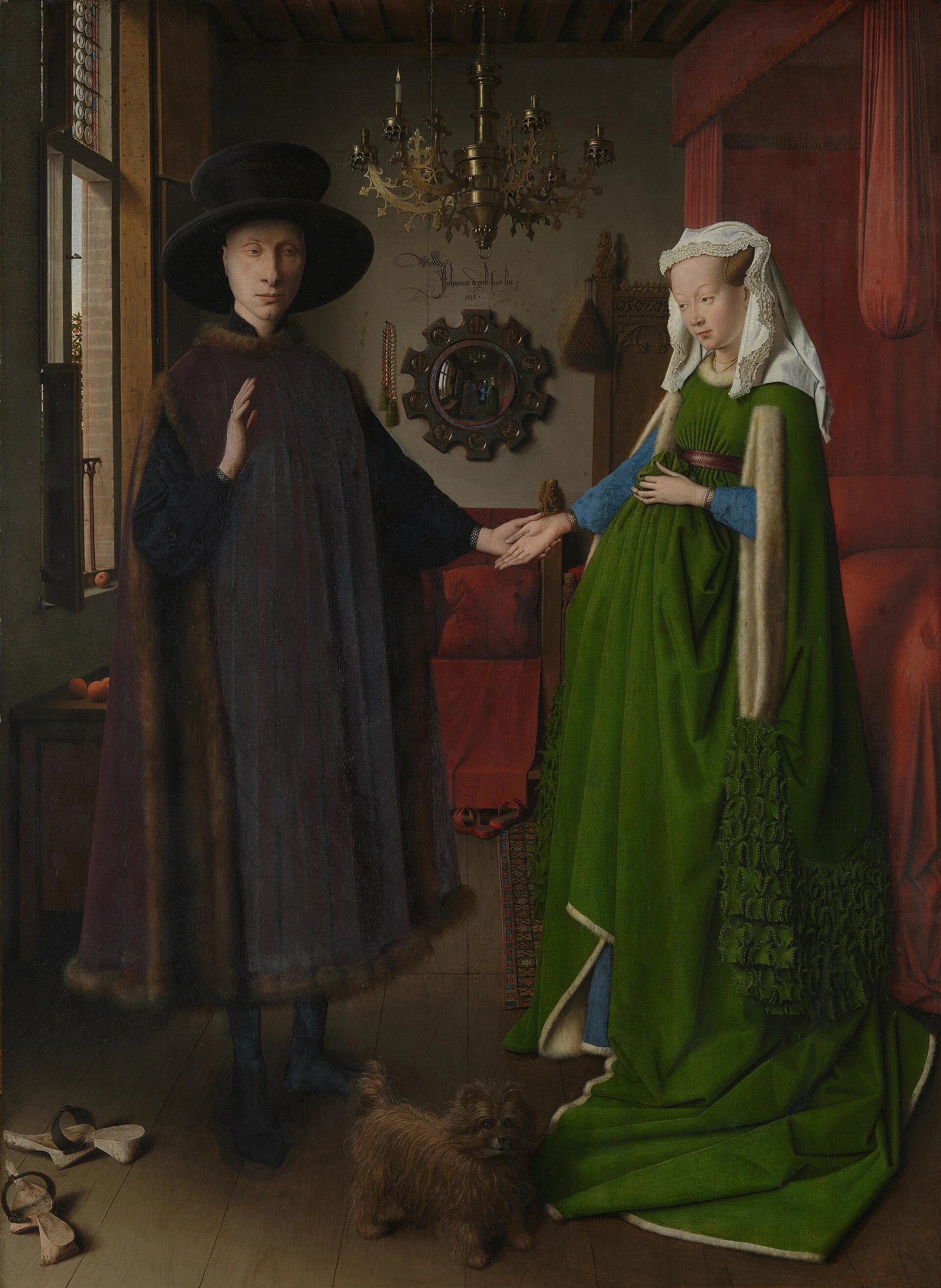
Read together, the two paintings clarify something important about the Northern Renaissance. Detail is never just a surface pleasure. It is a way of turning objects into arguments.
Why the painting keeps rewarding slow looking
The Ambassadors stays fresh because it teaches several kinds of reading at once. A newcomer can learn to identify sitters, objects, and the skull. A more advanced reader can map how perspective, theology, and politics interact. That layered accessibility is rare. Many famous paintings are either instantly legible and quickly exhausted, or so coded that they lose beginners. Holbein manages both clarity and density.
The best next steps are obvious and useful: go to Hans Holbein the Younger, then to The Arnolfini Portrait, then widen the field through Northern Renaissance. That path makes the painting less isolated and more historically precise.