
Northern Renaissance Artist
Jan van Eyck
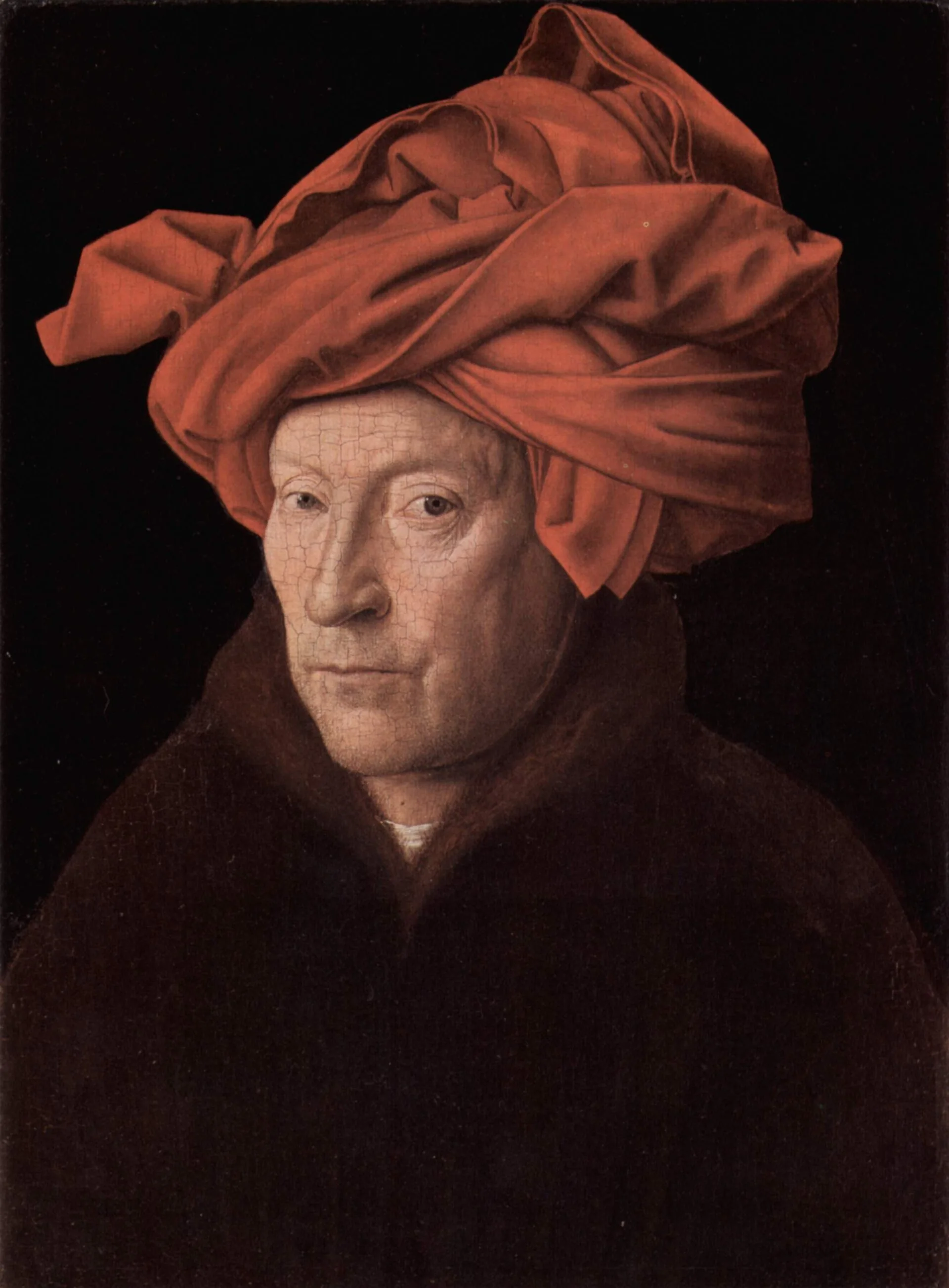
In Jan van Eyck, precision becomes a political language. Fur, metal, glass, skin, inscriptions, mirrors, and windows are never decorative extras: they organize evidence. His paintings teach viewers to infer status, devotion, trade, and private intention from material clues, which is why they still feel intellectually demanding rather than merely “realistic.”
Burgundian courts and urban trade networks
Van Eyck worked in the first half of the fifteenth century, likely born before 1390 and active in the Burgundian world that connected court culture to expanding urban wealth. He served Philip the Good in roles that included diplomatic travel. Therefore, his pictures reflect a cosmopolitan environment where objects move across borders and symbols carry layered meanings.
Although documentation is fragmentary, his training likely began in workshop practice before his career moved into ducal service. That trajectory from technical formation to court responsibility helps explain the unusual combination of precision and political intelligence in his paintings.
Bruges, where he spent key years, was one of Europe’s commercial hubs. Italian merchants, Northern patrons, clerics, and administrators interacted in dense networks. In practice, van Eyck absorbs that complexity: a domestic interior can stage legal identity, while a devotional panel can signal social ambition.
His name is often tied to the history of oil painting through the myth that he “invented” the medium. The better claim is stronger: he refined layering and glazing to an unprecedented level of control, producing luminous surfaces and minute tonal transitions that changed what panel painting could do.
Material precision as social intelligence
Van Eyck’s technique depends on calibrated sequencing. Underlayers establish form; translucent glazes modulate light; sharp highlights punctuate tactile facts. Yet technique is never separate from meaning. In The Arnolfini Portrait, polished shoes, oranges, carved furniture, and reflective glass work as social signals as well as compositional anchors.
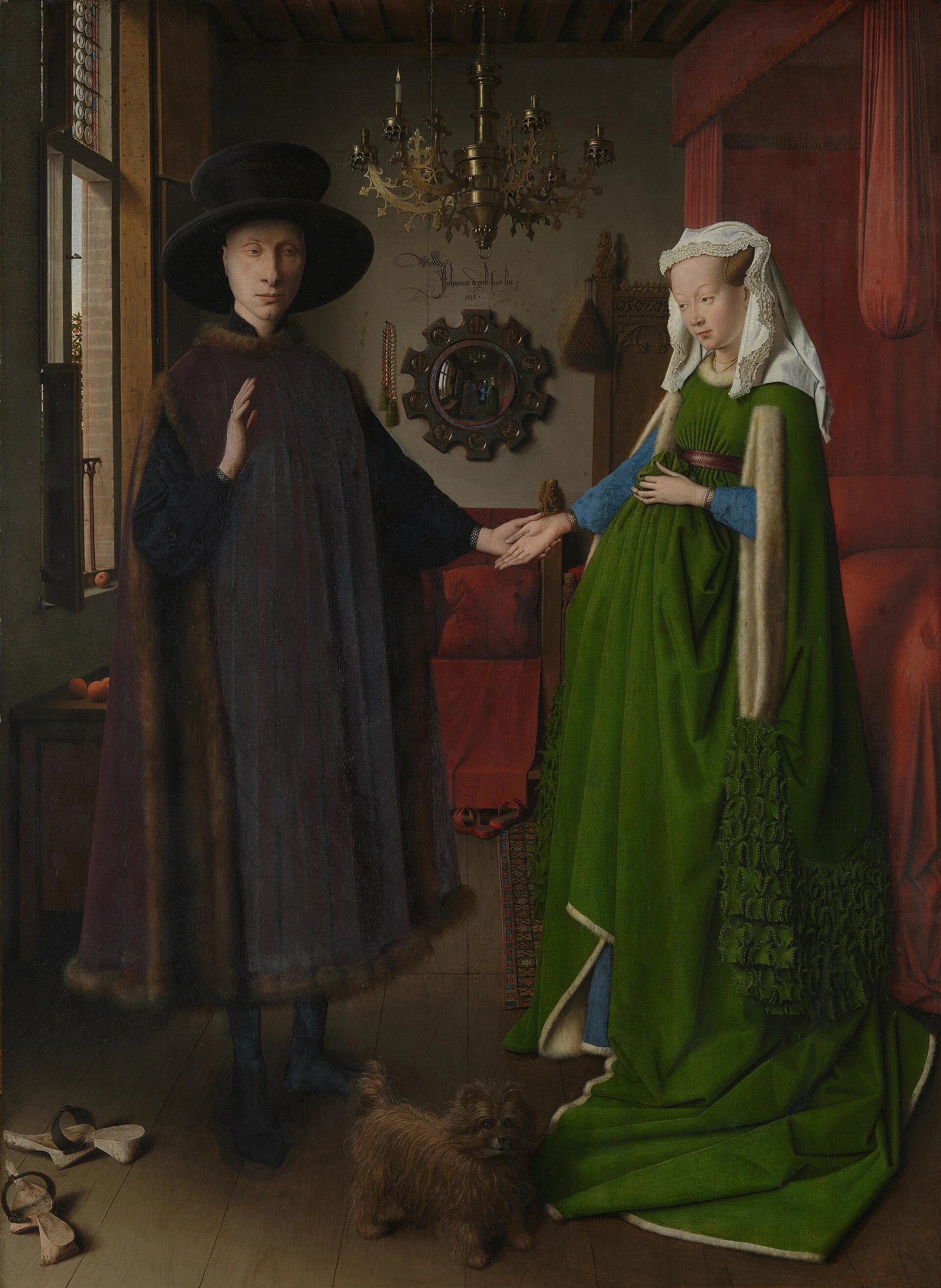
He also treats text as image. Signatures and inscriptions appear as material facts inside pictorial space, not merely labels outside it. The famous “Johannes de eyck fuit hic” reads like witness testimony and artistic self-assertion at once. As a result, the painting can certify reality while still staging ambiguity.
Spatially, he favors controlled interiors or measured landscape openings where viewpoint feels stable but never neutral. You are positioned as a careful observer, asked to decode symbolic density without being told exactly how to resolve it. That interpretive pressure is one reason these works remain alive in scholarship and public debate.
Why van Eyck still structures close looking
Van Eyck shaped the visual logic of the Northern Renaissance: precision tied to theology, material culture, and emerging notions of individuality. For example, later portraiture in the Low Countries and Germany inherits his insistence that likeness can include social argument, not just physical description.
His legacy is this durable link between visual beauty and evidentiary thinking. He makes close looking a historical method: details are not embellishments, but units of argument.
His impact also extends to how museums and viewers learn to look. He rewards slow attention. Under close viewing, small details behave like compressed essays on trade routes, household ritual, piety, and power. This is why his paintings remain foundational for art history teaching: they demonstrate that realism can be intellectually dense rather than merely descriptive.
Current technical imaging has only strengthened his reputation. Infrared reflectography and conservation studies reveal deliberate revisions under the paint surface, confirming that the apparent spontaneity of his detail is the result of calculated design. In other words, van Eyck’s realism is constructed argument, not passive transcription.
That is why his work stays central for contemporary viewers. He offers a model of visual literacy where beauty and evidence are inseparable. The painting pleases the eye, but it also trains judgment: what do we infer from objects, gestures, light, and text when social stakes are high?
For a broader path through Explainary, pair this page with Early Renaissance and Northern Renaissance, then compare van Eyck’s material clarity to later symbolic ambiguity in Symbolism. By contrast, the allegorical density of Hieronymus Bosch and the graphic severity of Albrecht Dürer push inference in different directions.
A useful sequence is to read Melencolia I after van Eyck, then test how symbolic compression differs from the moral theatricality of The Garden of Earthly Delights. In turn, you see that Northern realism was never one style but a field of competing visual logics.
Key works in Explainary
Associated movements
Continue with the art quiz to validate recognition, context, and comparison.