
High Renaissance
The Creation of Adam
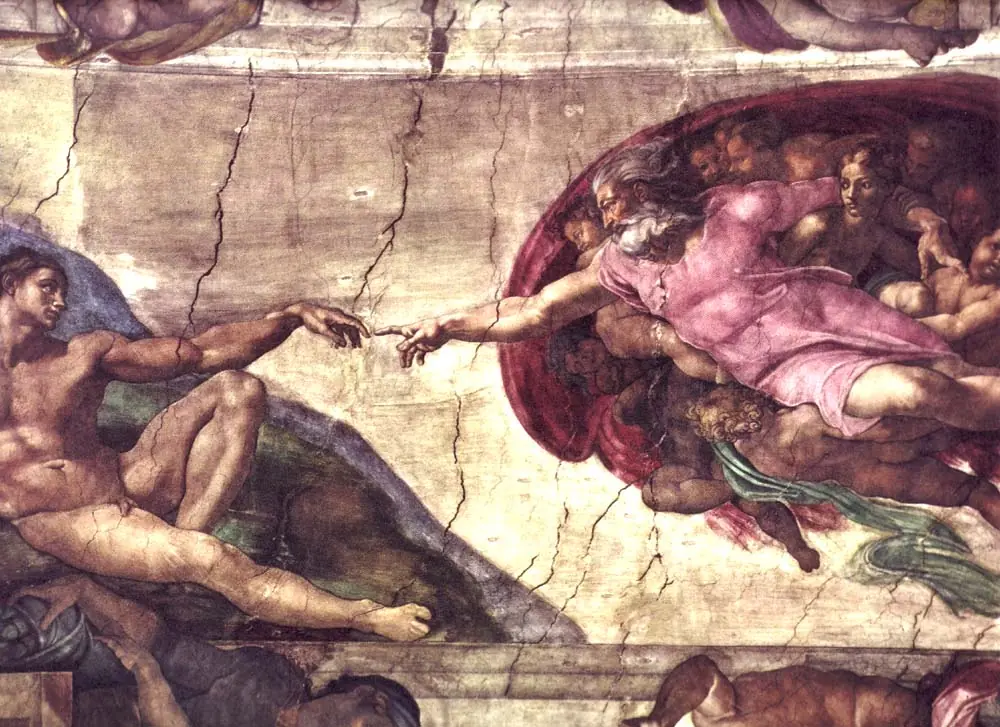
Most people remember the fingertips. Michelangelo wants you to feel the second just before life passes into Adam. Painted by Michelangelo on the Sistine Chapel ceiling between 1508 and 1512, The Creation of Adam is one of the most famous images in Western art because it is instantly legible and still surprisingly rich. Even without prior knowledge, you can read its basic drama at once: one body yields, one body rushes, and the gap between them becomes the whole point.
Start with the basic scene
This is not an isolated painting but one panel in the Genesis cycle of the Sistine Chapel, commissioned by Pope Julius II. Michelangelo places it within a larger sequence about creation, fall, and human destiny, yet he makes this particular scene unusually clear. Adam lies on the bare earth, heavy and unfinished. God arrives from the right in a dense mass of drapery and attendant figures, moving with a speed Adam does not yet possess.
The panel works so well because Michelangelo removes almost everything secondary. There is little landscape, little anecdotal detail, and no visual clutter. Your eye goes where it should go: first to the bodies, then to the hands, then to the tiny interval that keeps the act of creation suspended.
- Look first at Adam's relaxed arm and open hand.
- Then compare it with God's forward thrust from the right.
- Only after that focus on the narrow gap between the fingertips.
- Finally, notice how the attendants and drapery intensify God's momentum.
Michelangelo's intention
Michelangelo is not simply illustrating a Bible verse. His intention is to make creation feel like a transfer of force, intelligence, and breath before it is complete. Adam is not a dramatic actor here; he is potential waiting to be activated. God is not seated in distant majesty; he is a moving source of energy crossing space.
That is why the female figure tucked beneath God's arm has attracted so much attention. She is often read as Eve, not yet created, or as a figure of divine wisdom. The exact identification matters less than the role she plays inside the image: the divine side is packed with life, relation, and intention, while Adam is still singular, earthbound, and incomplete.
Why the hands matter so much
Many artists would have shown contact. Michelangelo leaves distance. That choice turns a familiar religious story into a visual problem the viewer can feel immediately. The life-giving act is imminent, but not yet fulfilled. The tiny gap becomes the place where anticipation itself takes form.
The famous hands, however, only work because the whole composition supports them. Adam's body opens outward and sinks into the ground. God's body is compressed, airborne, and directional. One side receives; the other side initiates. The almost-touch becomes unforgettable because every larger form in the fresco prepares it.
What the ceiling and the fresco change
The panel was painted in buon fresco on a ceiling, to be seen from below. That matters. Michelangelo had to make the scene readable at distance, which is why the bodies are monumental and the gestures so large. He does not rely on tiny narrative props; he relies on silhouette, anatomy, and directional force.
This is also where his sculptor's training becomes decisive. Muscles, limbs, and torsos are not just descriptive details. They are the architecture of meaning. In the language of the High Renaissance, the human body becomes the clearest instrument for showing order, energy, and spiritual significance at once.
One comparison that makes it clearer
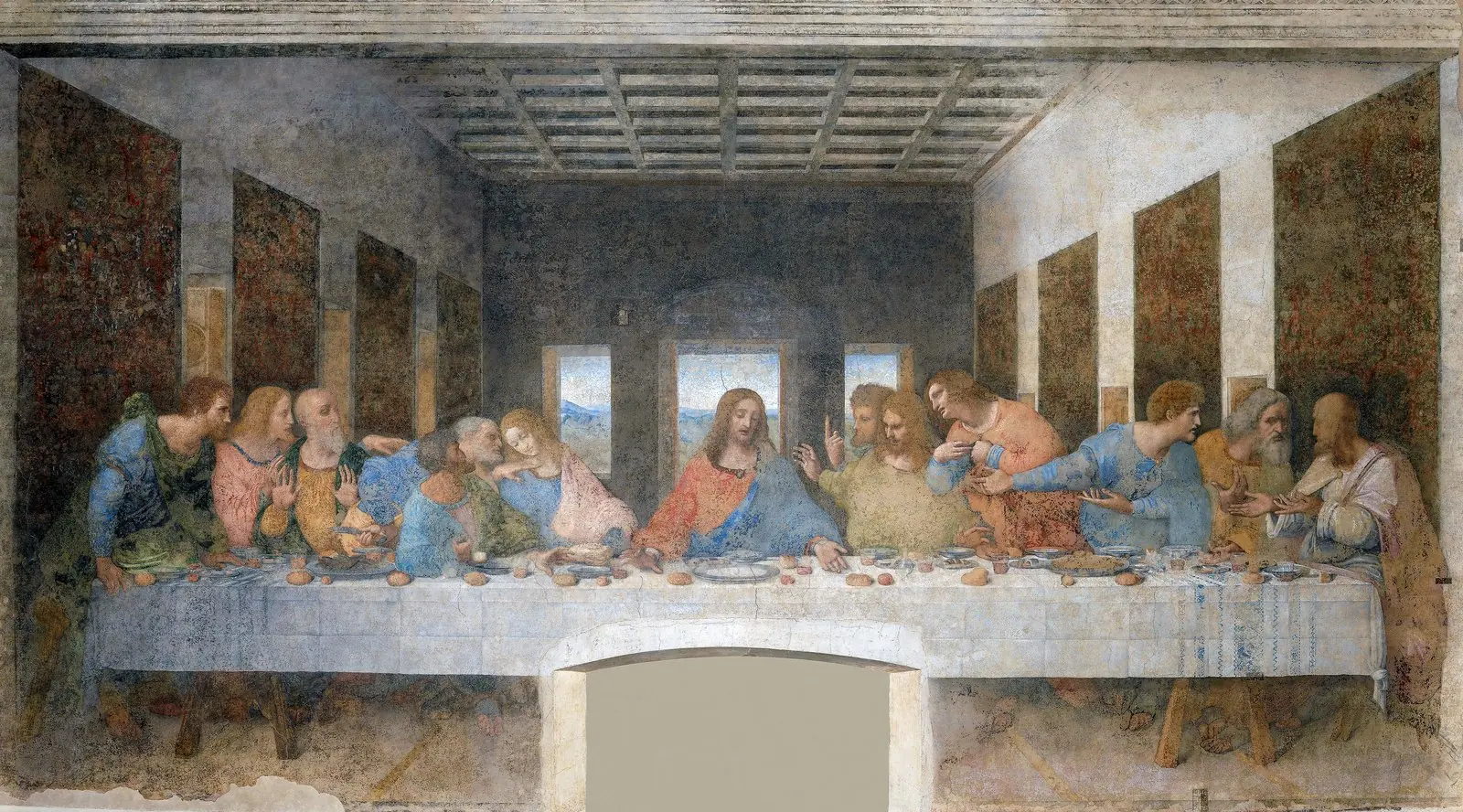
The best comparison is The Last Supper. Leonardo spreads tension across a room and a group of reacting apostles. Michelangelo condenses it into two bodies and a single charged interval. If you then want a broader Renaissance map, continue with The School of Athens and Vitruvian Man, where human form again becomes the vehicle for large ideas.
Why the panel remains so powerful
The Creation of Adam now appears everywhere from textbooks to advertising because it communicates fast. In a glance, viewers grasp relation, expectation, and nearness. But it lasts because quick legibility is only the beginning. The more slowly you look, the more carefully the entire panel reveals its logic.
That balance between immediate clarity and deeper structure is why the fresco keeps rewarding return visits: a first-time viewer can understand it, and a trained viewer still has real work to do. If you want to continue from here, move next to Michelangelo, the High Renaissance, or take the art quiz as a quick recognition test.
Explore more
Related works
Primary sources
Frequently asked questions
Michelangelo leaves a narrow gap so the scene feels imminent rather than completed. The distance turns creation into a physical sensation of suspense.
They are usually understood as heavenly attendants. The woman tucked beneath God's arm is often identified as Eve or as a figure of divine wisdom, though the panel does not depend on one fixed reading.
It is one of the central Genesis panels on the chapel ceiling, painted between 1508 and 1512 as part of Michelangelo's program for Pope Julius II.