
Renaissance
Vitruvian Man
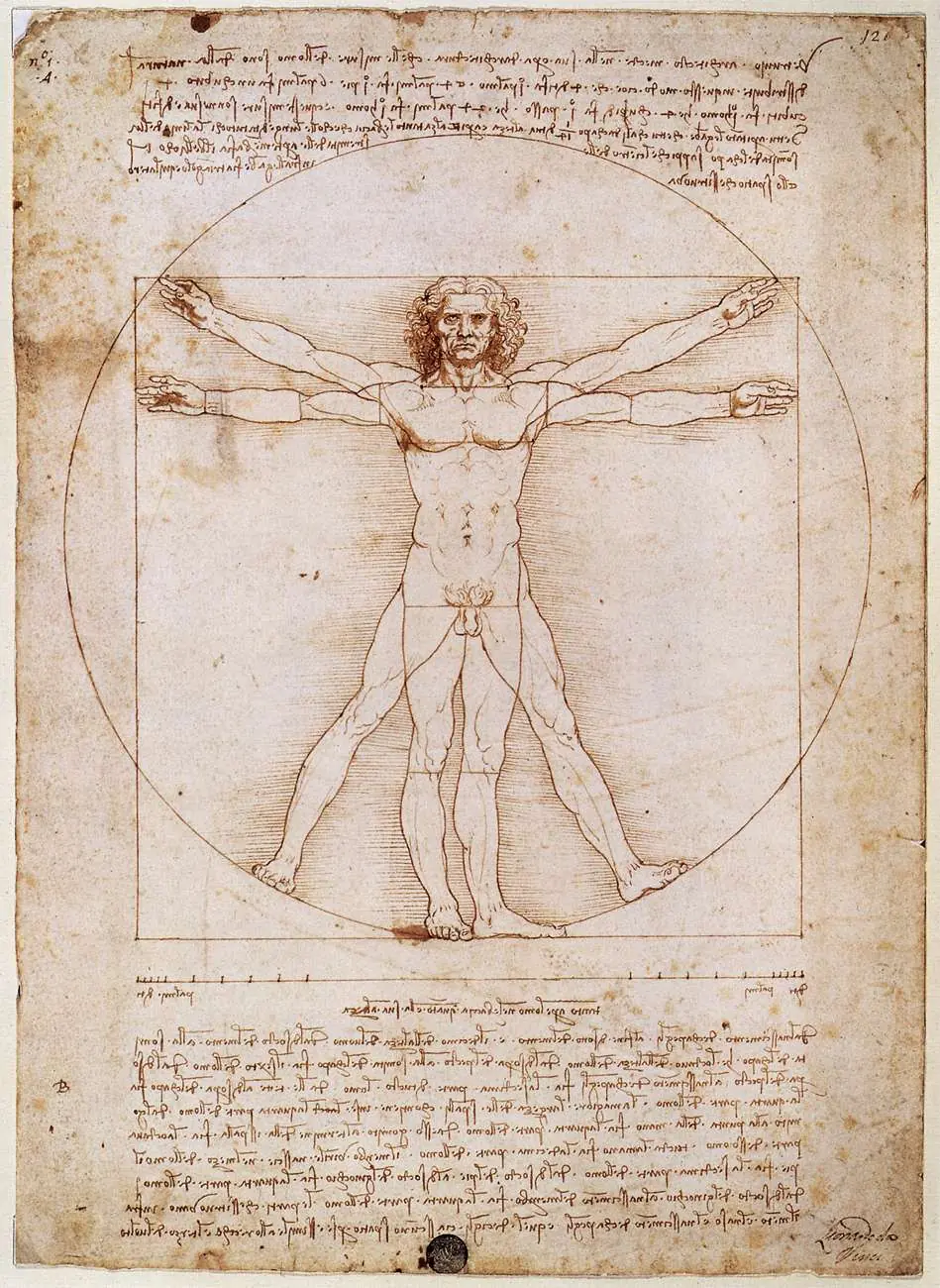
The world's most reproduced drawing is actually a notebook experiment. Vitruvian Man looks like a polished emblem, but Leonardo da Vinci built it as a test page: can ancient proportion rules survive direct observation of a body?
Milan around 1490: why proportion became a practical problem
Leonardo was working in Sforza Milan, where painting, architecture, military engineering, and court spectacle all depended on measurement. Revisiting Vitruvius was not antiquarian fashion. It was a way to build a shared design language across disciplines.
That context explains the format. Instead of a monumental panel, he chooses a compact sheet where text and drawing can correct each other in real time.
Read the full sheet, not just the famous silhouette
The figure is doubled: one stance aligns with the square, another opens into the circle. Limb endpoints shift, and so do geometric centers. Leonardo's notes around the figure list ratios and clarify how each construction should be interpreted.
Image and writing are inseparable here. The drawing is not a decorative illustration of theory; it is where theory gets tested.
Two centers, two measurement logics
The square uses one bodily anchor, while the circle pivots around another. That mismatch is the key intellectual move. Leonardo accepts that one frozen pose cannot satisfy every proportional claim at once, so he layers positions instead of forcing a false harmony.
This is why the work remains so singular: it stages conflict between rules and observation, then makes that conflict productive.
Try a concrete check while looking: follow the horizontal spread of the arms in the square pose, then the raised limbs in the circular pose. The shift is small but decisive. It proves Leonardo is modeling compatibility between systems, not claiming that one contour can absorb every proportional demand.
Vitruvian Man endures because it treats proportion as a problem to solve, not a formula to memorize.
What reproductions often erase
Mass reproductions usually crop the handwriting, paper edges, and tonal variation in the ink. In Venice, where the original is shown only intermittently for conservation, the full sheet reads less like a logo and more like a research page with visible revisions.
That material reality matters. It replaces the myth of instant genius with an observable workflow: observe, measure, annotate, revise.
Why it still teaches modern readers
Vitruvian Man links art practice to knowledge production. It demonstrates how drawing can function as a reasoning tool for architecture, medical illustration, and design thinking, where a model is valuable only if it clarifies structure.
Its conservation history strengthens that point. Because the original can only be displayed intermittently, most people first meet the image as a crop. A good reading therefore reconstructs the full sheet, including notes and paper context, before drawing conclusions.
If this reading feels clearer now, use the art quiz to test whether you can identify Leonardo quickly among visually adjacent works.
Explore more
Related works
Primary sources
Frequently asked questions
It visualizes a Renaissance claim: the body can be measured as a structured system linking nature, architecture, and mathematics. Read it as a research page, not a decorative icon.
Leonardo tests Vitruvius's proportion rules by mapping two body positions to two geometries. The square and circle imply different centers, so they reveal different measurement logics.
It is partly empirical and partly idealized. Leonardo observed anatomy directly, but he also aimed for conceptual order, not modern biometric exactness.