
Neoclassical Painting
The Death of Marat
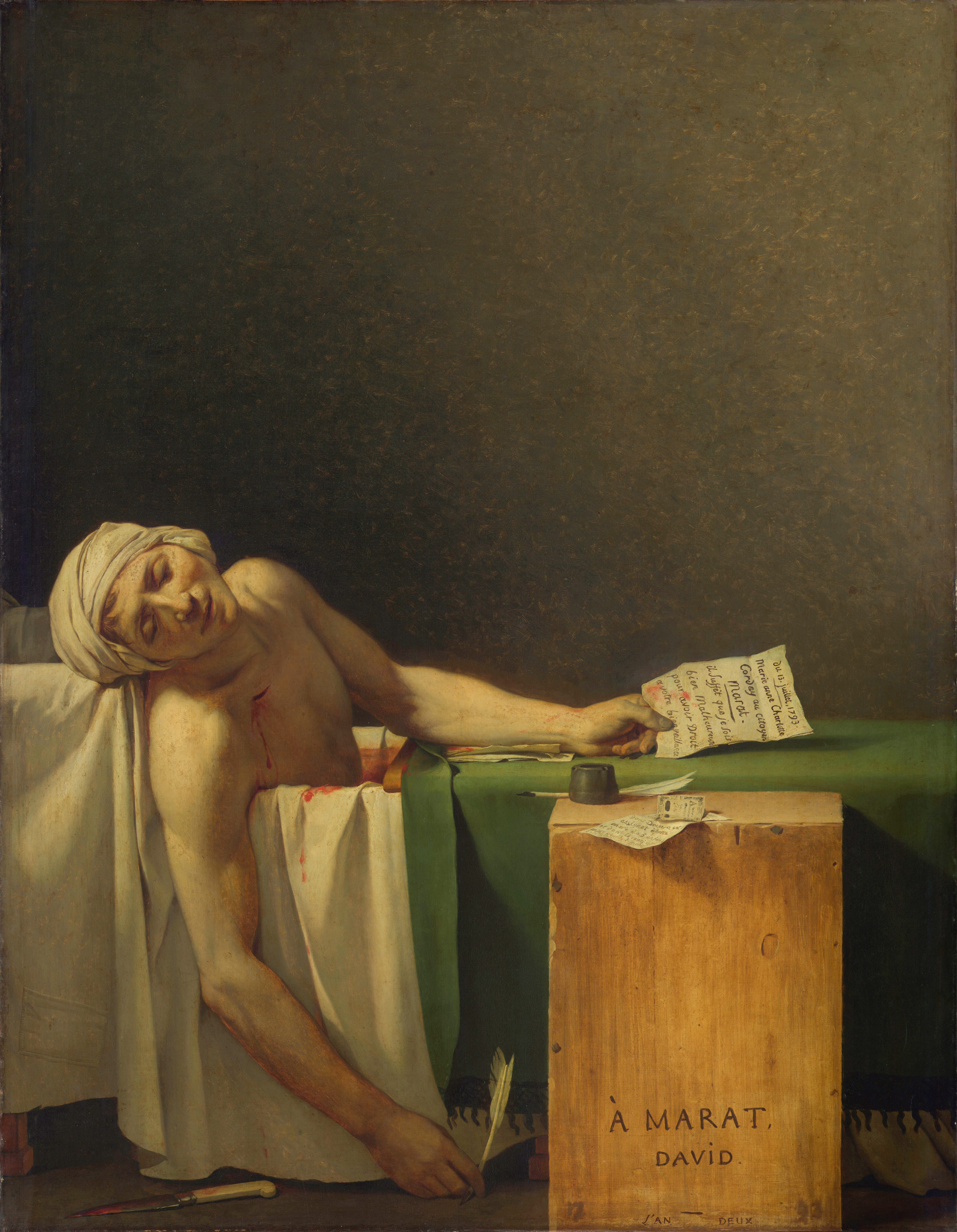
David paints a murdered revolutionary with the calm of a sacred image. In The Death of Marat, Jacques-Louis David turns a fresh political assassination into something closer to a secular martyr than a news report. Marat is already dead, the pen is still in his hand, and almost everything not essential has been cut away.
1793: a contemporary murder treated like history painting
The subject is not ancient Rome or Greek philosophy. It is a killing that had just happened in Paris. On July 13, 1793, Jean-Paul Marat was stabbed by Charlotte Corday while working in a medicinal bath. David knew Marat, shared the Revolution's political world, and responded quickly by painting a public memorial rather than a private lament.
History painting had long claimed its highest seriousness through biblical and classical subjects. David gives the same scale and gravity to a contemporary political death. Large painting no longer has to borrow authority from antiquity before addressing the present.
Why Marat is in a bath
Marat was not placed in a tub for dramatic effect alone. He suffered from a severe skin condition and often worked while seated in a medicinal bath, with papers, pen, and writing board close at hand. David keeps that fact because it anchors the picture in the real conditions of the murder before the image begins to simplify and elevate them.
The bath still explains the scene, but it also becomes a stripped stage. The box beside Marat works as desk and monument. The letter in his hand recalls the access Corday requested. The knife lies below. Nothing is crowded, yet nothing important is missing.
The assassin disappears, the martyr remains
David removes the murderer from the scene. Charlotte Corday is gone, the room is almost empty, and the violent event has already become aftermath. David does not narrate the whole crime. He clears the room so that Marat's body, wound, and writing tools carry the whole political charge.
There the painting also borrows some of its gravity from Christian images of lamentation and entombment. The dropped arm, the exposed wound, the white cloth, and the almost serene face give Marat a dignity that far exceeds police fact. David does not paint a saint, but he paints a modern political body with the composure once reserved for sacred suffering.
A modern event in neoclassical form
The power of the picture depends on how little David uses. The background is bare. The contour is hard. The body is simplified and idealized. Marat's skin appears cleaner, younger, and calmer than real life would have allowed. Neoclassicism here is not antique costume. It is a method for making a body and a public meaning unmistakably legible.
The Death of Marat shows that the same visual discipline David used in The Oath of the Horatii and The Death of Socrates can be applied directly to a current political event. Antiquity is no longer required as an intermediate screen. Modern history can receive the same hard clarity.
From Socrates to Marat
Set the picture beside The Death of Socrates and David's shift becomes obvious. In the earlier work, a philosopher chooses death while still teaching, and the antique setting gives conviction a formal stage. In The Death of Marat, the body is not choosing death but bearing the result of murder. The gesture is no longer active and upward. It has collapsed into silence.
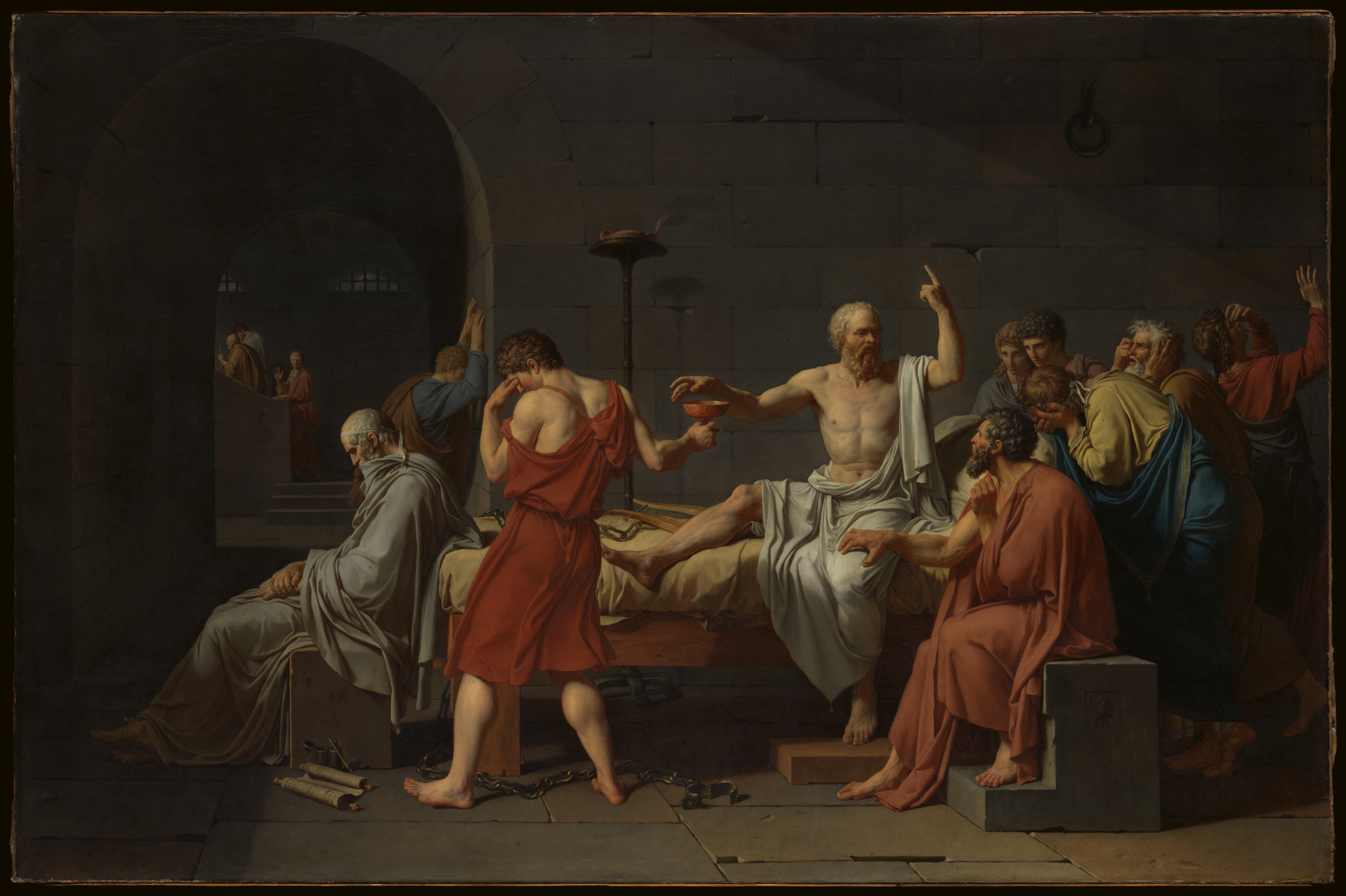
In both works, David arranges bodies so that meaning reads at once. He strips away noise, distributes emotion, and uses pose to separate steadiness from collapse. What changes is the political location of that clarity. Socrates belongs to moral example. Marat belongs to revolutionary memory.
Politics reduced to one body
The Death of Marat is propaganda in a high form, and it stays compelling because David does not rely on clutter, spectacle, or slogan. He reduces the event until it becomes unforgettable. Later political painting can take other routes, as in The Third of May 1808, where Goya fills the scene with terror and exposure. David does the opposite. He makes politics look bare, final, and already monumental.
Explore more
Then try the art quiz.
Primary sources
- Royal Museums of Fine Arts of Belgium: The death of Marat exhibition
- Royal Museums of Fine Arts of Belgium: collection search for Marat
- Smarthistory: Jacques-Louis David, The Death of Marat
- Encyclopaedia Britannica: The Death of Marat
- Encyclopaedia Britannica: Jacques-Louis David
- Wikimedia file metadata
Frequently asked questions
Because Marat often worked while sitting in a medicinal bath that eased his skin condition. David keeps that fact so the image remains grounded in the murder's real circumstances before it becomes political icon.
David cuts the assassin out so the picture concentrates on the dead body, the wound, the letter, and the tools of writing. The painting is built as a martyr image, not as a complete report of the crime.
Because David gives a contemporary political murder the gravity and clarity once reserved for biblical or antique history painting. He shows that modern politics can be made instantly monumental.