
Impressionism
Étretat, Coucher de Soleil
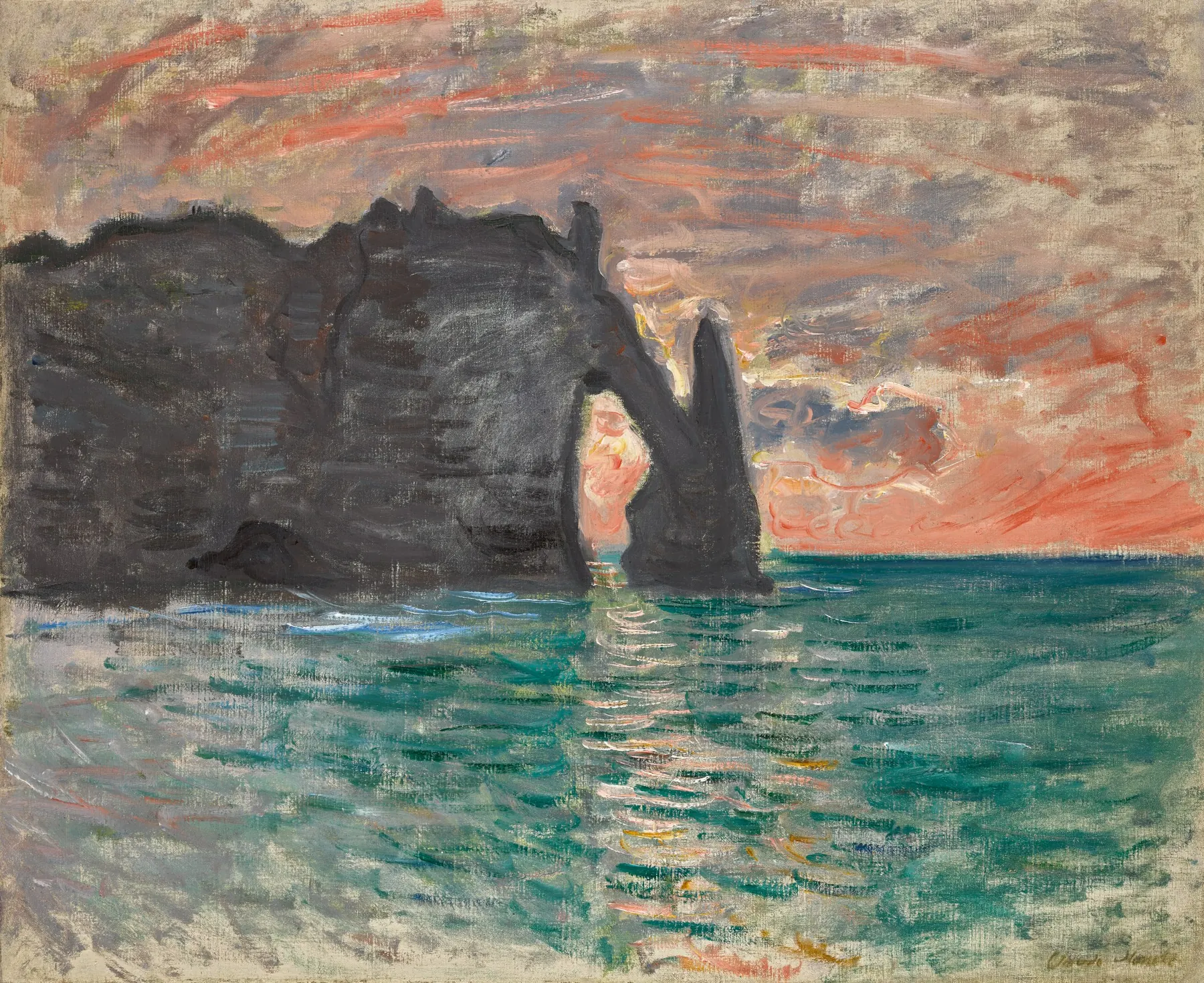
This is not a sentimental postcard sunset. Monet treats the last light at Étretat as a time-critical visual problem where each color decision has to be made before the scene reconfigures itself.
Sunset as method under pressure
Most landscape painting assumes relative temporal stability, but sunset removes that comfort: values compress, hues shift, and sea-sky relations mutate in minutes. Monet does not hide this volatility; he organizes it. Broad anchoring masses keep structural coherence while smaller chromatic accents capture transient events before they vanish. That balance explains why the panel feels immediate without becoming loose or anecdotal. His intention is not to "paint emotion" in the abstract but to render perceptual change in real time, with cliffs functioning as stable instruments against atmospheric drift.
Color as duration, not decoration
Narrative here is primarily chromatic. Warm intervals challenge cooler fields, then retreat through measured gradients. Because warm and cool are calibrated rather than oppositional, the eye keeps recalculating light source and reflection pathways, and the painting reads as temporal process rather than static view. This is where Monet's serial intelligence becomes visible: the same coast can generate different optical grammars depending on hour, moisture, and viewpoint.
Étretat as comparative laboratory
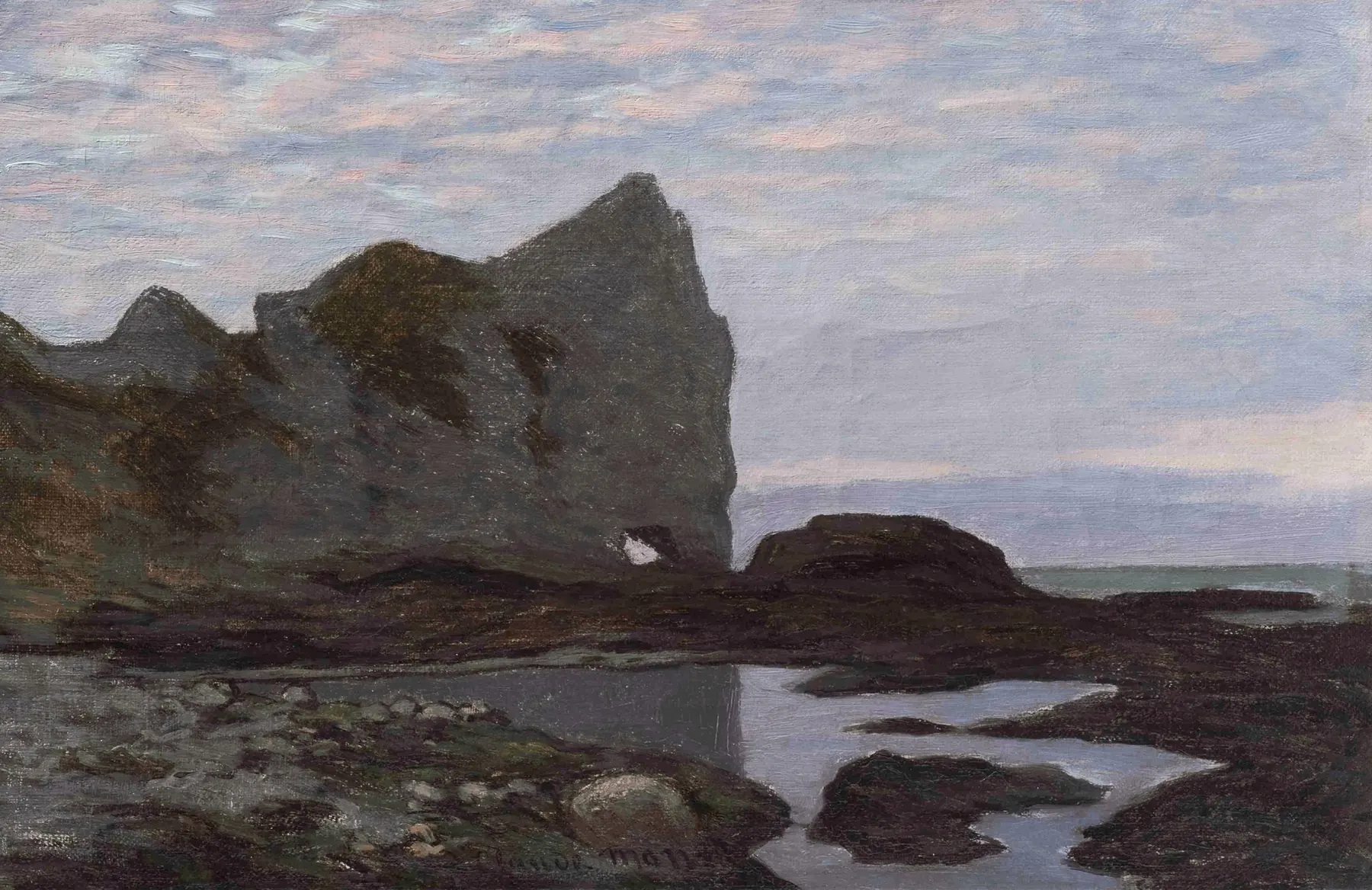
Read this canvas with Étretat (1864), The Manneporte near Étretat, and Étretat: The Beach and the Falaise d'Amont: same site, different problems. Monet is not repeating a motif for recognition value; he is running controlled comparisons across weather states and visual tempo. That is one reason Impressionism became historically decisive: each painting functions less as a final statement than as one state in an ongoing inquiry.
Sunset as a technical constraint
Dusk gives painters only a short workable interval. Instead of "capturing a mood" in vague terms, Monet has to make fast, pre-structured decisions: value hierarchy first, cliff silhouette second, chromatic intensification last. The order matters because light drops by the minute. What looks lyrical is also procedural.
This is where nineteenth-century painting technology matters. Portable tube paints and repeat visits to the same site let Monet test nearly identical motifs at different hours and weather states. The canvas therefore belongs to a disciplined time-study practice, not to a single spontaneous sunset impression. That discipline keeps the scene analytical rather than merely atmospheric.
The sheet also clarifies Monet's color economy at low light. Instead of multiplying hues, he compresses the palette so warm accents carry timing information and cooler masses preserve spatial orientation. This restraint is why the painting still reads clearly even as the scene approaches visual loss at dusk conditions.
Monet paints sunset as a disciplined negotiation between speed and structure.
If Étretat, Coucher de Soleil is clearer now, try the art quiz and see whether you can spot works by Claude Monet in seconds.
Explore more
Related works
Primary sources
Frequently asked questions
Because Monet organizes the canvas through measurable relationships in value and temperature. Emotion comes from formal precision under unstable light, not from anecdotal storytelling.
Compare it with Étretat (1864), The Manneporte near Étretat, and Étretat: The Beach and the Falaise d'Amont. You will see how Monet changes viewpoint and light state while keeping geological structure as a constant.