
Impressionism
Étretat: The Beach and the Falaise d'Amont
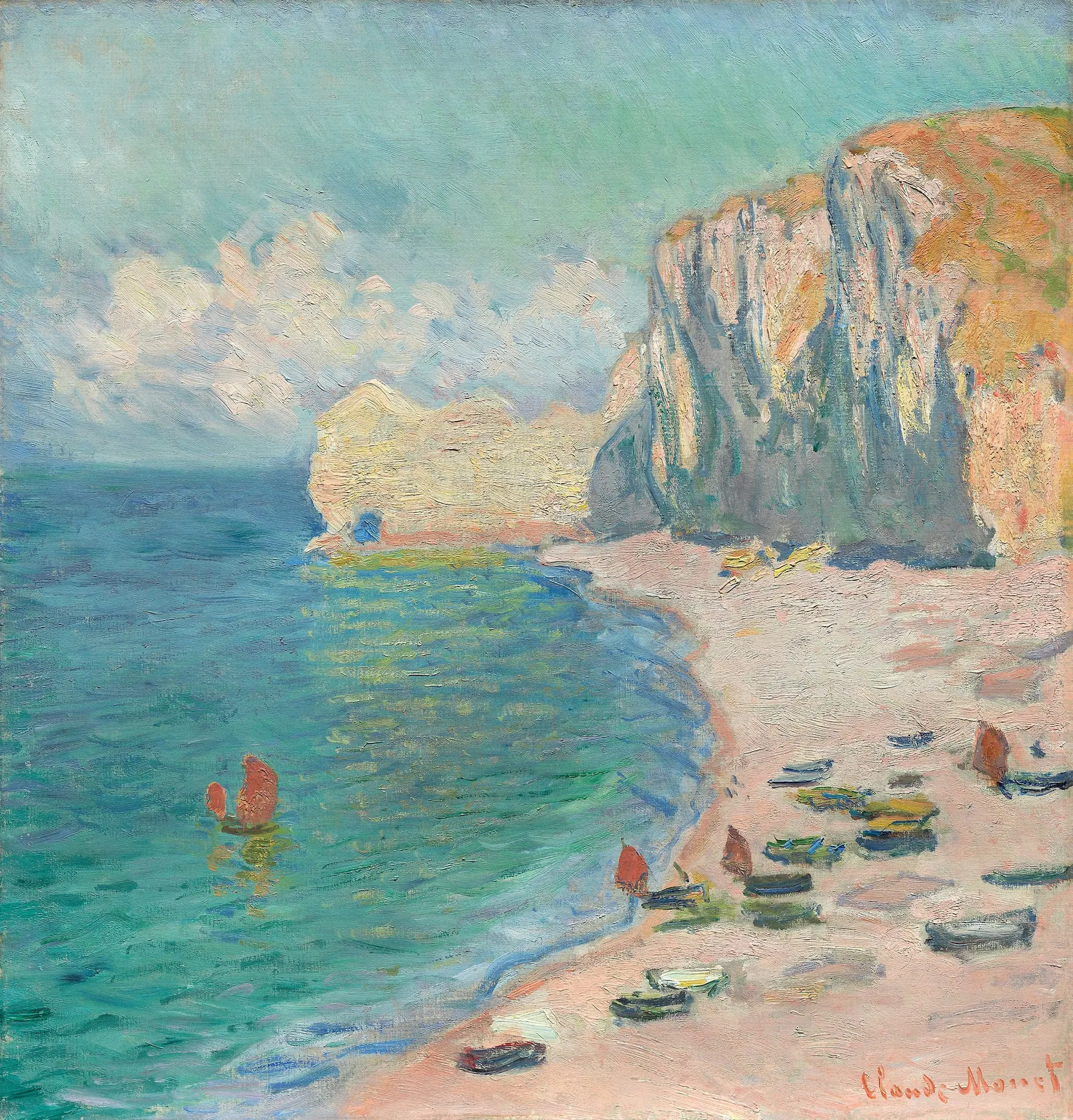
Monet lowers the horizon of experience here. Instead of offering a panoramic postcard of Étretat, he places the viewer almost at tide level, where geology, weather, and movement are felt as competing forces rather than calmly observed from a distance.
Low vantage as method, not effect
In many coastal paintings, an elevated viewpoint gives immediate overview and narrative comfort. Monet does the opposite: he positions the eye close to shore so the Falaise d'Amont gains physical weight and the foreground tide bands become active compositional engines. The result is strategic, not atmospheric accident. The cliff acts as a vertical anchor against the sea's horizontal spread, while short broken strokes in water and sky keep the surface unstable without collapsing the structure. Monet's intention is to turn coastline into lived perception rather than scenic inventory, and his method is to lock a clear scaffold (cliff, horizon, shoreline arc) before letting light and water vary inside it.
Time in the shore bands, knowledge through series
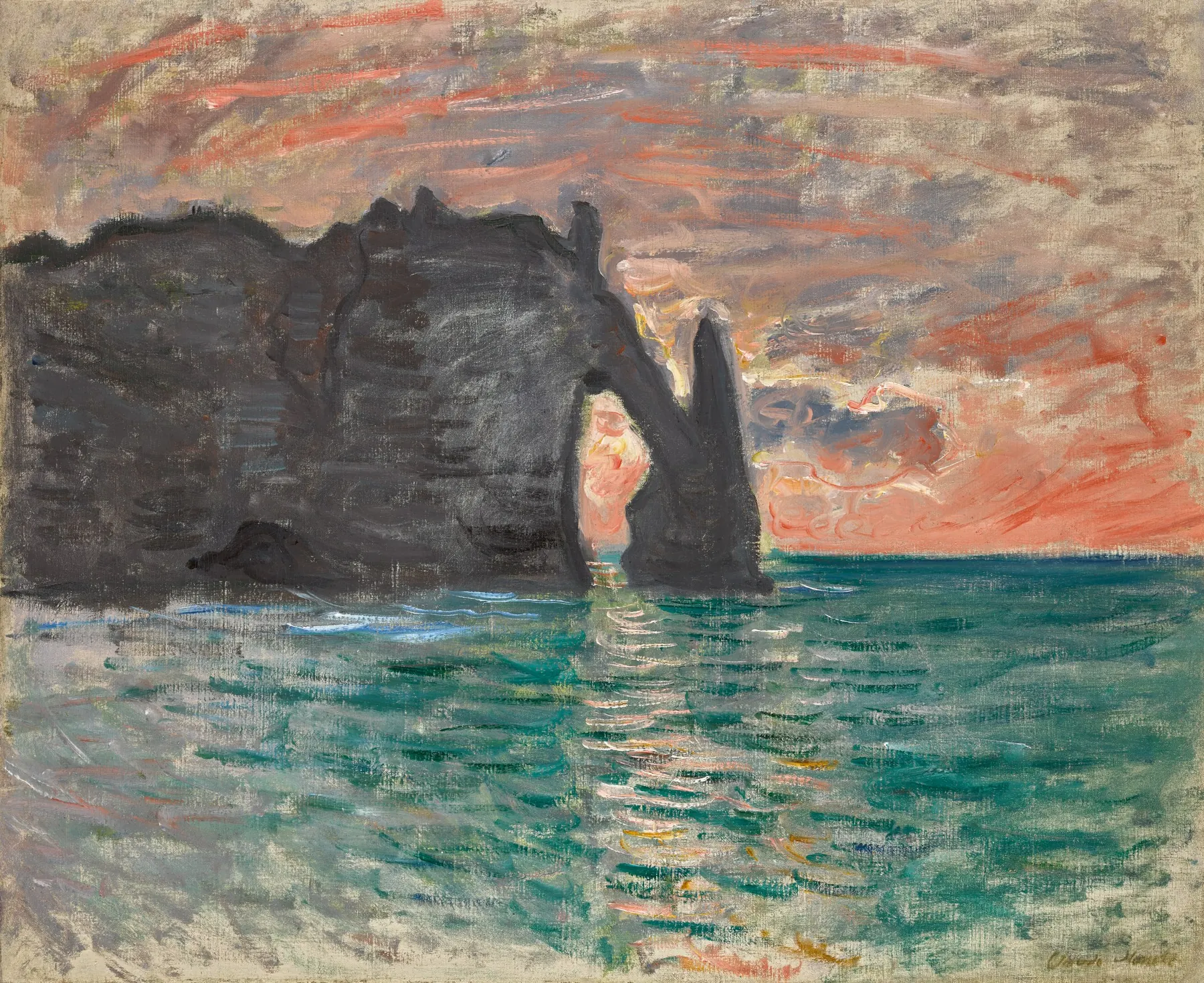
The beach strips read as temporal evidence: wet and dry zones, reflective passages, and wave residues suggest a moving interval, not a frozen moment. That temporal logic explains why this canvas works best inside Monet's Étretat sequence with Étretat, Coucher de Soleil, The Manneporte (Étretat), Étretat (1864), and The Manneporte near Étretat: same site, different visual problems. Instead of producing one definitive image of place, Monet builds analysis by controlled variation of distance, silhouette, atmosphere, and tempo.
From fishing coast to painted destination
By the 1880s, Étretat is no longer only a working shoreline; rail access from Paris and seaside tourism have turned it into a destination. Monet knows that risk: famous sites can collapse into postcard formulas. Here he resists that trap by avoiding panoramic comfort and forcing the eye to work from tide bands upward to the cliff mass. The place stays specific, but the image refuses cliche.
That choice also matters for how he paints geology. The chalk cliff is not a static monument; moisture, erosion, and shifting sea reflections continually alter its edge contrast. Monet treats the coast as a changing system, which is why the canvas feels observational rather than theatrical.
Seen in the broader history of nineteenth-century seascape, this matters. Academic marine painting often staged coastlines as heroic theater or narrative backdrop. Monet strips that rhetoric away and treats shoreline evidence itself as the subject: tide marks, unstable reflections, and cliff edge shifts. The painting's authority comes from this refusal of spectacle-first composition.
At Étretat, Monet shows that sensory immediacy works best when structural discipline is uncompromising.
If Étretat: The Beach and the Falaise d'Amont is clearer now, try the art quiz and see whether you can spot works by Claude Monet in seconds.
Explore more
Related works
Primary sources
Frequently asked questions
It proves that viewpoint itself is a working variable. By moving lower on the beach, Monet changes scale, weight distribution, and the emotional register of the coast.
Both, and that balance is the point. The cliff gives structural order while changing light creates optical volatility; Monet keeps both active at once.