
Impressionism
Étretat (1864)
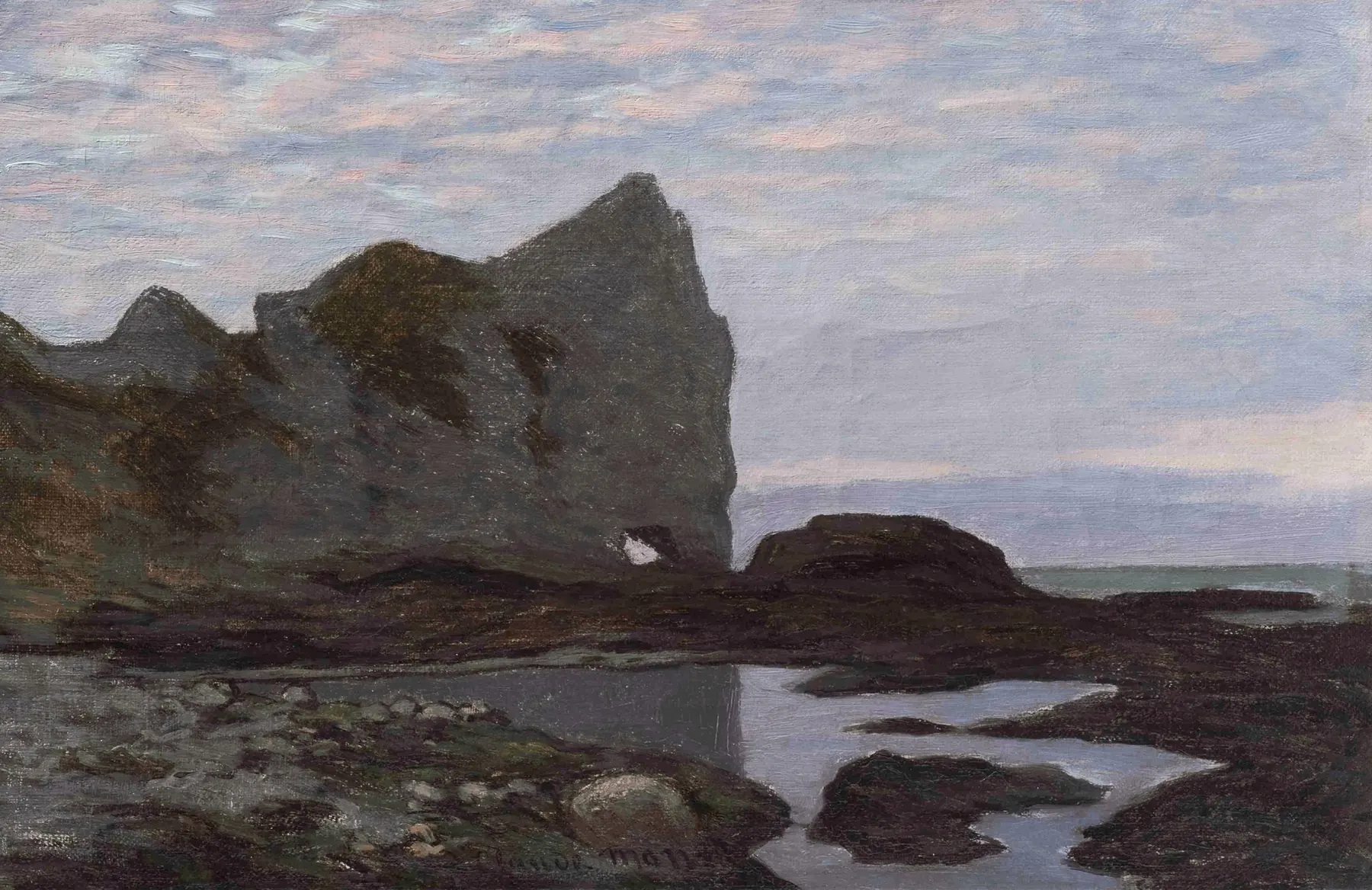
Étretat (1864) sits at a productive threshold. Monet has not yet reached full Impressionist fluency, but he is already moving away from static topographic description toward active perceptual analysis, using one stable coast to test how light, weather, and edge behavior can continuously reorganize what a viewer thinks is "the same" landscape.
Transition painting, not apprentice exercise
In 1864, Monet still works with inherited landscape discipline - firm horizons, readable mass blocks, and structurally reliable geology - yet he uses that stability to run a new experiment. Atmosphere is no longer decorative backdrop; it becomes a working variable that alters sea, cliff, and sky relations from moment to moment. That is the painting's historical value: it records the shift from representational certainty toward inquiry-based seeing. Étretat is ideal for this because it offers fixed forms (cliffs, shoreline architecture) under unstable conditions (tide, moisture, changing light), so method can be observed clearly.
Serial logic before style becomes iconic
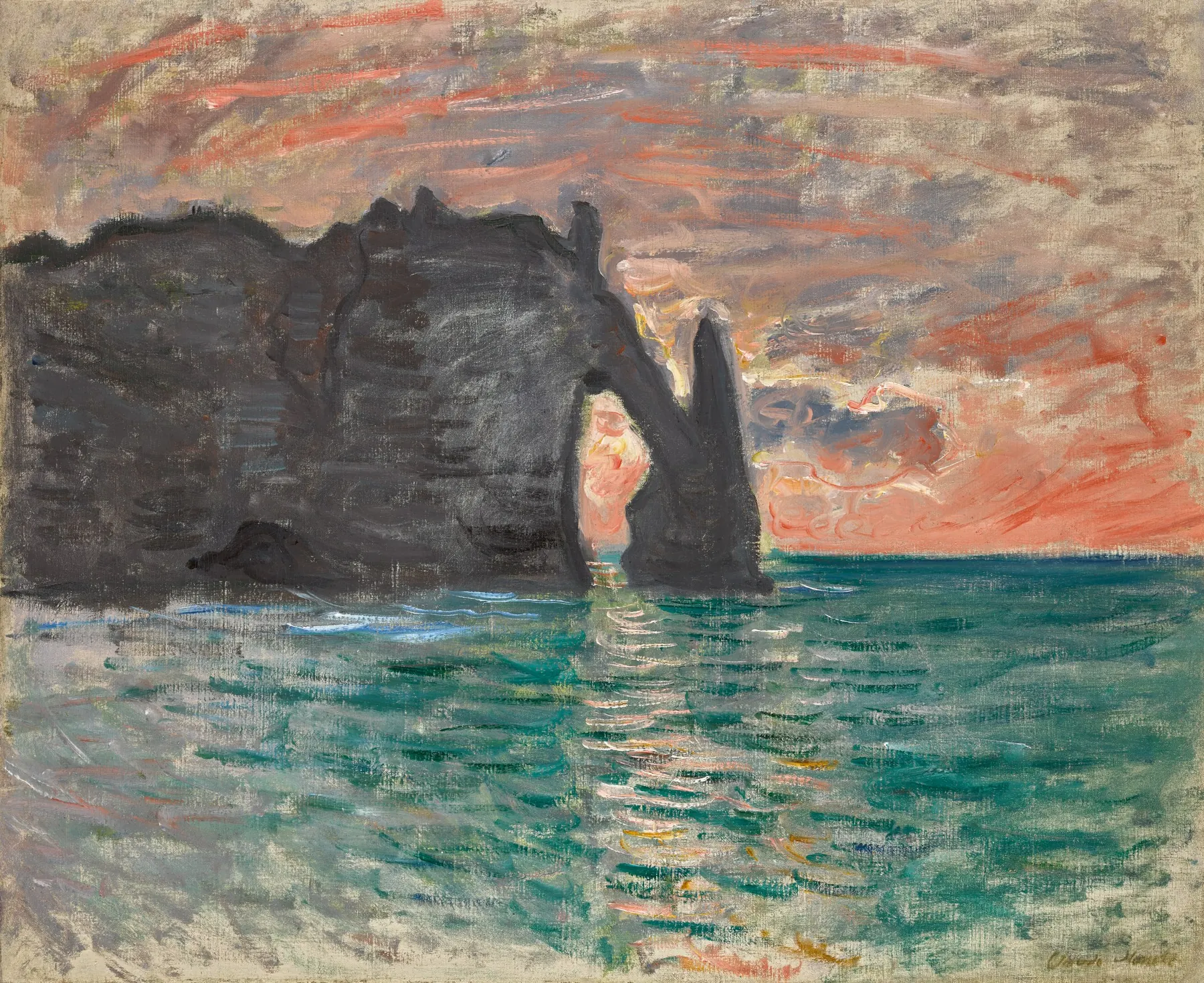
The canvas gains force when compared with Étretat, Coucher de Soleil, Étretat: The Beach and the Falaise d'Amont, and The Manneporte (Étretat). Seen across that sequence, you can track Monet's procedure hardening over time: more radical viewpoint decisions, tighter color-time calibration, and clearer use of repeated motif as an investigative framework. Early works matter precisely because they reveal the mechanics before the public image of "Impressionism" flattens those mechanics into style labels.
A young painter between Salon rules and field observation
In 1864, Monet is not yet the canonical Monet. He still needs paintings that remain legible within Salon-era expectations: stable structure, identifiable motif, and controlled finish. That pressure explains why this canvas keeps firmer scaffolding than his later Étretat works. The innovation is present, but it is threaded through an accepted visual syntax rather than announced as rupture.
It also helps explain the method. Like many painters of the period, Monet could combine on-site studies with studio consolidation to lock composition and tonal balance. Seen this way, the work is not hesitant; it is strategic, built at the intersection of career constraints and emerging perceptual ambition. It documents how he keeps atmospheric change visible without sacrificing geological clarity.
This transitional logic matches what we know about Monet's early formation around Normandy coast studies and open-air practice before full Impressionist recognition. He is already testing fast atmospheric notation, but he still protects structural readability for contemporary viewers. Étretat (1864) is therefore less a preliminary sketch than a negotiated professional statement within a competitive exhibition culture.
In 1864, Monet is already using Étretat less as scenery than as a laboratory of perception.
If Étretat (1864) is clearer now, try the art quiz and see whether you can spot works by Claude Monet in seconds.
Explore more
For stronger comparison methods, read How to Understand a Painting and Why Art Goes Viral.
Related works
Primary sources
Frequently asked questions
Not entirely. It keeps the structural discipline of earlier landscape painting, while already moving toward Impressionist priorities: variable light, freer brushwork, and perceptual immediacy.
Because the comparison reveals method. A stable coastal motif lets Monet test time, weather, and viewpoint repeatedly, then refine that serial logic over two decades.