
Romanticism
The Fighting Temeraire
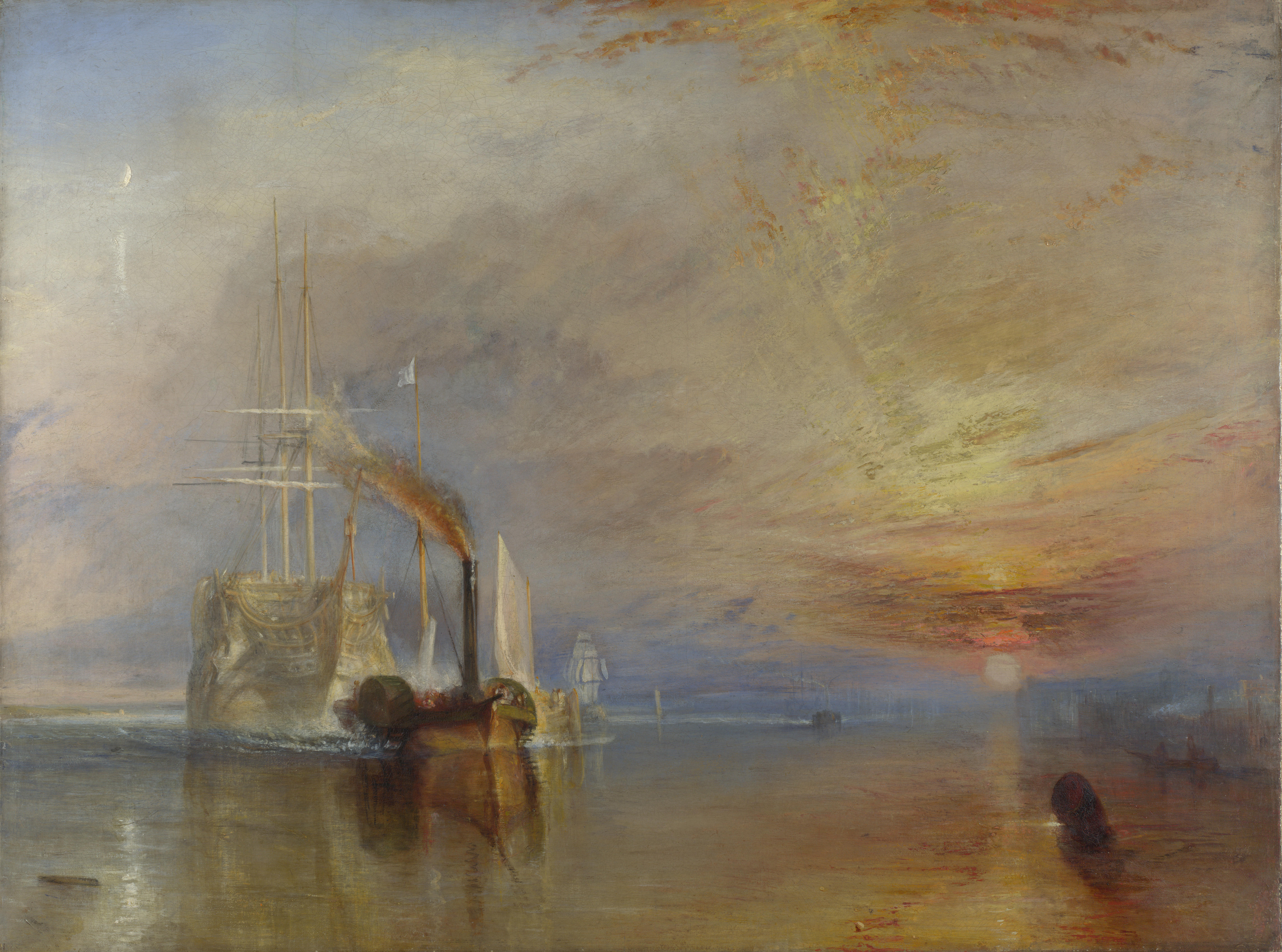
J. M. W. Turner makes a famous warship look like a white apparition, pulled into the industrial age by a squat black steam tug. The Fighting Temeraire is often described as a farewell to the age of sail, but the painting is sharper than simple nostalgia. It stages a collision between memory and machinery. The old ship carries Trafalgar, naval pride, and heroic scale; the tug carries steam, work, smoke, and the future.
A warship turned into a ghost
The ship on the left is HMS Temeraire, a 98-gun warship launched in the 1790s and remembered for her role at the Battle of Trafalgar in 1805. Turner shows her at the end of her useful life, towed along the Thames toward Rotherhithe, where she would be broken up for timber and scrap. The historical event is prosaic: a redundant vessel sold out of naval service. The image Turner makes from it is anything but prosaic.
The Temeraire glows in pale white and gold, almost weightless, as if she were already half memory. Her masts rise into the evening air like ceremonial remains. She is large, dignified, and strangely silent. In front of her, the tug is dark, low, smoky, and practical. Turner does not need a crowd, a battlefield, or a theatrical gesture. The drama comes from the relation between two kinds of power: the old power of sail and cannon, the new power of coal and steam.
The last journey becomes a public image
When the painting appeared at the Royal Academy in 1839, the Temeraire was not an anonymous ship. She belonged to a national memory of Trafalgar and Nelson, even though Turner was painting her decades after her moment of military fame. The National Gallery notes that the real vessel had been stripped of much of what Turner restores in paint. The artist gives her back the vertical dignity of masts and rigging because he is not documenting a towing operation. He is shaping a public farewell.
Turner alters fact to clarify meaning. He moves the scene toward ceremony: the sunset burns behind the journey, the water reflects gold, the old ship glides rather than lurches, and the tug's smoke cuts through the air with blunt modern force. The painting holds admiration and replacement in the same view.
Why the tug dominates without being large
The steam tug is small, but it controls the picture. Its black body sits low in the water, its funnel throws smoke, and its motion gives the larger ship no choice. Turner makes scale and agency diverge. The Temeraire dominates visually, yet the tug has the power to move her. The painting's pressure comes from that split: visual grandeur on one side, practical command on the other.
The tug is not a villain. Turner had a complicated, alert relation to modern technology, which becomes even clearer in Rain, Steam, and Speed. Here, steam power is ugly compared with the luminous ship, but it is also real, energetic, and irreversible. The painting does not say that modernity is evil. It says that modernity can arrive without ceremony and still reorder everything.
Sunset, moonrise, and the age of sail
The right side of the canvas is flooded with sunset. Orange, copper, blue, and white turn the sky into an emotional field, not a neutral backdrop. The old ship moves toward that glow, while a pale crescent moon rises at the upper left. Turner uses the sky to hold several times at once: the day ending, an era ending, and another cycle beginning.
The painting belongs strongly to Romanticism. The subject is modern, but the treatment is not a clean report on transport technology. Turner translates a historical transition into atmosphere, color, and scale. The ship is a fact; the light makes it a memory.
Turner edits reality to sharpen the image
Several details are deliberately unfaithful to the practical record. The ship would not have looked exactly as Turner shows it, and the direction of the sunset does not behave like a strict map of the Thames. These liberties do not weaken the painting. They reveal Turner's method. He is less interested in reconstructing the tow than in making visible the feeling of being present at the end of one historical world.
The picture avoids simple sentimentality because each element keeps its limit. The Temeraire is beautiful, but she is not returning to battle. She is being dismantled. The tug is ungainly, but it performs the work. The sunset is magnificent, but it is a sunset. Turner lets the image mourn without pretending that the past can continue unchanged.
Beside Rain, Steam, and Speed
Read beside Rain, Steam, and Speed, The Fighting Temeraire becomes even more precise. In the later railway painting, Turner pushes the viewer into modern velocity. The train arrives through rain, vapor, and unstable light. In The Fighting Temeraire, modernity is slower, darker, and more ceremonial. Steam does not race toward us; it pulls the past away.
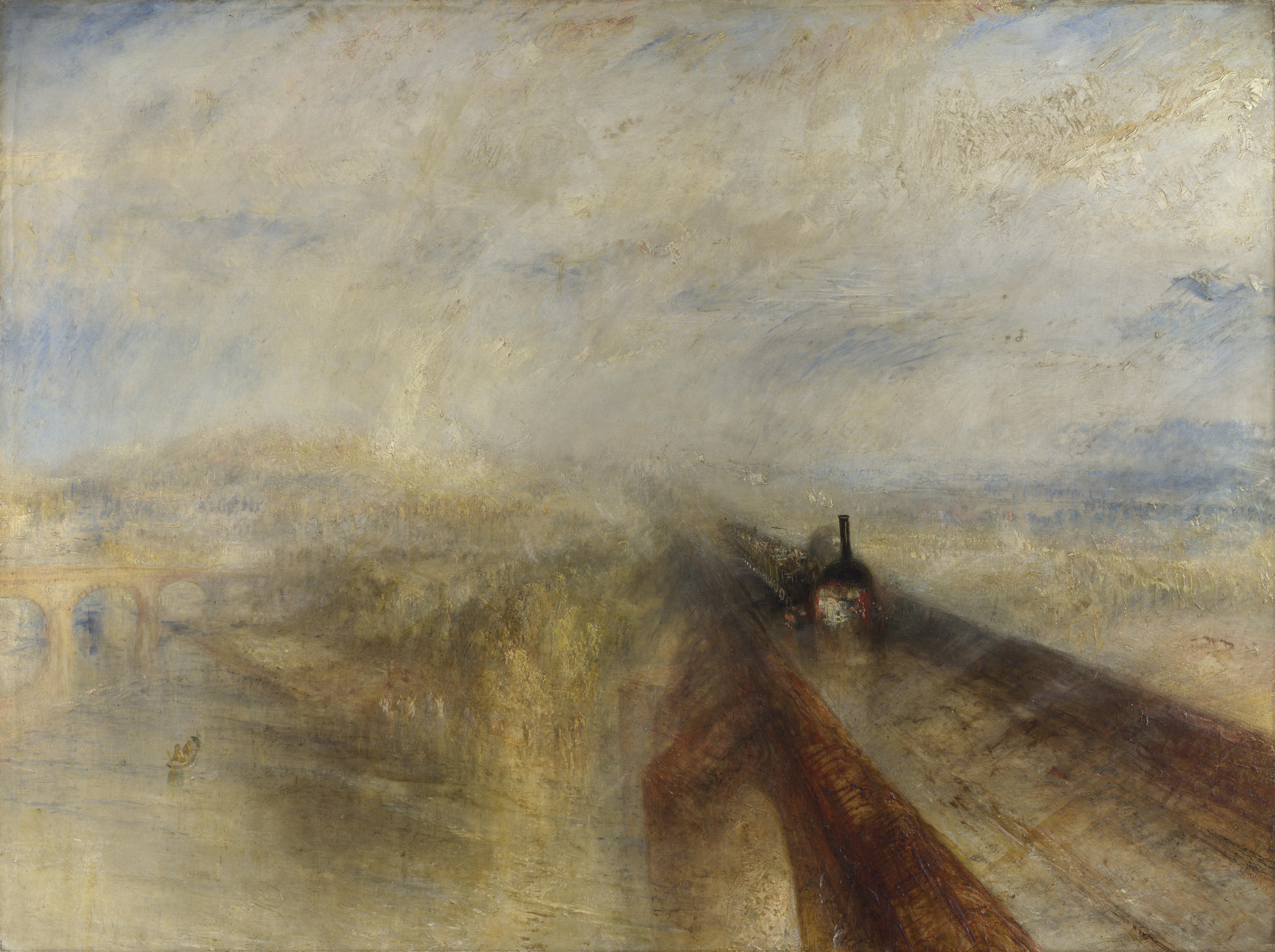
Together, the two paintings define Turner's industrial sublime. One shows an old warship losing command over history; the other shows a train remaking space and perception. Both prove that Turner could make modern technology a serious pictorial subject without reducing it to illustration.
How to read it in the gallery
Start with the contrast between the two vessels. The old ship is pale, tall, and distant from ordinary labor; the tug is dark, compact, noisy in implication. Then follow the smoke through the masts, the line of towing, and the band of sunset on the right. The painting becomes clearer when read as a sequence of forces rather than as a single pretty sunset: memory, labor, steam, light, and disappearance.
For a British landscape counterpoint, compare Turner with John Constable in The Hay Wain. Constable keeps landscape close to weather, labor, and place. Turner makes the same broad field answer to history, industry, and atmospheric transformation.
Related works
Test yourself with the quiz
Then try the art quiz.
Primary sources
- The National Gallery: The Fighting Temeraire
- The National Gallery catalogue entry: The Fighting Temeraire
- Art UK: The Fighting Temeraire
- The National Gallery: Joseph Mallord William Turner
- The Met: Joseph Mallord William Turner (1775-1851)
- Encyclopaedia Britannica: J. M. W. Turner
- Wikimedia Commons: image file and public-domain metadata
Frequently asked questions
It shows HMS Temeraire on her final journey up the Thames to be broken up, transformed by Turner into an image of naval memory and industrial transition.
The dark tug pulls the pale warship toward dismantling, making steam power visible as a small but decisive force replacing the age of sail.
Not exactly. Turner changed details such as the ship's rigging and the sunset direction to give the scene dignity, drama, and symbolic force.
The painting is in The National Gallery, London, where it forms part of the Turner Bequest.