
Impressionism
The Floor Scrapers
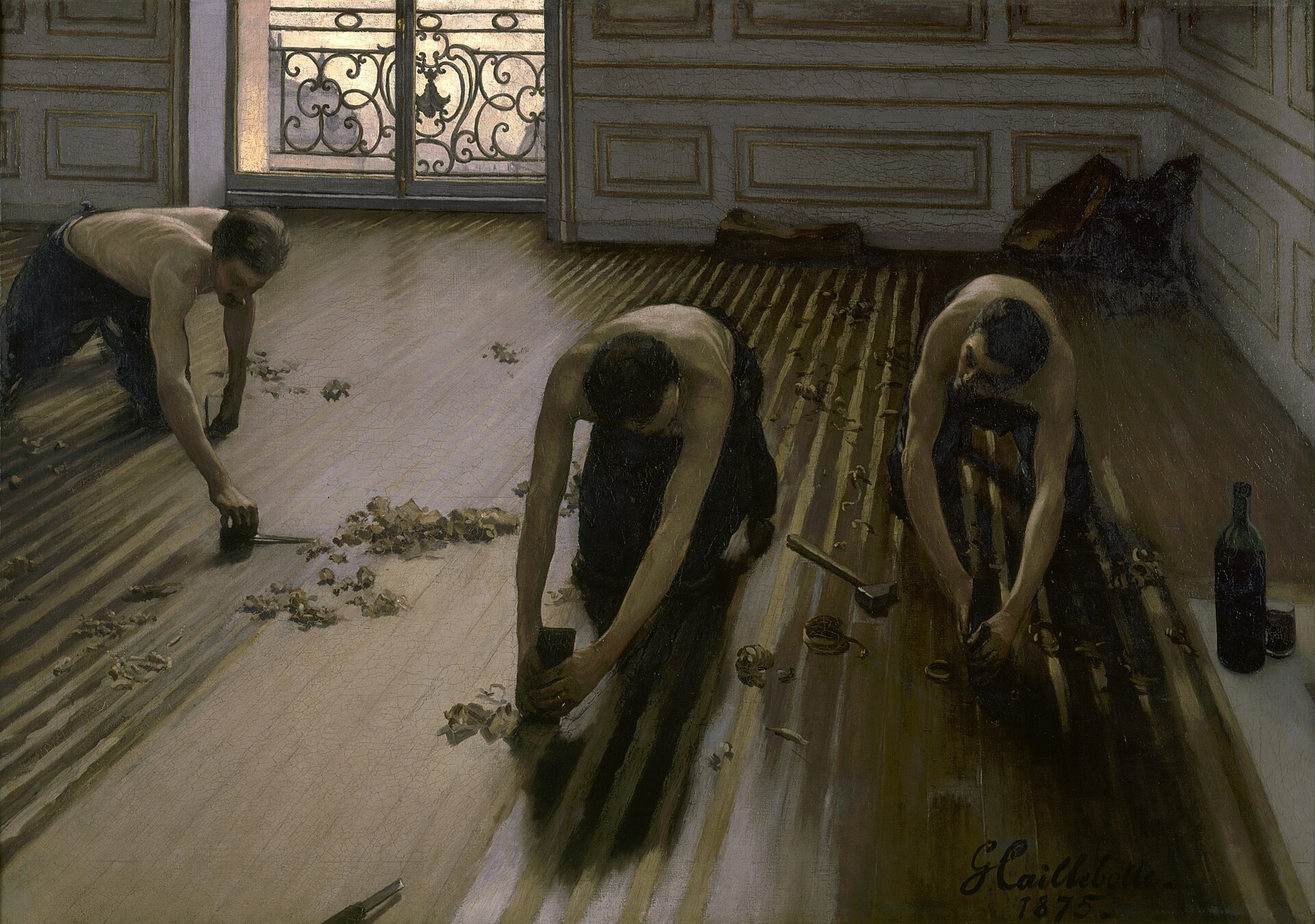
Three men lean over a wooden floor, and every board seems to pull our eye into their work. Gustave Caillebotte does not romanticize the labor or turn the workers into an anecdote. He builds the painting from their repeated movements, the bright scraped wood, the darker varnish, and a steep viewpoint that places us almost inside the room.
The Floor Scrapers is powerful because the parquet is not a background. It is the visual engine of the image. Its converging lines set the depth, distribute light, extend the gestures, and make physical effort tangible. The painting gives urban labor the scale of serious art while refusing both sentimental pity and heroic rhetoric.
A modern labor scene rejected by the Salon
Painted in 1875, The Floor Scrapers measures 102 by 147 cm. Its subject was unusual for a large ambitious canvas. Rural labor had already entered nineteenth-century painting through works such as The Gleaners by Jean-François Millet, but workers inside the modern city remained much rarer.
Presented to the Salon in 1875, the painting was rejected. Its raw realism and a subject considered too ordinary, even vulgar, disturbed official taste: an ambitious large canvas devoted to urban workers did not yet meet its expectations. The refusal helped push the young painter toward the Impressionists. He presented the canvas at their second exhibition in 1876, where its exactness, unusual viewpoint, and contemporary subject made it difficult to ignore.
What the painting shows
Three shirtless workers scrape old varnish from a parquet floor. Two kneel in the foreground, their arms extended around heavy tools. A third bends farther back. Bottles and a glass sit against the wall. Light enters from the rear of the room and moves across the floor, catching the exposed wood and the ridges left by the work.
The image is quiet, but not still. Each man occupies a separate rhythm. The foreground worker on the right reaches forward; the man on the left turns slightly toward his companion; the figure at the back narrows into the perspective. Their bodies do not pose for us. They remain absorbed in a task that continues beyond the instant painted.
The floor directs the eye
Caillebotte chooses a high, plunging viewpoint. We look down into the room rather than meeting the workers at eye level. Bands of wood stretch toward the rear wall and create a strong corridor of vision. The composition feels precise because these lines guide the eye so firmly, but it also feels slightly disorienting: the floor seems to tilt upward as it recedes.
This spatial construction is central to Caillebotte's method. He trained with Léon Bonnat and prepared the composition carefully through drawing and transfer. Academic rigor does not make the image conservative. It gives him the means to turn an ordinary modern interior into an arresting spatial device.
Bodies between classical form and urban work
The workers' bare torsos matter. Their backs, shoulders, and arms are modeled with the seriousness traditionally given to antique heroes. But Caillebotte does not remove them from their social reality. These are not timeless bodies arranged for admiration. Their muscles bend around tools, balance, friction, and repetition.
The painting therefore creates a productive tension. The bodies carry echoes of academic tradition, while the task belongs unmistakably to modern urban life. Caillebotte uses an old pictorial discipline to make a new subject visible.
Urban labor without a moral lesson
The Musée d'Orsay describes the canvas as one of the early representations of the urban proletariat. Yet Caillebotte does not turn it into an explicit political statement. There is no theatrical suffering, no moralizing contrast, no patron supervising the men. The workers are shown through close observation: gesture, tool, bottle, floorboard, light.
That restraint distinguishes Caillebotte from a simple social illustrator. He gives labor dignity through scale and attention. The painting remains socially charged because it places working bodies at the center of a major canvas, but it leaves the viewer to confront that fact without a ready-made lesson.
Where to look first
- Begin with the scraped strips of wood. Their pale bands lead directly into the room.
- Follow the workers' arms and tools. Their diagonals extend depth into physical effort.
- Pause on the backs and shoulders. Classical modeling is redirected toward contemporary labor.
- Look toward the rear wall. The bottles, glass, and raking light keep the scene concrete.
- Step back and take in the whole floor. It is both the subject of the work and the structure of the painting.
From the parquet to the boulevard
Paris Street; Rainy Day makes an especially strong comparison. Two years after the floor scrapers, Caillebotte moves from an interior under renovation to a Haussmannian boulevard. Pavement replaces parquet. Umbrellas replace tools. The lines of the city take over from the lines of the floor to distribute modern bodies across space.
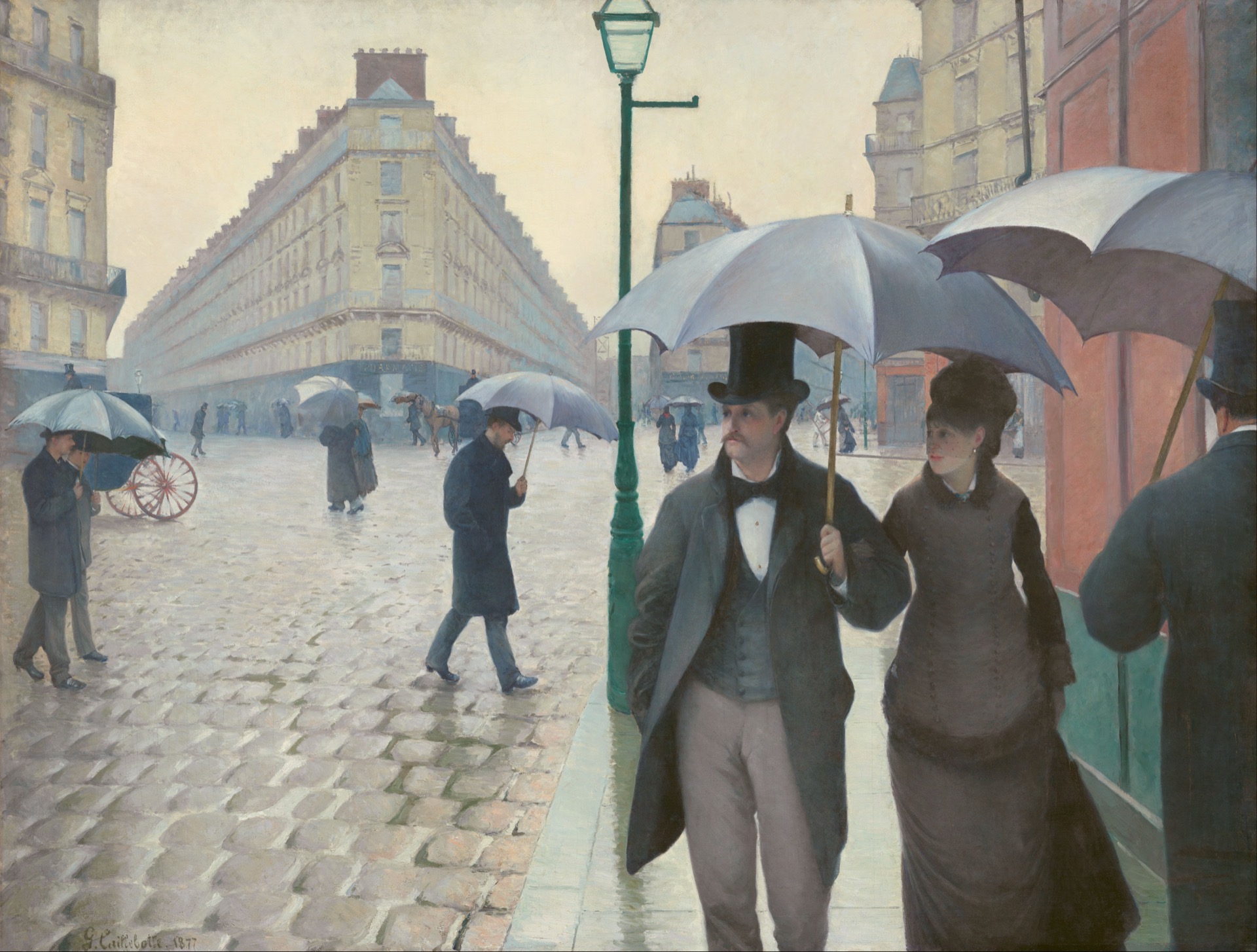
This comparison sharpens Caillebotte's place inside Impressionism. He shares the movement's attention to contemporary life, but his signature is unusually architectural. Instead of dissolving form into atmosphere, he often uses perspective, cropping, and interval to make modern experience feel newly strange.
Why the painting still holds attention
The Floor Scrapers stays memorable because it makes looking feel inseparable from labor. The eye follows the same boards the men scrape. It tracks the same diagonals their arms repeat. It registers light not as a decorative effect, but as a way of revealing what has already been removed and what remains to be done.
Caillebotte does not turn work into spectacle. He gives it structure, duration, and physical presence. The painting remains modern because its rigor never closes the scene. It leaves us standing above the floor, aware of the distance between seeing an effort and performing it.
The parquet is not the background of the scene. It is where the eye understands the effort.
Continue from Caillebotte
Primary sources
Frequently asked questions
The painting shows three shirtless workers scraping a wooden floor in a Parisian interior. The long boards and steep viewpoint give their repeated gestures a shared structure.
Presented to the Salon in 1875, the painting was rejected. Its raw realism and a subject considered too ordinary, even vulgar, disturbed official taste. Caillebotte showed it at the second Impressionist exhibition in 1876.
The Floor Scrapers belongs to the Musée d'Orsay in Paris. The museum's official title is Raboteurs de parquets.