
Realism
The Gleaners
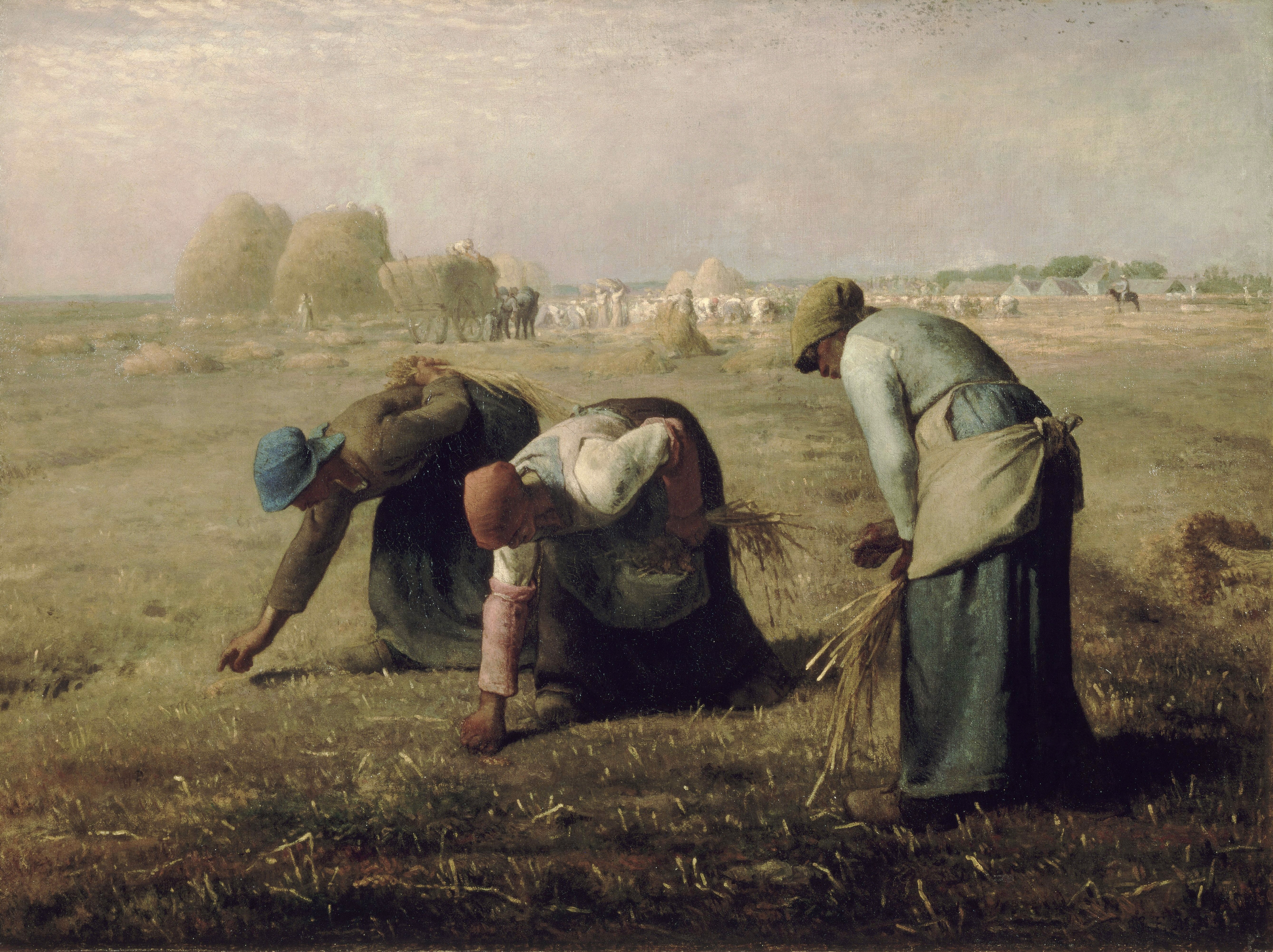
Jean-François Millet puts three women picking up leftover wheat in the foreground, while the abundance of the harvest stays far behind them. That simple arrangement is what makes The Gleaners one of Realism's defining paintings. Millet is not showing harvest at its triumphant center. He is showing what comes after it: the hard, regulated labor of the rural poor collecting what the main harvest has left behind. Painted in 1857, the canvas gives those women scale, gravity, and dignity without pretending their work is easy or picturesque.
Three bodies set against a field of plenty
The first thing to notice is the structure. Three gleaners occupy the front of the image so completely that they become the true scale of the painting. Each body takes a different phase of the same repetitive action: bending down, gathering, rising slightly, then beginning again. Behind them, much farther away, the field opens onto haystacks, sheaves, carts, workers, and bright late-afternoon activity. The abundance is real, but it belongs to another zone of the image.
That contrast is not decorative. It tells you how the social world is organized. The women are close because their labor is what the picture asks us to read. The wealth of the harvest is distant because it does not belong to them. Even the rider on the right, often read as a steward or overseer, matters for that reason. He reminds viewers that gleaning is permitted only within rules set by others.
What gleaning meant
Gleaning was not a charming pastoral custom. It was the right of the poorest rural people, often women, to collect leftover stalks after the main harvest had finished. Millet is painting labor at the lowest edge of the agricultural economy. These women are not celebrated harvesters. They are working after the wealth has already been gathered and counted.
The scene makes both the repetitive bodily movement and the strict social distance unmistakable. The women are allowed into the field, but only after the real harvest is done and only under supervision. Millet therefore gives a poor, marginal task a seriousness that nineteenth-century viewers could not dismiss as mere local color.
Why the painting made viewers uneasy
When The Gleaners appeared at the Salon of 1857, French viewers were still living in the aftermath of the 1848 Revolution and the June Days, when social conflict and fear of working-class unrest had become politically explosive. Millet did not paint rebellion, but he painted poverty with an unusual monumental calm. That was enough to trouble many critics. The women are poor, yet they do not appear comic, decorative, or morally corrected. They hold the foreground with a weight normally reserved for far more prestigious subjects.
This is why the painting belongs so securely to Realism. It does not shout. It does something slower and, in some ways, more disturbing: it asks whether a world structured by inequality can still be painted without myth, sentimentality, or social evasion. The answer is yes, but only if the image accepts labor as a serious subject in its own right.
Dignity without sentimentality
Millet's great achievement is that he neither humiliates nor idealizes the women. He does not turn them into picturesque peasants, and he does not dramatize them into heroines. Their faces are mostly unreadable from this distance. What carries meaning instead are backs, shoulders, hands, and the repeated curve of the body. The painting asks us to understand labor through posture and rhythm before we ever search for anecdote.
That is also Millet's method. He wants the viewer to stay with the repetitive labor itself rather than escape into pastoral charm or sentimental pity. So he keeps the gleaners large, close, and rhythmically linked, while the main harvest stays distant. The painting's intention is not to beautify poverty, but to make this marginal work fully legible and fully serious.
The light helps. It gives the gleaners a sculptural solidity, picking out necks, arms, and clothing while the distance dissolves into gold haze. The result is not miserabilism. It is something tougher: an image in which poverty is fully visible, but still granted form, gravity, and dignity.
Another route through Realism
Set the painting beside A Burial at Ornans and a second path through Realism appears. Courbet makes a provincial community monumental by spreading many figures across a huge public canvas. Millet works differently. He narrows the field, reduces the number of bodies, and lets repeated labor carry the weight. Courbet shocks through scale and social presence. Millet shocks through restraint, pressure, and the refusal to turn rural poverty into anecdote.
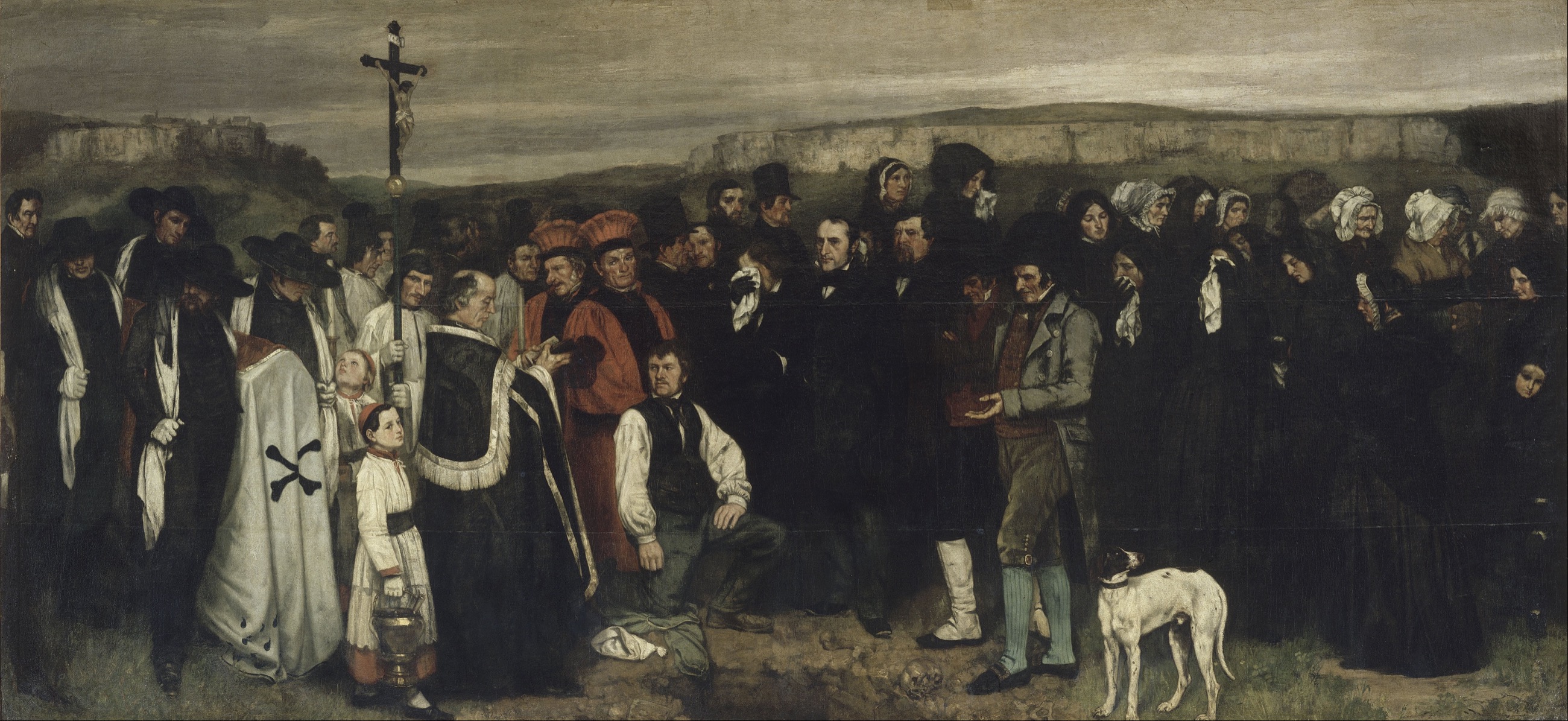
Realism does not collapse into one formula. The movement can be coarse or controlled, crowded or stripped down, urban or rural. What remains constant is the refusal to treat ordinary life as minor.
From Millet to later social images
The afterlife of The Gleaners is long because the image solves a problem later artists keep returning to: how to represent laboring people without reducing them either to symbols or to spectacle. Van Gogh admired Millet intensely because he recognized that peasant work could carry formal seriousness without academic pomp. Much later, images like Migrant Mother would give poverty another visual language, but the question remains similar: how do you make hardship visible without stripping away dignity?
The Gleaners endures because it answers that question with unusual precision. It shows labor, distance, class, and repetition in one stable arrangement. Nothing spectacular happens. That is exactly why the picture remains so powerful.
Related works
Test yourself with the quiz
Then try the art quiz.
Primary sources
Frequently asked questions
It shows three rural women gleaning leftover stalks of wheat after the main harvest, while the abundant harvest and the estate's supervising world remain farther back in the field.
Gleaning was the right of the rural poor to collect what remained in the fields after harvesting. It was a hard, tightly regulated form of survival labor rather than an idyllic rural custom.
Millet gave poor laboring women unusual scale, gravity, and dignity at a moment when rural poverty and social unrest were politically sensitive subjects. The painting looked too serious to dismiss as picturesque genre.