
Romanticism / Portrait
The Monomaniac of Envy
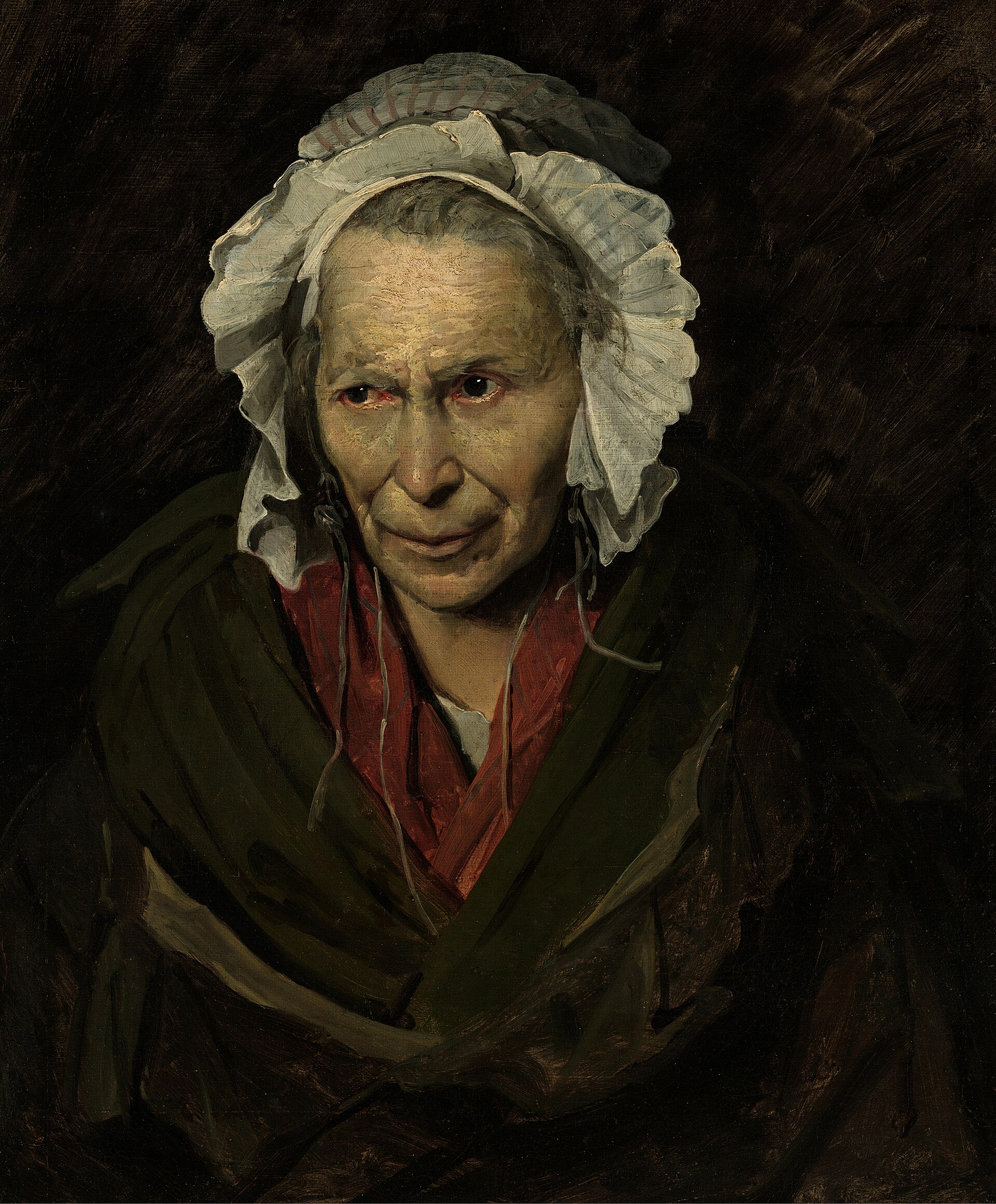
A woman turns slightly away, yet the painting refuses to let her become a case file. Théodore Géricault's The Monomaniac of Envy, known in French as La Monomane de l'envie, is a small oil painting with the authority of a major work. It was painted around 1819-1822 and is now in the Musée des Beaux-Arts de Lyon. Nothing in it performs: no dramatic gesture, no theatrical setting, no explanatory object. A face, a cap, a dark ground, a reddish garment, and a sideways gaze carry the whole force of the image.
The restraint keeps the portrait disturbing. Géricault does not turn the sitter into an emblem of madness. He paints someone caught between medical classification and human presence. The nineteenth-century word “monomania” named a mental disorder supposedly organized around one fixed obsession, but the title was assigned after the painting. The Lyon museum stresses that the labels attached to the surviving portraits came later, especially through the critic Louis Viardot. The image belongs to the history of psychiatry, but it cannot be reduced to a diagnosis.
What the portrait shows
The sitter is shown close up, roughly half-length, against a dark background. Her white head covering frames the face with blunt clarity. The red-brown garment gives weight to the lower part of the image, while the head turns slightly away from the viewer. The eyes do not invite easy contact. They look alert, guarded, perhaps suspicious, but the painting does not fix them into a single readable emotion.
The face is built without flattery: rough skin, closed mouth, shadow under the cheekbones, tension around the eyes. The result is neither social portrait nor caricature. Clothing, background, and pose no longer announce rank or role. The dark ground removes anecdote, leaving no room to explore and no object to decode. The painting forces a difficult encounter between viewer and model while refusing the comfort of explanation.
The monomaniac series and the medical problem
The painting belongs to a group of surviving portraits traditionally called Géricault's monomaniacs. Five are identified today, each associated after the fact with an obsession: envy, gambling, theft, military command, and the abduction of children. The Lyon museum is careful about the story. For a long time, scholars linked the series to Dr. Étienne-Jean Georget, a physician at the Salpêtrière in Paris, but no document proves a commission or even a direct relationship between the doctor and the artist.
The uncertainty places the portrait inside a world where early nineteenth-century psychiatry was trying to classify mental suffering through faces, gestures, and recurring symptoms. Géricault absorbs that world without producing a medical illustration. The word “monomania” belongs to a historical vocabulary that later disappeared as a diagnosis; reading the work today means seeing how art borrowed that classificatory gaze, then made it more troubling by giving an anonymous sitter the gravity of a major portrait.
Géricault's method: one face instead of a crowd
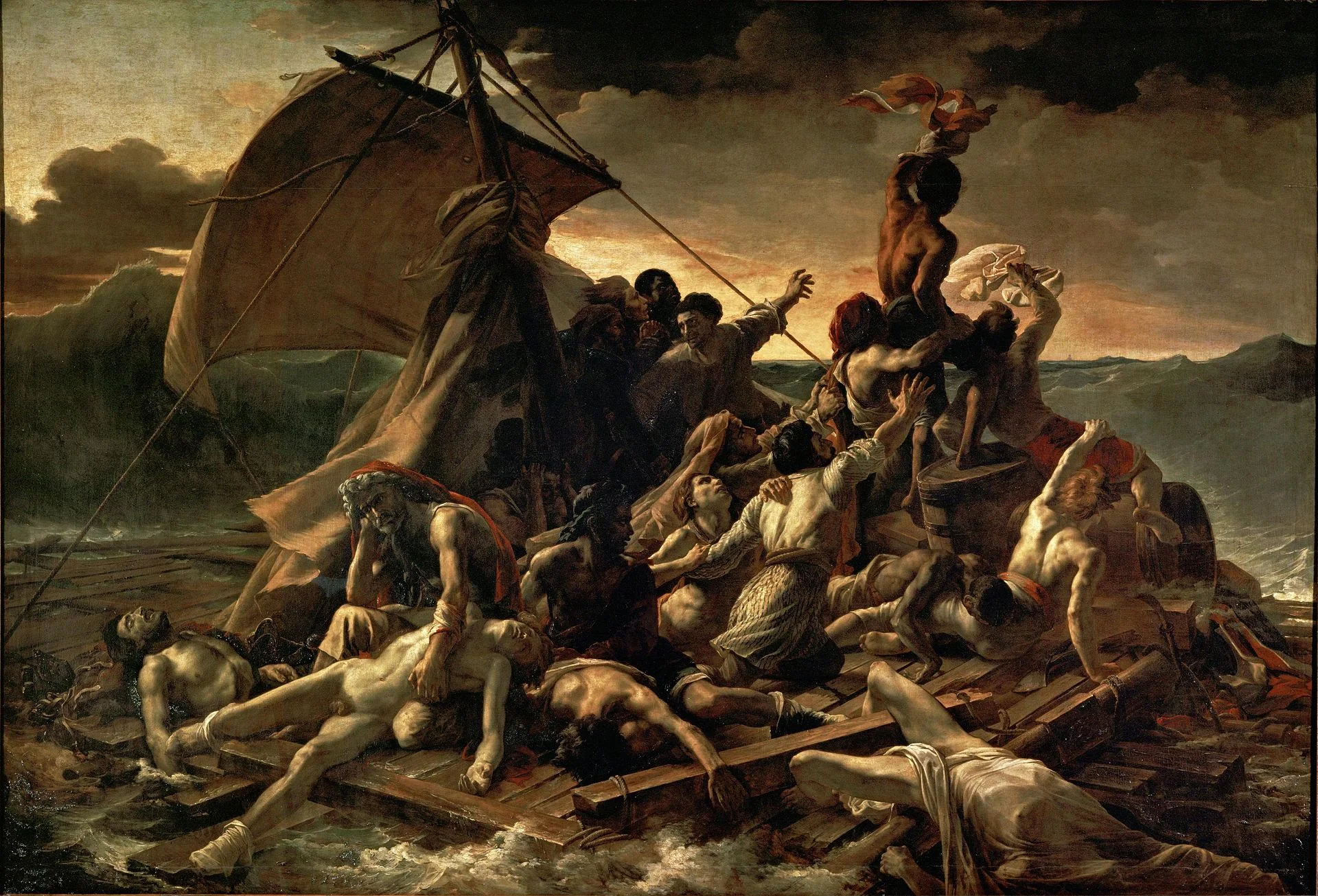
Beside The Raft of the Medusa, the Lyon portrait shows the same ethical pressure through opposite means. In the Louvre painting, suffering is collective, political, and monumental: the shipwreck of the Méduse becomes a public accusation built from anatomy, pyramidal composition, and a distant horizon. In The Monomaniac of Envy, the sea disappears and the drama contracts into proximity, stillness, and a withheld story. Géricault does not lower the stakes. He changes the instrument: both works reject decorative suffering and make the viewer responsible for the line between looking and judgment.
A Romantic portrait without theatrical excess
Because the image is quiet, it can be easy to miss how deeply it belongs to Romanticism. Romantic art is not only storms, shipwrecks, barricades, and sublime landscapes. It also gives new seriousness to inner disturbance, marginal figures, and states of mind that polite society preferred not to see. Géricault removes spectacle so that psychological pressure becomes the whole field of the painting.
The portrait unsettles genre hierarchy as well. An anonymous woman associated with mental illness receives the gravity of a major portrait, but her face is not treated as a symptom to be consumed quickly. It has duration. The viewer must stay with the image long enough to feel how little the title explains.
Géricault gives an anonymous sitter the weight of history painting, but he does it by removing almost everything except the face.
How to read it closely
Start with what is absent. There is no diagnostic instrument, no hospital room, no obvious symbol of envy. Then look at the turn of the head. The sitter is close enough to confront, but not open enough to possess. The mouth is closed; the eyes are active; the white cap creates a hard frame around the face. The painting gives access and withholds certainty at the same time.
Next, compare the face with the clothing. The reddish garment anchors the body while the light concentrates on skin, cap, and gaze. Géricault uses color sparingly because the drama is not in display. Hold the title at a distance too: “Envy” helps locate the work within the later classification of the series, but it should not replace looking.
A Lyon portrait at the edge of modernity
The Monomaniac of Envy condenses a major nineteenth-century shift into a single portrait. The subject is not a monarch, saint, hero, or patron. She is anonymous, medically framed, and socially vulnerable, yet Géricault gives her an intensity that refuses ornament, ridicule, and easy pity.
Continue with the profile of Théodore Géricault, the guide to Romanticism, and the analysis of The Nightmare for another Romantic image of inward disturbance. Then test your eye with the art quiz.
Explore more
Primary sources
Frequently asked questions
The Monomaniac of Envy is an oil painting by Théodore Géricault, dated around 1819-1822 and held by the Musée des Beaux-Arts de Lyon. It shows an anonymous woman traditionally identified with the nineteenth-century category of monomania.
The painting is in the Musée des Beaux-Arts de Lyon. The museum acquired it at public auction in 1908.
The exact circumstances remain uncertain. The portraits have long been associated with medical interest in mental illness, but the Lyon museum notes that no document proves a commission from Dr. Étienne-Jean Georget.
Yes. Its intensity is quiet rather than theatrical, but it belongs to Romanticism through its focus on inner crisis, marginal subjects, bodily presence, and the instability of modern human experience.