
Neo-Impressionism
Opus 217: Portrait of Félix Fénéon
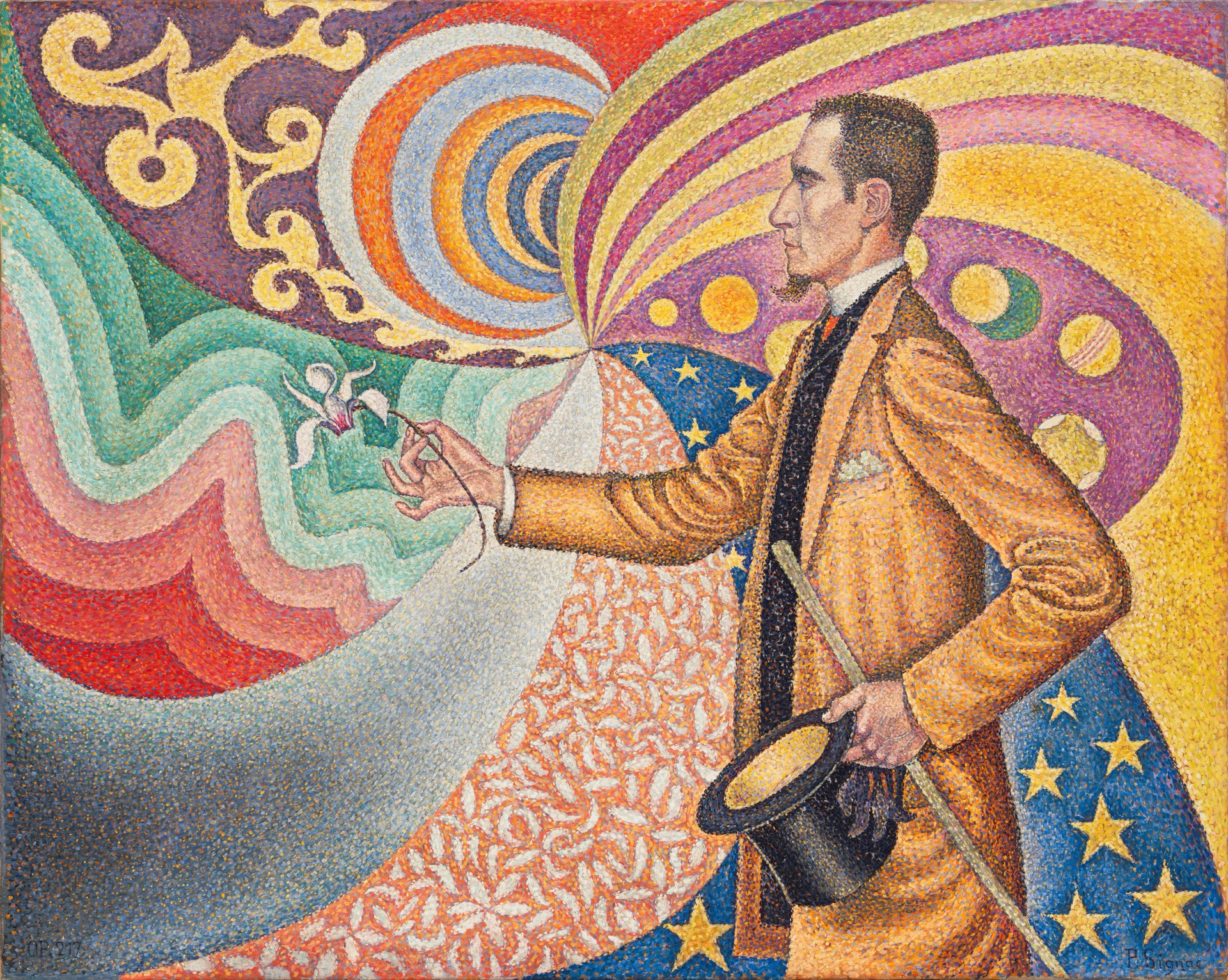
A man in a dark coat holds a flower while a wheel of broken color spins behind him. Paul Signac's Opus 217 makes portraiture behave like a manifesto: Félix Fénéon is not only represented as a critic, editor, collector, and anarchist, but staged as the human center of a new optical culture.
The painting belongs to the same Neo-Impressionist world as Seurat's La Grande Jatte, but it feels less frozen and more electric. Signac keeps the divided touch, the faith in color relations, and the planned surface. Then he lets the system flare into arabesque, wit, and decorative force.
Fénéon as an avant-garde signal
Fénéon was the kind of figure who makes the late nineteenth-century avant-garde easier to understand. He wrote criticism, edited journals, worked as a dealer and collector, and championed young artists around Georges Seurat, Signac, Pierre Bonnard, and Henri Matisse. Signac paints him as a precise modern operator rather than as a passive sitter.
His profile is sharp, almost cut out. The cane, gloves, flower, and tailored silhouette create a controlled public persona. Behind that control, the background refuses stillness. Color breaks into rays, wedges, and pulses. The portrait turns character into a relation between composure and agitation.
Pointillism with a theatrical edge
In Opus 217, pointillism is not a texture pasted over a conventional portrait. The tiny touches build a field of optical pressure around the sitter. Yellow, violet, green, red, and blue do not simply decorate Fénéon; they test how far a portrait can move toward abstraction while keeping a recognizable social subject.
The long title helps. Signac calls attention to rhythm, measures, angles, tones, and tints, as if the image were a score. The word Opus also pushes painting toward music. Color is not a local description of skin, wall, or clothing. It becomes a timed structure, something the eye performs while moving across the canvas.
How it differs from Seurat
A comparison with A Sunday Afternoon on the Island of La Grande Jatte clarifies Signac's ambition. Seurat uses divided color to stabilize a modern crowd into social geometry. Signac uses the same broad method to produce a more mobile and graphic intelligence. The dots and dashes no longer hold people at a measured distance; they make the entire field rotate around one figure.
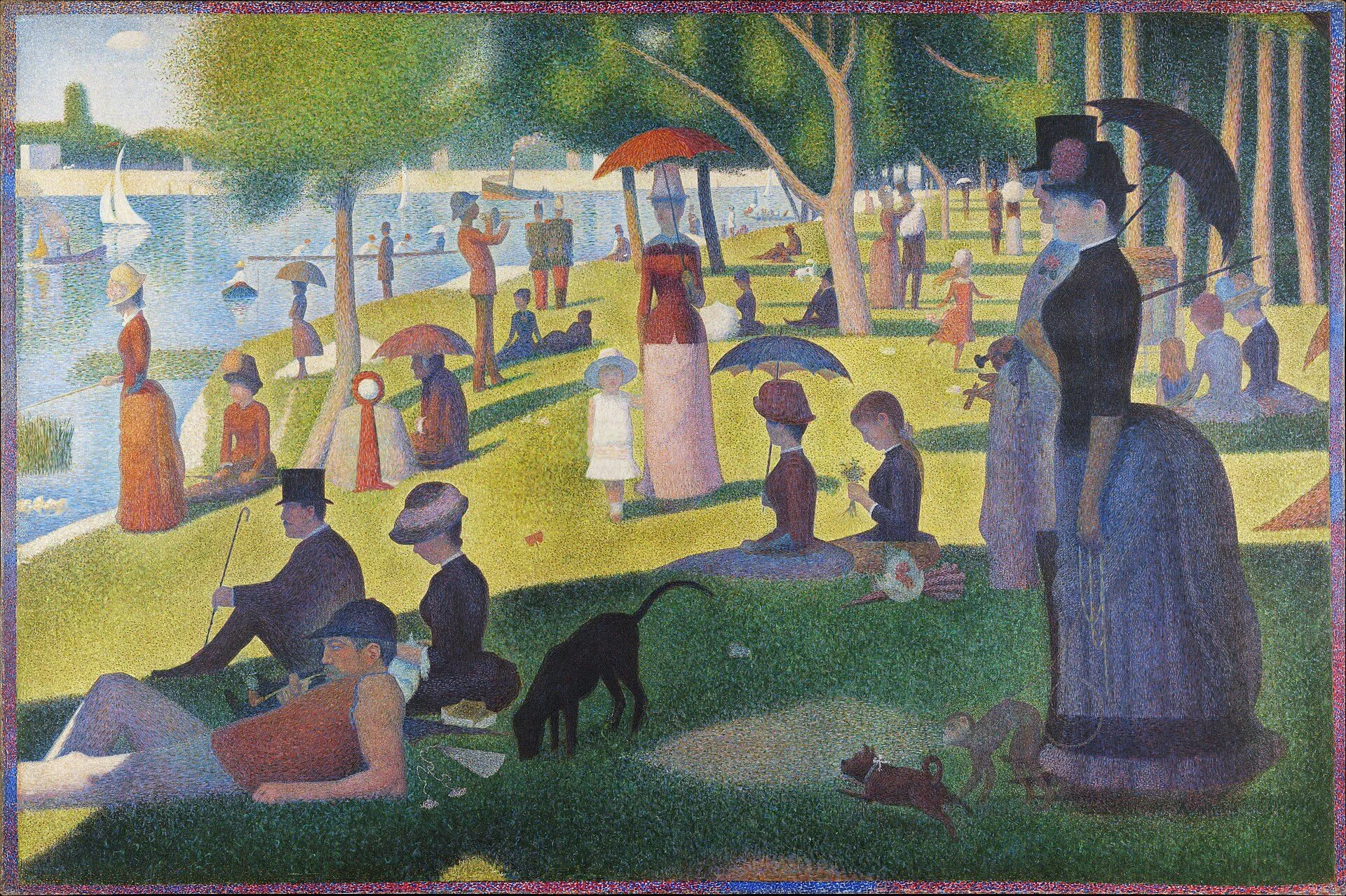
Signac's strongest contribution begins in this shift. He inherited Seurat's discipline, but he was not content to preserve it as a closed formula. His mature work often expands the method into bolder color, more decorative architecture, and looser mosaic surfaces.
Politics inside the optical system
The portrait also carries political charge without turning into propaganda. Fénéon was associated with anarchist culture, and Signac shared radical commitments. The painting does not illustrate a political program. It models a different kind of order: decentralized marks, intense contrasts, and a sitter whose authority comes from intellectual circulation rather than official rank.
That is the hidden force of the work. It makes modernism look social. The new color system is not sealed inside studio technique; it belongs to journals, exhibitions, friendships, polemics, and public taste. Fénéon appears as the mediator who helps those networks become visible.
Why this portrait still looks modern
Opus 217 remains startling because it predicts several modern habits at once. It treats the portrait as identity design. It turns color into a structural interface. It makes a critic, not a monarch or saint, worthy of chromatic ceremony. It also shows why Post-Impressionism cannot be reduced to expressive brushwork or personal emotion.
Seen after Monet's Impression, Sunrise and Seurat's La Grande Jatte, Signac's portrait opens a third route. Impressionism catches a passing sensation; Seurat calibrates that sensation into order; Signac makes the system public, graphic, and almost poster-like. The result is one of pointillism's most memorable images because it joins method, personality, and visual spectacle without letting one cancel the others.
Signac turns the critic into a color machine with a face.
Explore more
Related works
Then use the art quiz to test whether Signac's color rhythm stays recognizable when it appears beside Seurat, Monet, and later abstraction.
Primary sources
- MoMA: Opus 217 collection record
- MoMA: Pointillism term page
- MoMA: Félix Fénéon: The Anarchist and the Avant-Garde
- Musée de l'Orangerie: Félix Fénéon (1861-1944). The modern times, from Seurat to Matisse
- The Met: Signac 1863-1935: Master Neo-Impressionist
- Wikimedia Commons: public-domain image record