
Orphism
Simultaneous Contrasts: Sun and Moon
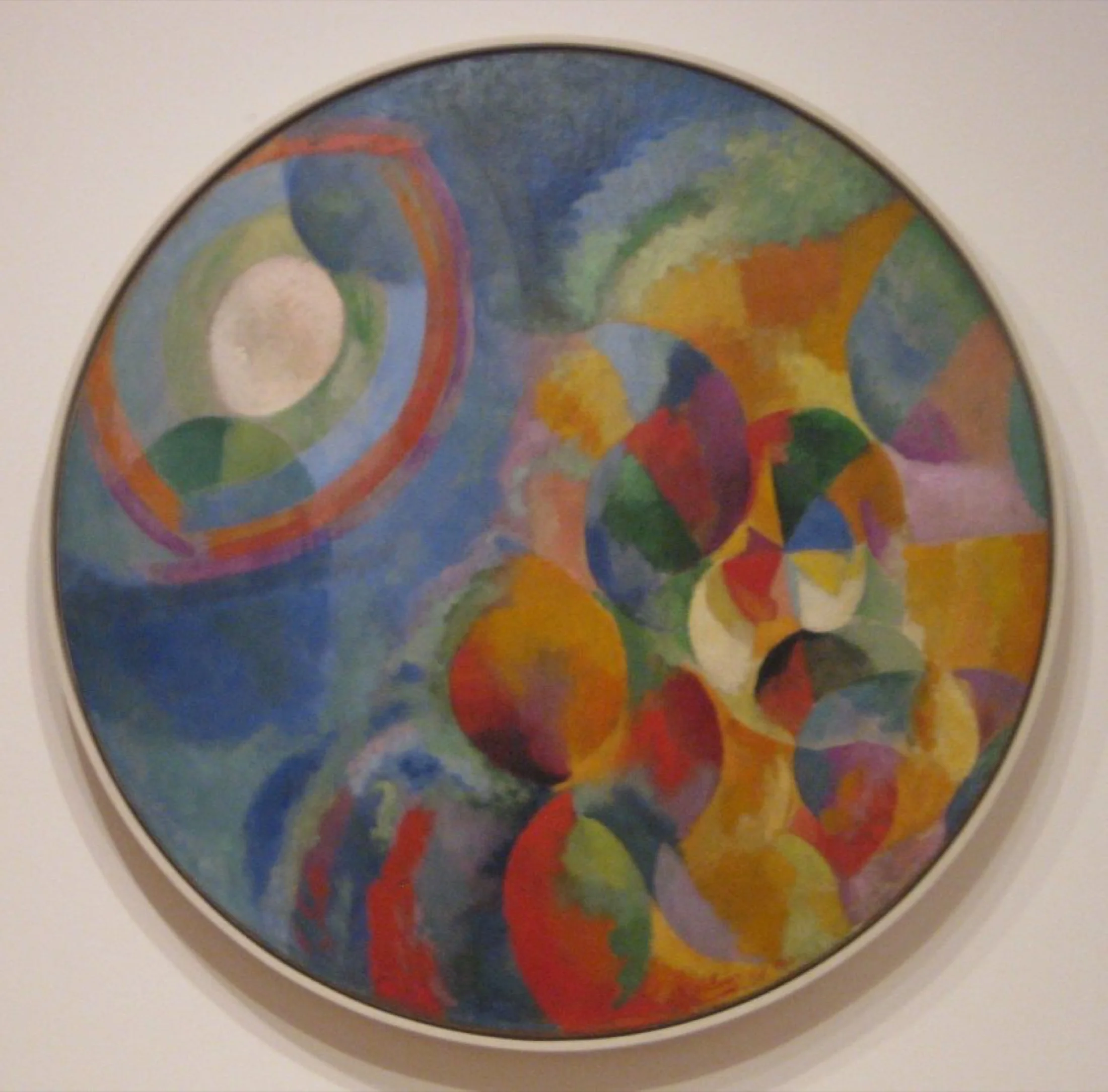
Delaunay paints the sky as a system of pulses. The title gives us "sun" and "moon," but the real subject is not astronomy—it is simultaneous color energy, organized as a disciplined experiment in perception.
Why the painting feels alive
Circular forms rotate your eye while adjacent hues intensify each other. A red near a green, a blue near an orange: every pair alters the neighboring tone. The canvas appears to vibrate because the eye keeps adjusting in real time.
Concretely, the canvas shows overlapping discs, curved wedges, and chromatic bands that keep crossing without settling into one focal center. You read the work as moving color intervals rather than as a fixed scene.
That is the core of Delaunay's simultaneity theory. Perception is active and relational, never static.
Music without instruments
The painting has no violin, no singer, no concert hall. Yet it behaves musically: repeated arcs establish beat, color intervals create variation, and circular returns function like refrain. This is exactly why Orphism is often discussed in dialogue with cross-sensory experience.
Historical context
Painted in the early 1910s, this work sits at a turning point where Cubist structure opens into luminous abstraction. Delaunay keeps formal rigor but replaces analytic fragmentation with radiant continuity.
Compared with Kandinsky's Improvisation 28, Delaunay is less storm-like and more orbital: the eye circulates instead of colliding.
In Delaunay, color does not describe light; it becomes light's own rhythm.
From Chevreul to Orphism
Delaunay's title points to celestial bodies, but the deeper framework comes from color science. Nineteenth-century theories of simultaneous contrast, especially those associated with Michel-Eugene Chevreul, argued that colors are never perceived in isolation. A hue changes depending on what sits beside it. Delaunay turns that principle into structure: the painting is engineered so adjacent colors continuously react, making the image feel active even when nothing is literally moving.
This is where Orphism separates itself from both strict Cubist analysis and decorative colorism. Cubism often dissects form; Delaunay wants form to circulate. His circles, arcs, and wedges are not fragments of an object but intervals in a visual score. The canvas behaves less like a still window and more like a rotating field.
Orbit rather than collision
A useful comparison is Yellow-Red-Blue: Kandinsky often builds tension through directional opposition, while Delaunay prefers orbital continuity and pulse. Both are abstract, but they train different visual habits. Delaunay's canvas asks the eye to circulate, return, and recalibrate, rather than to decode symbolic fragments.
That difference also explains why the painting adapts well to repeated viewing in museums. The composition does not resolve into one privileged center; it keeps redistributing attention through rotational cues, so each pass reveals a slightly different hierarchy.
Legacy beyond painting
This painting explains a central fact of modern visual culture: color is relational and behavioral. Designers, interface teams, and data-visualization specialists still solve the same problem Delaunay stages here - how neighboring colors change legibility, emotion, and perceived movement.
It also offers a corrective to shallow narratives of abstraction. Abstraction is not an escape from reality; it is a method for studying how perception works. Read with Robert Delaunay's profile, the Orphism overview, and the blog essay on synesthesia and abstraction, this page becomes part of a coherent chain: color, rhythm, and attention as historical, not merely stylistic, questions.
This is also why the canvas rewards repeated visits. What first looks like a decorative abstraction becomes a disciplined perceptual machine once you track adjacency, rhythm, and return over time.
Related links
For tighter comparison, read Composition VII, Black Square, plus How to Understand a Painting and Why Art Goes Viral.
Use the art quiz as a quick check: can you connect Simultaneous Contrasts: Sun and Moon to Robert Delaunay when the options are mixed?