
Symbolism / Musée des Beaux-Arts de Lyon
The Sacred Grove, Beloved of the Arts and Muses
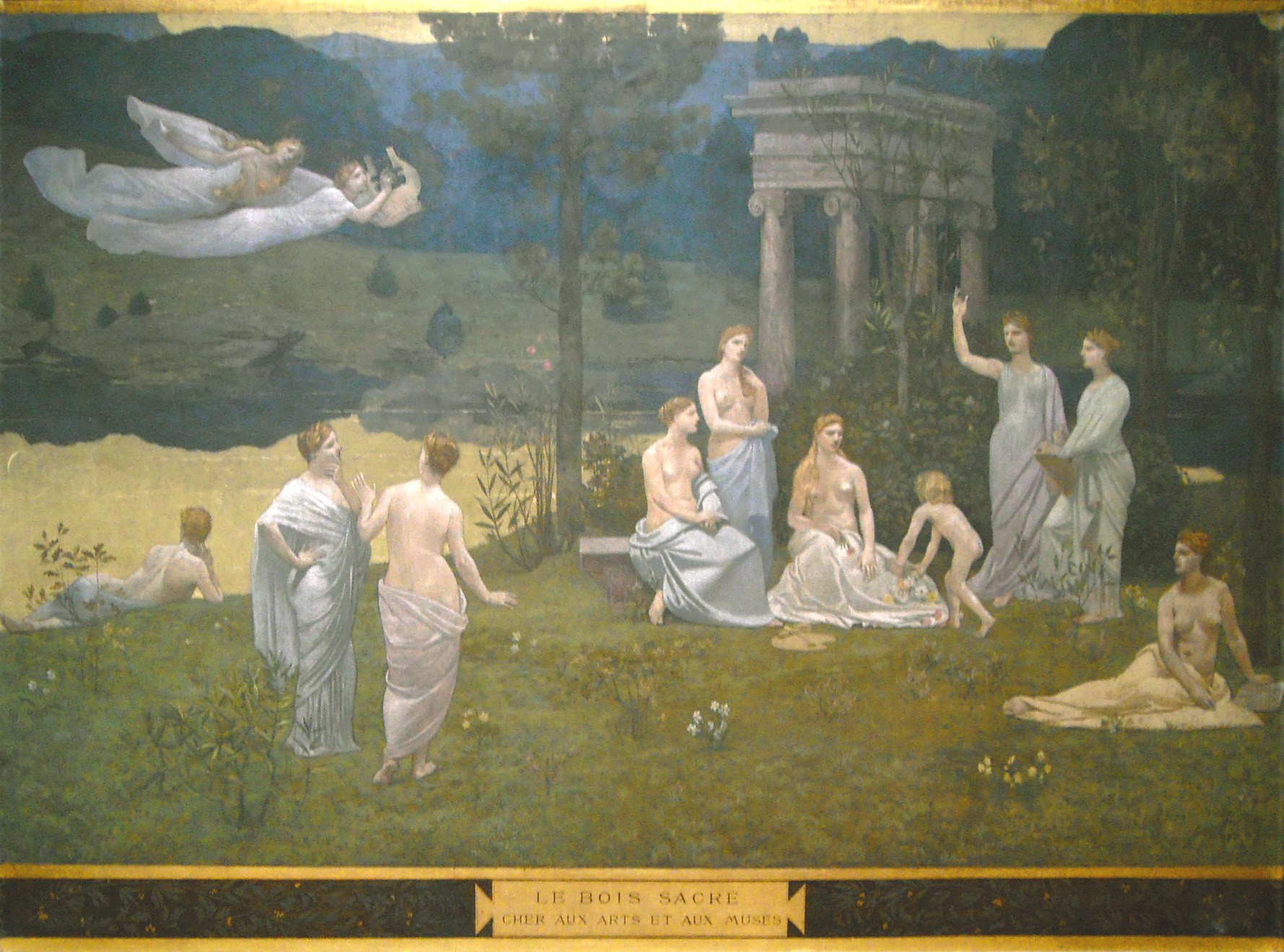
In the staircase of the Musée des Beaux-Arts de Lyon, Puvis de Chavannes paints the Muses not as a noisy triumph of culture, but as pale figures speaking quietly in an evening grove. The Sacred Grove, Beloved of the Arts and Muses, painted in 1884, is one of the museum's defining works because it is not only an object in the collection. It helps shape the museum as a place.
The City of Lyon commissioned Pierre Puvis de Chavannes to decorate the monumental staircase newly created in the Palais Saint-Pierre. The museum describes the ensemble as four compositions painted on canvas in the studio and then mounted in their final positions. Together they form one of Puvis's finest decorative cycles and one of the major public works of the late nineteenth century.
What the painting shows
The central scene is deliberately still. In a twilight grove, the nine Muses recline, sit, stand, fly, speak, or listen. At the right, the allegories of Architecture, Sculpture, and Painting stand near a fragment of antique portico. No dramatic story unfolds. The figures do not act like characters in a plot. They make art appear as a climate of attention.
That stillness is the point. Puvis gives the museum an image of artistic origin without turning it into a literal history lesson. The grove is neither ancient Greece nor modern Lyon. It is a mental place: calm, suspended, ideal, almost outside time. The visitor climbing the staircase enters a space where art is presented as memory, dream, discipline, and retreat from ordinary noise.
The museum as a place of passage
The work's location matters as much as its subject. This is not a portable easel painting meant to be encountered on a wall among many others. It belongs to a staircase. Viewers see it while moving, pausing, ascending, and turning. Puvis uses a broad, pale, slow composition to change the tempo of the body inside the building.
The side compositions sharpen that program. Antique Vision evokes a radiant ideal Greece. Christian Inspiration sets creative labor in a late medieval or early Renaissance convent. The central grove joins those origins without choosing one over the other. Art is presented as both inheritance and inward work.
Puvis's method is to replace narrative pressure with mural rhythm. He wants the viewer to feel the staircase as a symbolic environment: pale bodies, even spacing, trees, architecture, and quiet light combine into one public image of art rather than into a single dramatic episode.
Why the calm is modern
Puvis can look old-fashioned if judged only by avant-garde noise. He does not fracture form like Cubism or break color like Fauvism. Yet his importance lies in a different modernity: he strips narrative down, flattens space, lowers dramatic contrast, and gives figures a suspended, almost abstract dignity. The image feels quiet because every effect has been reduced.
That reduction connects the painting to Symbolism. The work is not a puzzle with one hidden answer. It uses atmosphere, allegory, pale color, and silence to suggest what art might be. Puvis does not describe inspiration; he builds a room where inspiration feels possible.
A path toward Gauguin, Seurat, and modern decoration
The comparison with Nave Nave Mahana helps explain Puvis's reach. Gauguin's image is sharper, more troubling, and inseparable from colonial fantasy, but both artists use simplified figures, flattened structure, and symbolic atmosphere rather than naturalistic incident. Puvis makes the public mural quiet; Gauguin makes the modern myth uneasy.
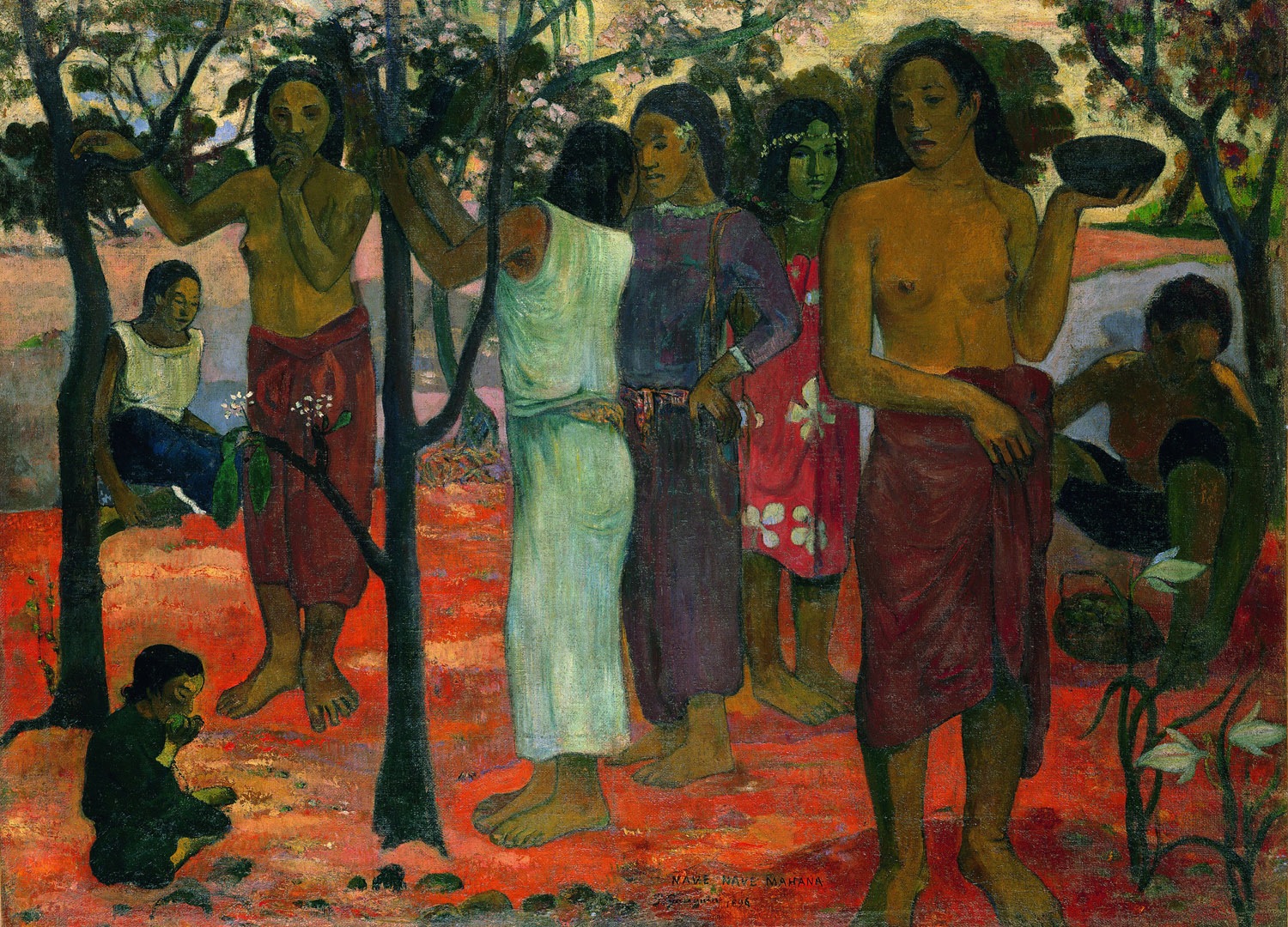
Puvis also helps explain why decoration becomes so important for later modern art. A wall can organize thought, not just fill space. A large public image can be modern by slowing the eye, simplifying the figure, and making atmosphere carry meaning.
How to read it in the museum
Do not begin by looking for dramatic action. Begin with the tempo. Notice the pale bodies, the low contrast, the evenly spaced figures, the trees, the portico fragment, and the quiet evening light. Then step back and read the work as part of a staircase, not as an isolated canvas. Puvis is designing an encounter between movement through the building and a symbolic image of art.
Continue with Pierre Puvis de Chavannes, the guide to Symbolism, and Gauguin's Nave Nave Mahana. Then test your eye with the art quiz.
Explore more
Primary sources
Frequently asked questions
The Sacred Grove, Beloved of the Arts and Muses is a monumental mounted oil on canvas painted in 1884 by Pierre Puvis de Chavannes for the staircase of the Musée des Beaux-Arts de Lyon.
It is installed in the Musée des Beaux-Arts de Lyon, in the Puvis de Chavannes staircase of the Palais Saint-Pierre.
The central scene shows the nine Muses in a calm grove, with allegories of Architecture, Sculpture, and Painting before an antique portico. The museum describes the grove as an ideal, timeless place of art.
Yes. The work belongs to the late nineteenth-century Symbolist climate through its atmosphere, allegory, silence, flattened space, and refusal of ordinary narrative action.