
Artist Guide
Pierre Puvis de Chavannes
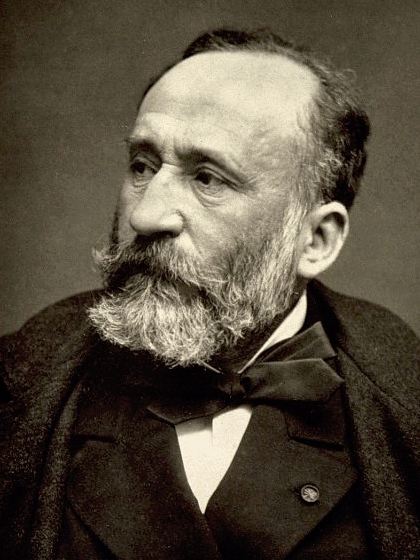
Pierre Puvis de Chavannes made modern public painting quiet, pale, and monumental. Born in Lyon in 1824, he became the leading French mural painter of the later nineteenth century, but his importance is not only civic or decorative. He showed younger artists that a modern image could gain force through simplification, stillness, muted color, and symbolic atmosphere.
Puvis worked against the louder habits of much nineteenth-century painting. He did not build drama through violent gesture, thick narrative, or dazzling anecdote. He reduced. Figures stand apart. Landscapes flatten. Color is often chalky, restrained, and slightly remote. The result can look calm at first, but it is not empty. His paintings ask large public spaces to slow down the eye.
His training and career were shaped between Lyon, Paris, travel, and the public commission system of the Second Empire and Third Republic. Puvis was not a rebel painter outside institutions. He learned how institutions spoke through walls, then changed the tone of that speech by making it quieter, broader, and less anecdotal.
Why his murals changed the public wall
The French public mural was often expected to celebrate institutions with clarity, allegory, and grandeur. Puvis kept the scale and the allegorical ambition, then stripped away theatrical emphasis. He made decoration behave less like a painted speech and more like a climate. A museum, town hall, library, or civic staircase could become a place where art, memory, history, and learning are held in a single atmosphere.
His work belongs naturally to Symbolism. Puvis does not usually hide meaning inside obscure codes. His figures and allegories remain legible. The symbolic charge comes from distance, rhythm, silence, and simplification. Meaning is not shouted by action; it settles across the whole wall.
The Sacred Grove in Lyon
The Lyon mural anchors the reading: The Sacred Grove, Beloved of the Arts and Muses, painted in 1884 for the staircase of the Musée des Beaux-Arts de Lyon. The work measures 4.6 by 10.4 meters. It is not a small canvas enlarged to fit a wall. It is a mural conceived for the rhythm of a building, for viewers who move up and down the staircase.
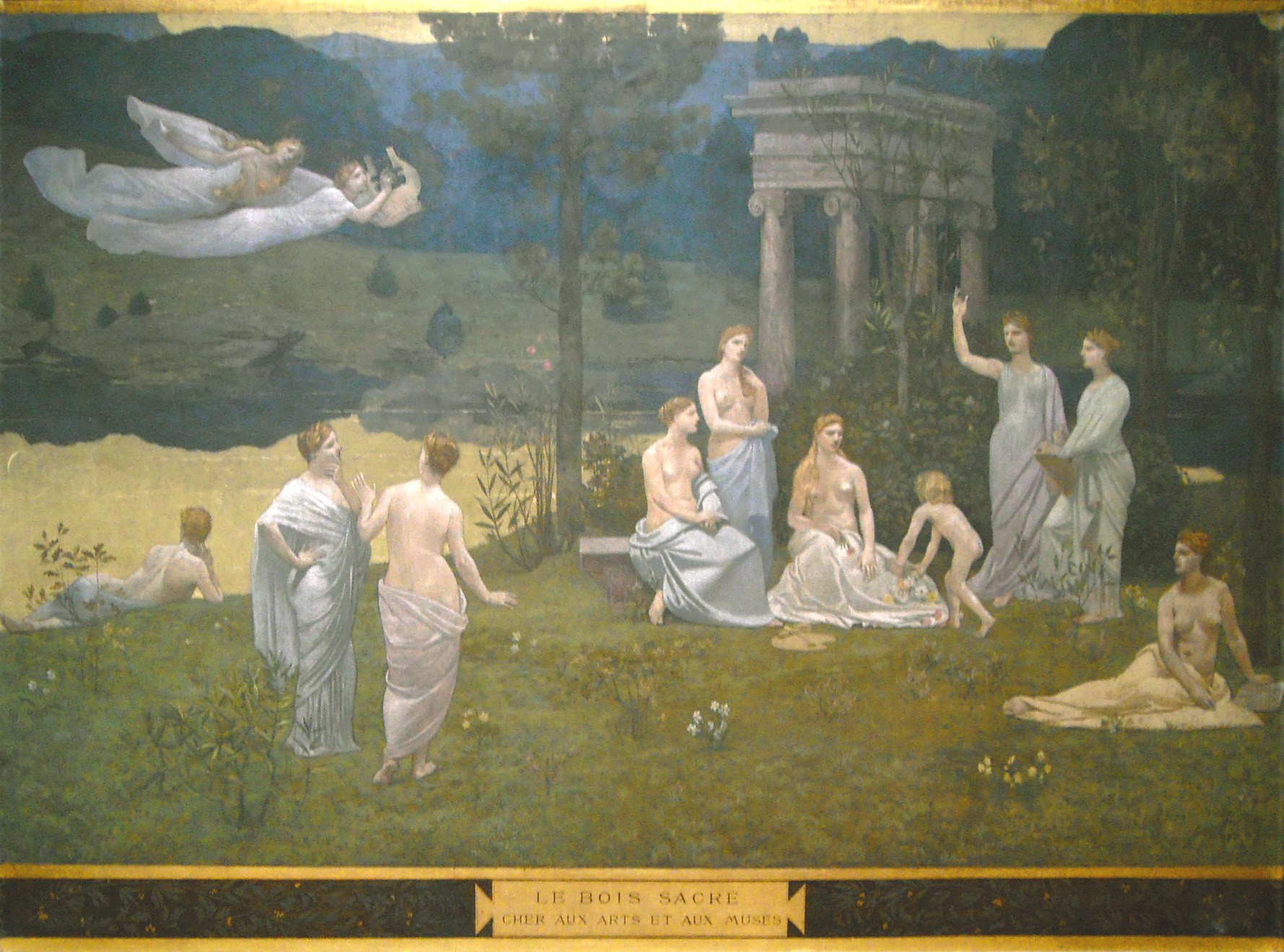
The painting gathers the Muses, allegories of the arts, trees, pale sky, and antique architecture into one slow arrangement. Nothing depends on a dramatic incident. The scale is public, but the tone is nearly private. Puvis makes the museum imagine itself as a grove of learning, not as a room of trophies.
Legacy: a bridge toward modern painting
Puvis was admired by artists who did not all paint like him. Paul Gauguin, the Nabis, Seurat, and later modern decorative painters found in him a way to leave strict naturalism without abandoning structure. His figures are simplified without becoming casual. His spaces are flattened without becoming merely decorative. His color is reduced, but the reduction gives the image authority.
The connection with Gauguin is especially useful. In Nave Nave Mahana, Gauguin also builds a frieze-like world of figures, color, and symbolic distance. But Gauguin's image is sharper, more colonial, more unstable in its fantasy. Puvis offers a quieter model of symbolic construction: public, ordered, and deliberately restrained.
How to recognize Puvis
Look first for pace. Puvis often removes the signs that make narrative painting quick: pointed gesture, sudden movement, theatrical facial expression, crowded incident. He gives viewers spaced figures, broad planes, thin atmosphere, and gestures that feel suspended. His paintings do not usually tell you what just happened. They establish a condition.
Puvis can look both old and modern because he uses classical figures, allegory, and public decoration while anticipating the modern interest in flatness, rhythm, mural scale, and image-as-environment. He keeps the monument while reducing the rhetoric.
A route through Explainary
Read Puvis through The Sacred Grove, then compare it with Gauguin's Nave Nave Mahana and the wider guide to Symbolism. From there, Georges Seurat offers another path into modern order, stillness, and composition after Impressionism.
Primary sources
- Musée des Beaux-Arts de Lyon: The Sacred Grove, Beloved of the Arts and Muses
- Musée d'Orsay: Pierre Puvis de Chavannes
- Britannica: Pierre Puvis de Chavannes
- Art Institute of Chicago: The Sacred Grove version
- The Met: Puvis de Chavannes and mural adaptation