
Movement Guide
Symbolism
Symbolism is a late nineteenth-century movement in which painters use visible forms to suggest inner life, myth, desire, and dread. Instead of describing the world as clearly as possible, they make images that stay partly open.
Figures, flowers, water, masks, gold, twilight, and unstable landscapes remain recognizable, but they do more than describe a scene. They carry meanings that the painting does not spell out directly.
Why Symbolism appears when it does
By the 1880s, many artists and writers feel that strict naturalism and academic clarity leave too much out. Industrial modernity is accelerating, cities are changing everyday life, psychology is becoming more ambitious, religious certainty is less stable, and literature is testing new forms of ambiguity. Under those pressures, painting starts looking for images that can hold spiritual anxiety, erotic tension, and psychic instability without reducing them to one literal story.
Writers are central from the beginning. Baudelaire, Mallarme, Verlaine, and Maeterlinck do not simply supply themes. They help establish an artistic method based on suggestion, atmosphere, recurrence, and indirection. Symbolist painting learns from poetry that an image can be precise and unresolved at the same time.
Not one look, but one method
Symbolism is not one visual recipe. It can move from the dreamlike silence of Odilon Redon to the ritual density of Gustav Klimt, the existential pressure of Edvard Munch, and the cosmic musical structures of M. K. Ciurlionis. The common thread is simpler: the image is built to suggest more than it states.
Symbolist pictures often resist paraphrase. They keep literal subject matter in place, but push color, pattern, line, and atmosphere into a meaning-bearing role. You do not read them only by asking what is shown. You read them by asking how the image makes significance hover around what is shown.
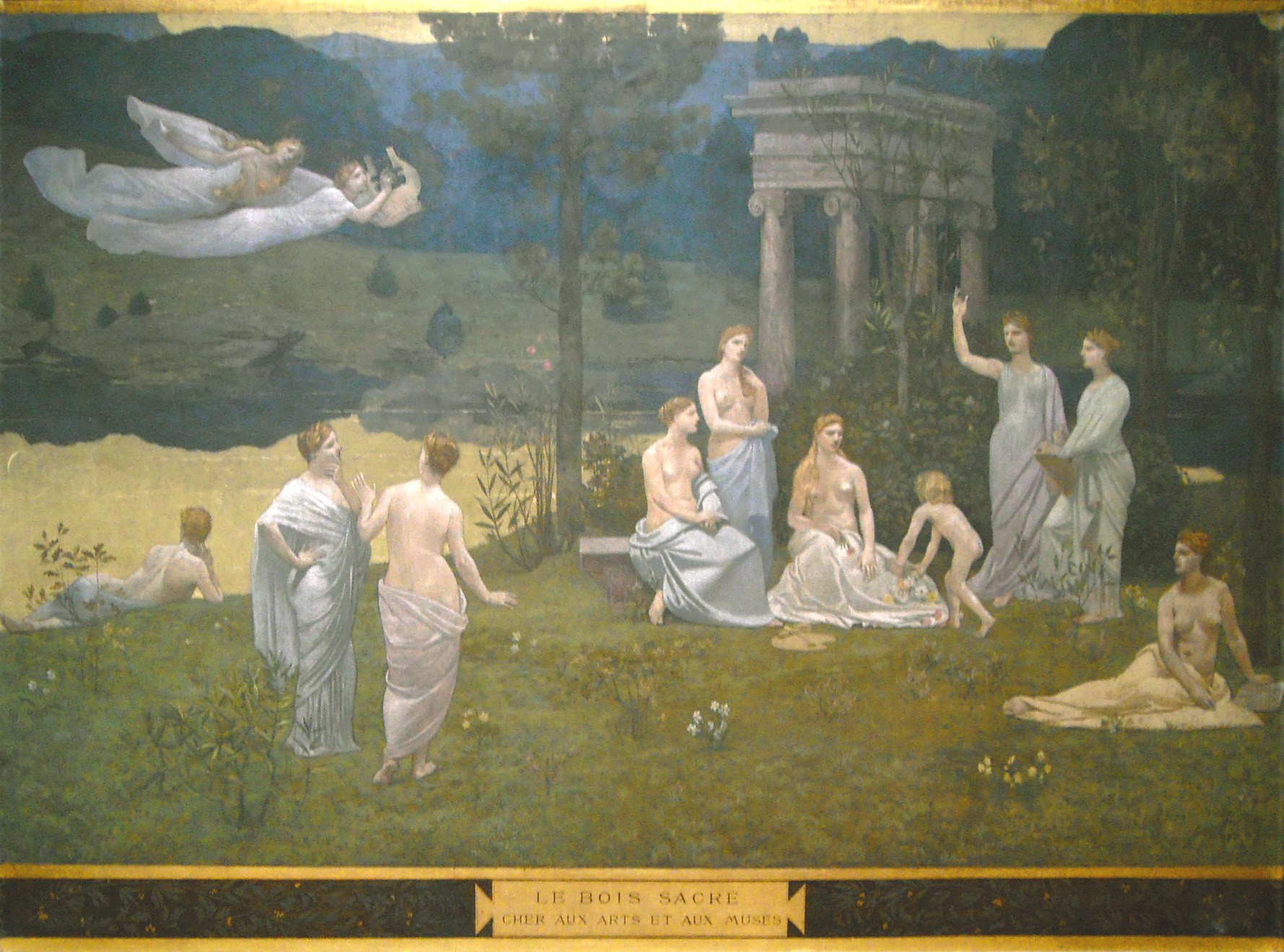
Pierre Puvis de Chavannes offers one of the quietest versions of this method. In The Sacred Grove, Beloved of the Arts and Muses, made for the staircase of the Musée des Beaux-Arts de Lyon, symbolic meaning comes through pale color, spacing, scale, and silence rather than dramatic action.
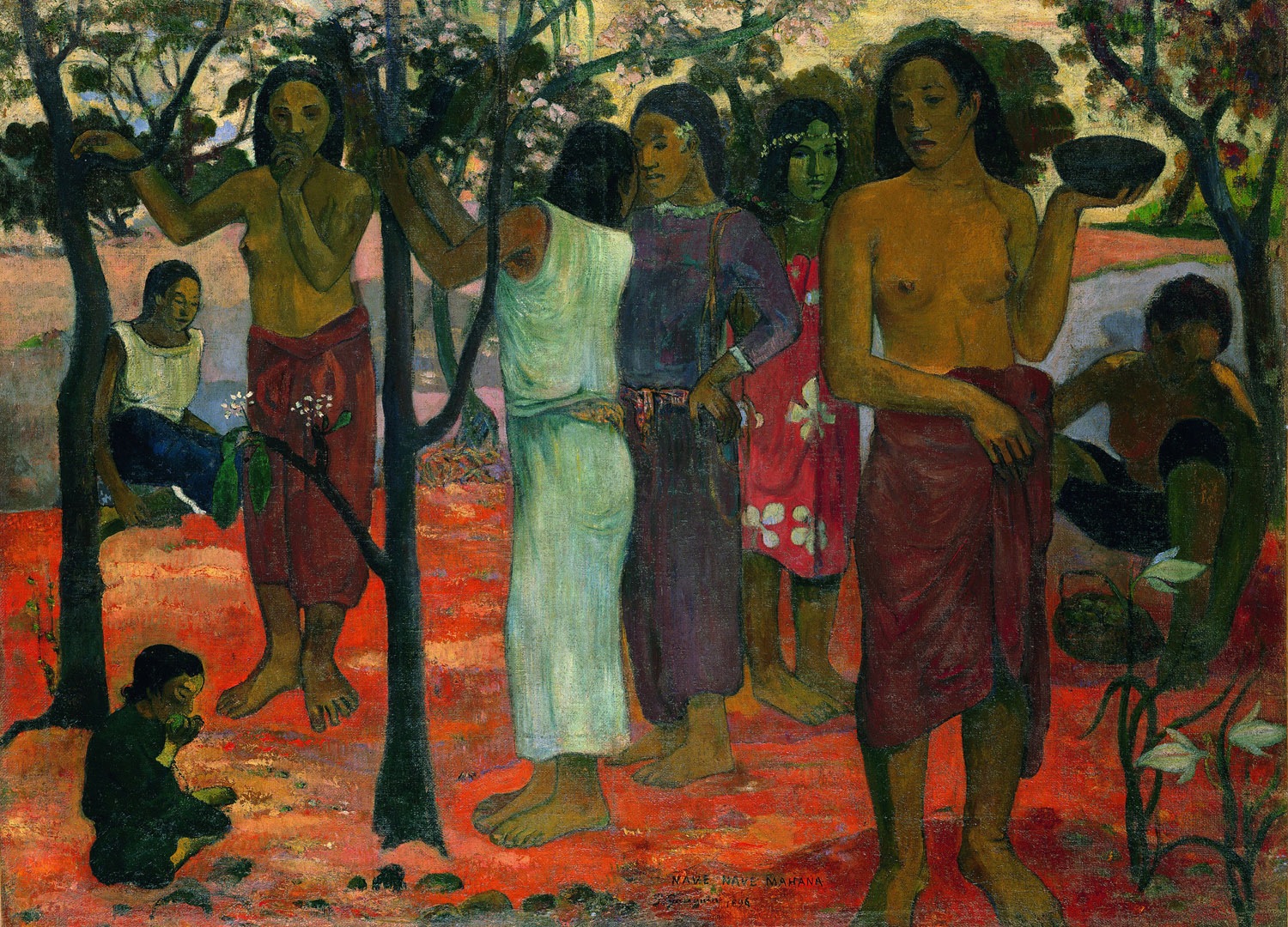
Paul Gauguin sits close to this logic through his Tahitian paintings. In Nave Nave Mahana, figures, red ground, trees, and title do not explain one fixed story. They build a charged image of paradise, myth, and colonial projection.
Klimt turns ornament into structure
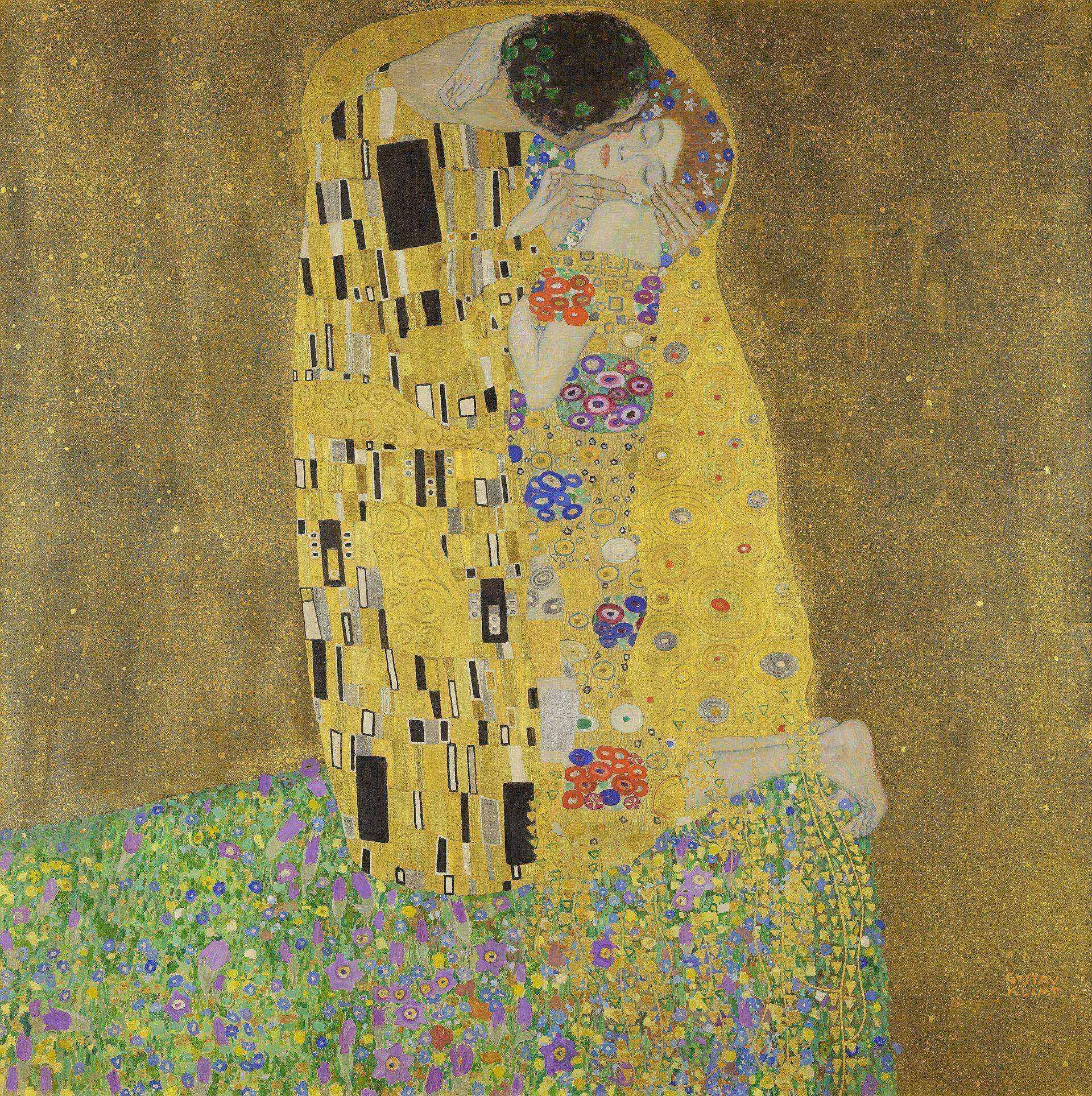
In The Kiss, Gustav Klimt shows one Symbolist possibility. Ornament does not sit on top of the image as decoration. Gold leaf, patterned garments, and compressed space turn intimacy into a threshold between flesh, ritual, and abstraction. The lovers are close, but the image never settles into simple sentiment.
Klimt proves that Symbolism can be lush without becoming vague. Pattern is structure. Surface is argument. The image invites attraction, then complicates that attraction by making the bodies look almost absorbed into a larger decorative system.
Munch pushes Symbolism toward psychic shock
In The Scream, Munch keeps the Symbolist logic of suggestion but drives it toward a more direct perceptual crisis. The bridge, the sky, and the figure no longer describe a setting and a person in a stable way. They vibrate together until the whole image behaves like an exposed nervous system.
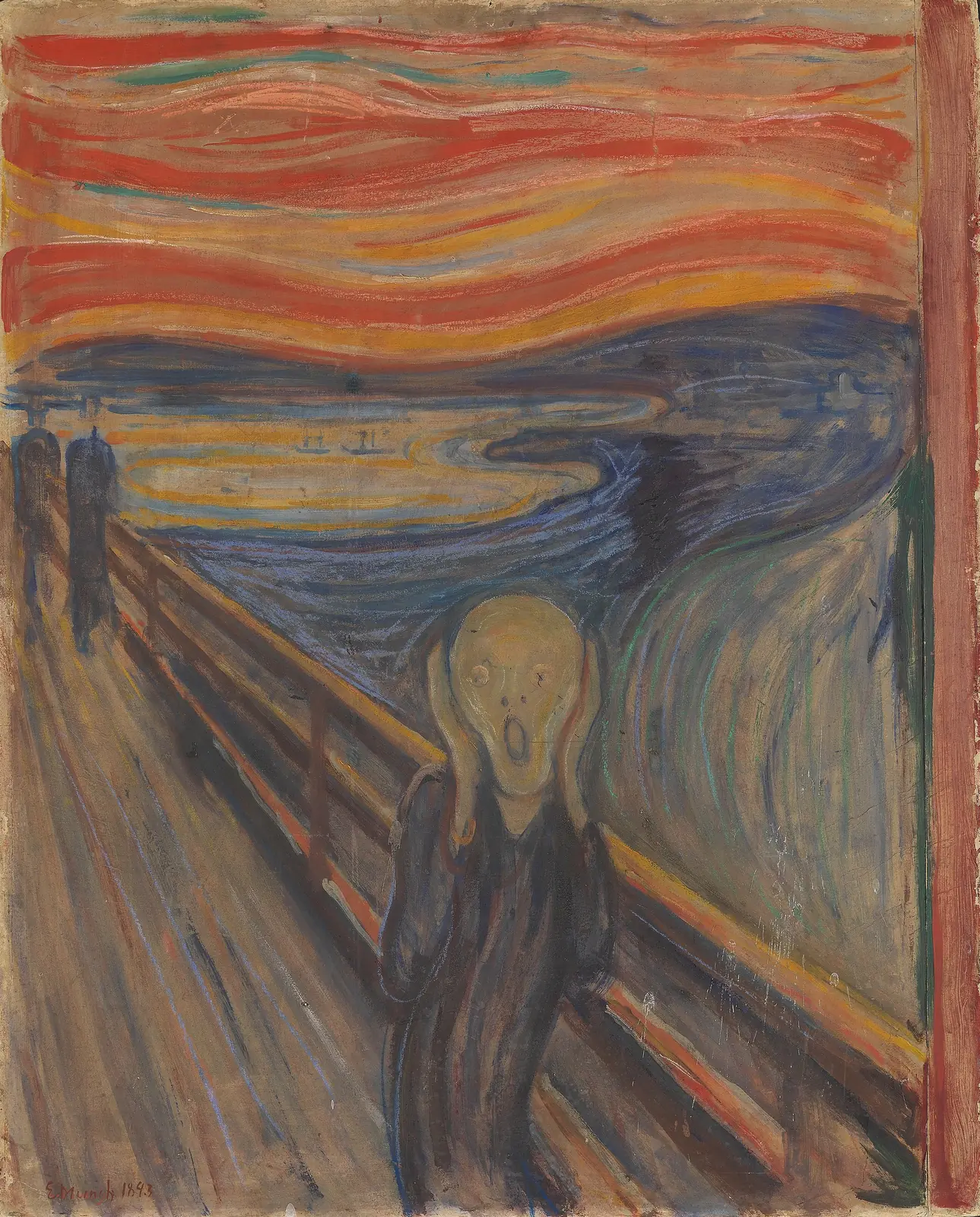
Munch stands near the threshold of Expressionism. The painting still works through ambiguity and symbol, but the pressure is no longer held at a distance. Symbolism begins to sound louder inside the picture.
Ciurlionis composes the image like a score
With Sonata of the Sea. Allegro, Ciurlionis opens a third path. The image remains full of symbolic atmosphere, but it is organized less like a scene than like a score. Repetition, interval, and visual tempo matter as much as iconography. Symbolism here begins to move toward musical structure and, eventually, toward abstraction.
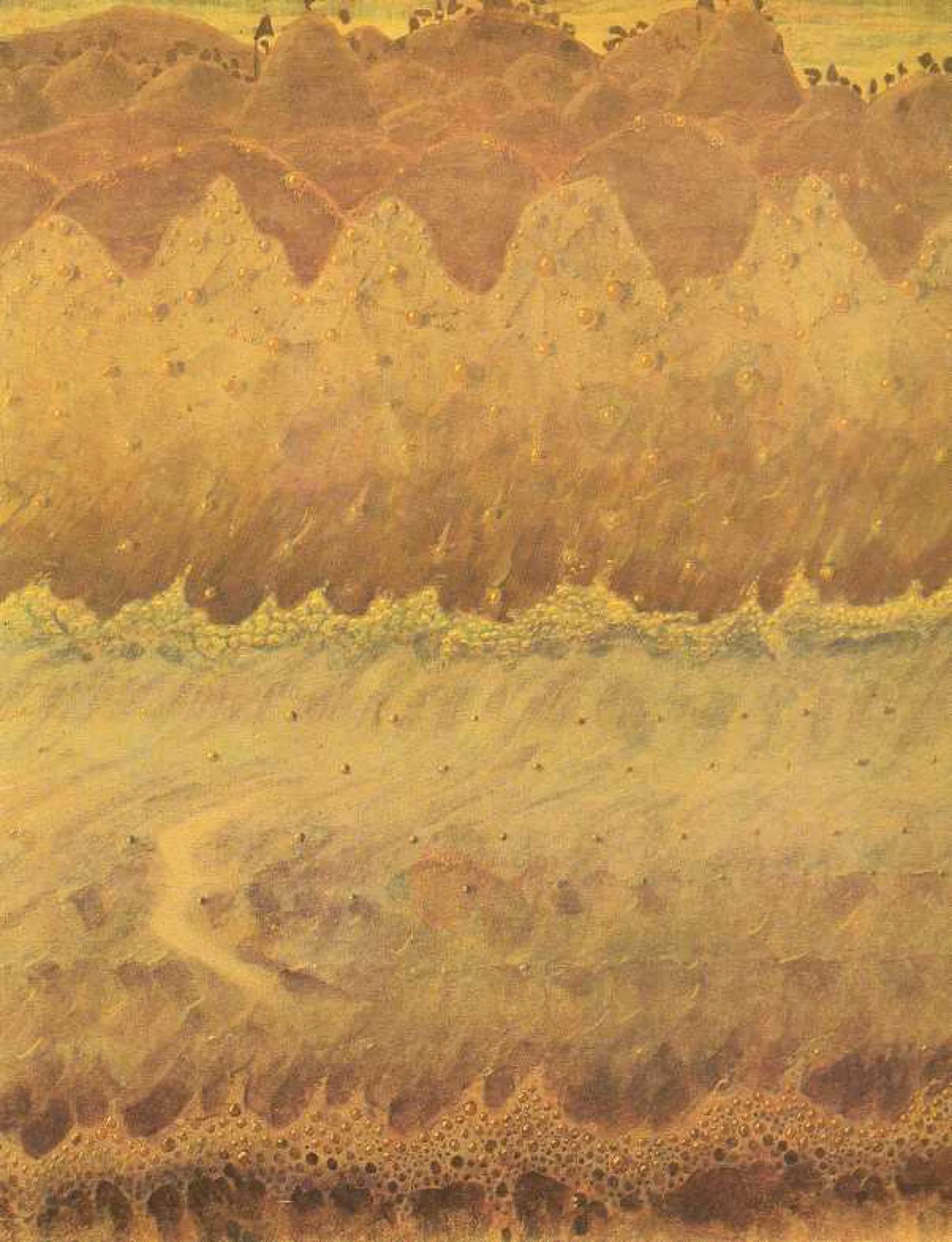
Across that range, Symbolism becomes more than a decorative side branch of modern art. It gives modern artists a disciplined way to make literal description only one possible relation to truth.
What Symbolism changes in modern art
Symbolism occupies a hinge position between late Romanticism, Post-Impressionism, Expressionism, and later forms of abstraction and Surrealist dream imagery. It changes the status of ambiguity. In academic art, ambiguity often looked like failure. In Symbolism, ambiguity becomes a disciplined method.
That shift is still modern. A Symbolist image can be exact and indeterminate at once. It can hold emotional pressure without turning into illustration, and mythic charge without collapsing into one fixed allegory. Symbolism still helps explain how images work after the nineteenth century.
How to read a Symbolist image
- Start with the literal scene before jumping to hidden meanings.
- Track which motifs feel loaded but unstable: water, flowers, mirrors, twilight, gold, isolated figures.
- Read line, color, and pattern as meaning-bearing elements, not as secondary style.
- Keep several interpretations active, but reject readings that the image itself does not support formally.
Read Klimt for ornamental density, Munch for psychic pressure, and Ciurlionis for images built like visual scores. Together they show that Symbolism is not one look, but a shared way of loading images with meaning beyond plain description.
Key artists
Key works in Explainary
Connected movements in Explainary
Use the art quiz as a quick check: can you recognize Symbolism not by one repeated look, but by the way images keep meaning open while still feeling tightly built?
Primary sources
Frequently asked questions
Symbolism in art is a late nineteenth-century movement in which artists use figures, objects, color, and atmosphere to suggest inner states, mythic meanings, and psychological pressure rather than simply describe the visible world.
Symbolism usually keeps more distance, ambiguity, and allusion. Expressionism pushes inner pressure closer to rupture, distortion, and direct perceptual shock. Munch stands near the threshold between the two.
The Scream does not only show a frightened person. Munch turns sky, bridge, line, and color into signs of inner panic. The image still works through suggestion, even as it points toward Expressionism.
No. Symbolism is better understood as a shared method than a single look. Klimt, Munch, and Ciurlionis paint very differently, but all use images to carry more meaning than literal description can contain.