
Post-Impressionism / Symbolism
Nave Nave Mahana
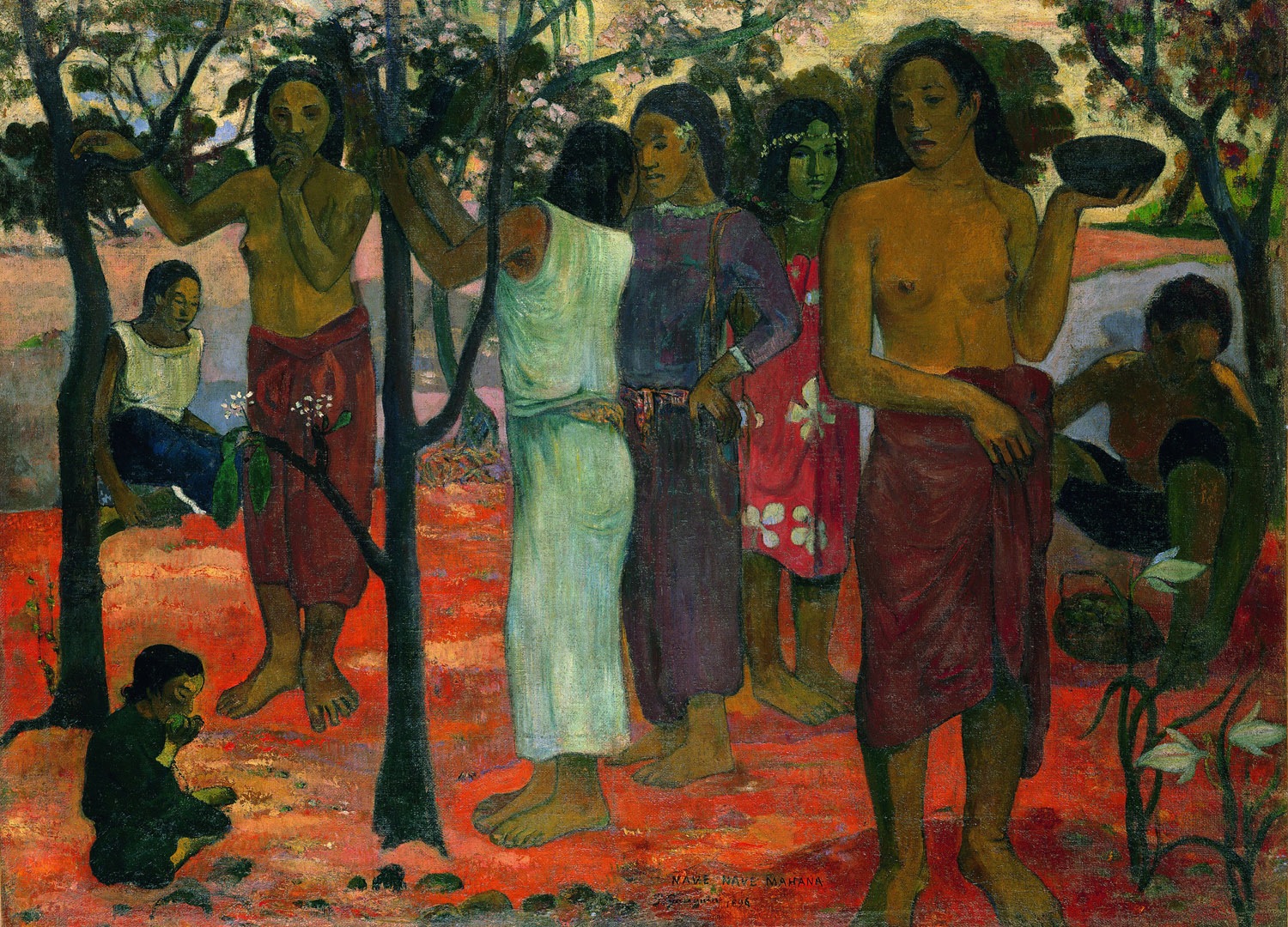
A group of Tahitian figures stands across red earth, and Gauguin makes the scene feel less like a recorded moment than a painted myth. Paul Gauguin painted Nave Nave Mahana in Tahiti in 1896, during his second stay in the Pacific. The work now belongs to the Musée des Beaux-Arts de Lyon, which acquired it in 1913. Its Tahitian title means "Delicious Days," but the picture is not a simple postcard of pleasure. It is a staged world, built from strong contours, flattened figures, repeated poses, and an idea of Tahiti shaped by European desire.
The painting is large enough to feel public: 95 x 130.2 cm. Gauguin arranges bodies across the surface like a frieze. Some stand frontally, some turn sideways, some sit or crouch near the edges. Trees cut through the scene as dark verticals. The ground is not natural brown soil but a hot red field, and the figures do not dissolve into atmosphere. They hold their place like signs.
That is the first thing to see. Gauguin is not painting Impressionist light. He is building an image through placement, color, and contour. The result belongs to Post-Impressionism, but it also leans toward Symbolism: the visible scene carries more meaning than it can explain directly.
A Tahitian title, a European construction
The title gives the painting part of its attraction. Nave Nave Mahana evokes delicious or delightful days, and the Lyon museum notes that Gauguin used it to connect the work with an imagined paradise. But the painting has to be read with care. Tahiti was not outside history. Gauguin worked there inside a French colonial world, and his image turns people, plants, color, and myth into material for a fantasy of origin.
That tension does not weaken the painting formally. It makes the picture sharper to read. Gauguin's power lies in the way he organizes the surface: the red ground pushes forward, the dark trees divide the figures, the bodies become simplified blocks, and the palette refuses ordinary naturalism. His problem lies in the fantasy attached to that organization. The image asks to be admired for its invention and questioned for the world it invents.
The central figures do not behave like casual models. They are slowed, frontal, and almost ceremonial. The museum's focus sheet connects Gauguin's own thinking to the idea of a woman becoming an idol while remaining alive. That sentence helps explain the painted stillness: the bodies are not portraits in an everyday setting. They are figures arranged to make Tahiti look timeless, symbolic, and available to the painter's myth.
How the composition works
The painting is organized by verticals and pauses. Tree trunks interrupt the view like dark bars. They keep the eye from moving smoothly across the scene. Between those trunks, Gauguin places bodies that face different directions but share the same flattened pressure. The picture advances across the surface more than it recedes into depth.
Color carries much of the structure. The red-orange ground occupies the lower half of the canvas and makes the scene feel heated, artificial, and decorative. White, purple, green, and deep red garments then mark the figures as distinct blocks. The large bare torso on the right becomes a calm mass of ocher against the darker trees and cloth. Gauguin does not use color to imitate light; he uses it to hold the image together.
The figures also differ in scale and attention. Some look outward, some turn away, one crouches in the foreground, and another bends at the right edge near pale flowers. The scene stays legible but never settles into a single story. It is more useful to read it as a constructed field of poses, symbols, and distances than as an episode with a beginning and an end.
Beside Gauguin's larger Tahitian question
Nave Nave Mahana belongs near Where Do We Come From? What Are We? Where Are We Going?, painted in 1897-1898. Both works use Tahitian figures, a frieze-like arrangement, and a surface that reads almost like a mural. The Boston painting turns that method into a vast meditation on birth, life, and death. The Lyon painting is tighter, brighter, and more concentrated around the fantasy of a paradise made still.
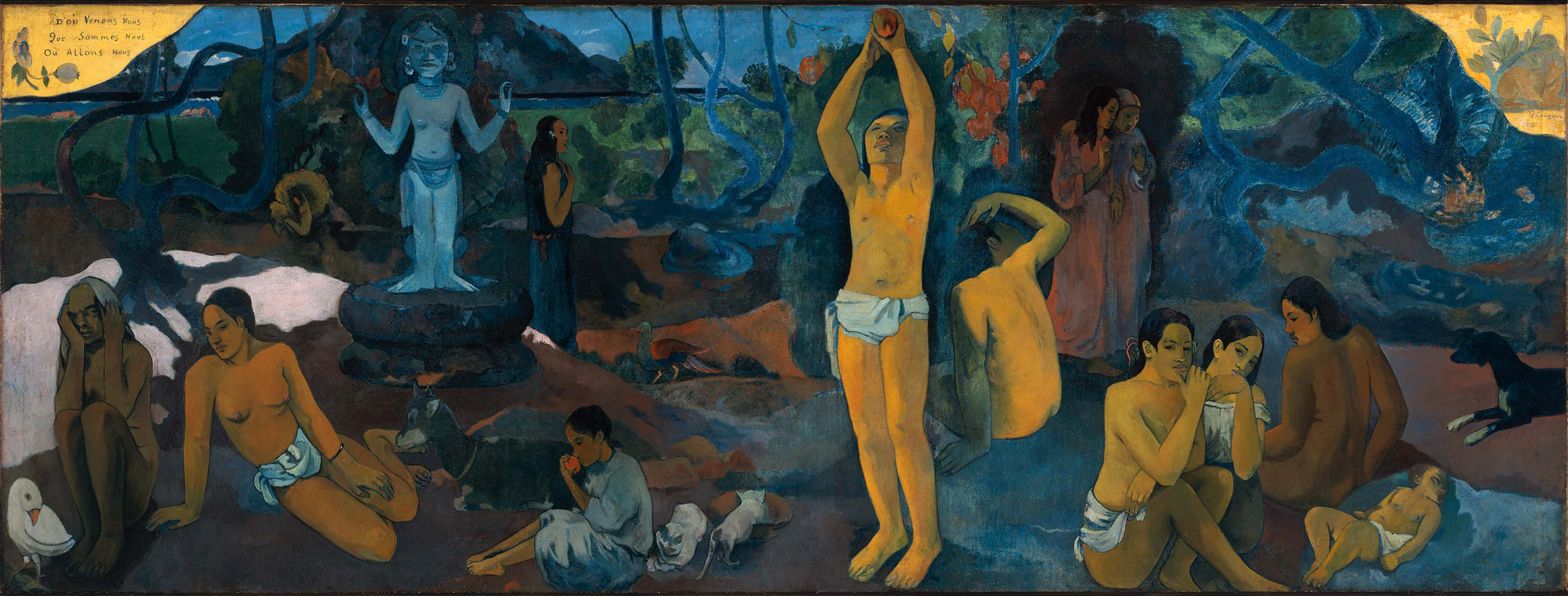
Reading the two together makes Gauguin's method concrete. He repeats and rearranges figures, pushes depth into pattern, and lets titles steer interpretation without closing it. The paintings do not explain Tahiti. They reveal how Gauguin wanted painting to transform place into symbol, and how unstable that transformation becomes once the colonial frame is visible.
Why Lyon's acquisition matters
The Musée des Beaux-Arts de Lyon acquired Nave Nave Mahana in 1913, ten years after Gauguin's death. The museum presents the acquisition as the first purchase of a Gauguin by a French museum. At the time, that decision was bold: Gauguin's style still met resistance, and his Tahitian paintings did not fit comfortably within older French expectations of finish, perspective, and subject.
The acquisition also helps locate the painting in modern art history. This is not only a Tahitian subject. It is a French museum accepting that modern painting could be flat, decorative, anti-naturalistic, and intellectually ambitious. The Lyon canvas therefore belongs to a wider shift that leads from Gauguin toward the Nabis, Fauvism, and early twentieth-century simplification.
The museum's focus sheet even points to Matisse's Luxe, Calme et Volupté as an heir to the frieze-like arrangement and pure color of Nave Nave Mahana. The connection is formal rather than anecdotal: Gauguin gives later painters a way to make color and arrangement carry the main burden of meaning.
How to read it in front of the painting
Start with the red ground, not with the faces. It tells you that the scene is constructed rather than simply observed. Then follow the tree trunks and notice how they divide the bodies into separate stations. Next, compare the standing figures with the crouching and seated figures near the edges. The painting holds them together without turning them into one narrative action.
Gauguin makes Tahiti look timeless by flattening bodies into a frieze, but the painting remains tied to a colonial fantasy of paradise.
Continue through Gauguin's profile, the guide to Post-Impressionism, and the broader page on Symbolism. Then compare the work with Where Do We Come From? What Are We? Where Are We Going? and test your eye with the art quiz.
Explore more
Primary sources
Frequently asked questions
The Musée des Beaux-Arts de Lyon explains that Nave Nave Mahana means "Delicious Days" in Tahitian.
Nave Nave Mahana is in the Musée des Beaux-Arts de Lyon. The museum acquired the painting in 1913, ten years after Gauguin's death.
It is one of Paul Gauguin's major Tahitian paintings and the first work by Gauguin purchased by a French museum. It shows his mature use of flattened form, symbolic color, and frieze-like composition.
It belongs to Post-Impressionism through its anti-natural color and flattened structure, and to Symbolism through its mythic, suggestive treatment of Tahiti.
Begin with the red ground, then follow the dark tree trunks, the repeated poses, and the simplified bodies. The painting works less as a narrative scene than as a constructed field of color, contour, and myth.