
Post-Impressionism
The Card Players (Met version)
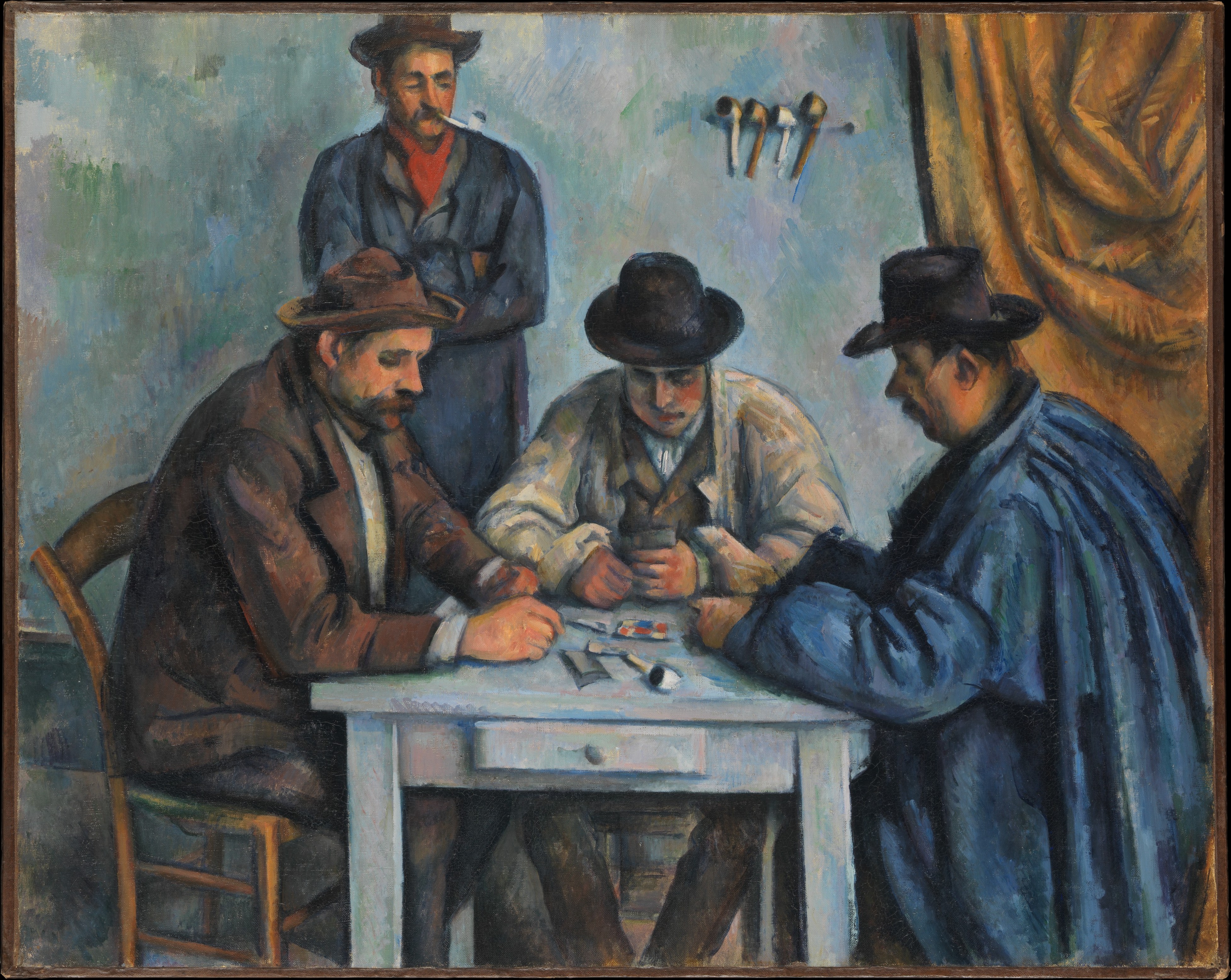
Paul Cézanne turns a card game into a slow, tightly built scene. The first thing to know is that The Card Players is not a single isolated canvas, but a late series of five related paintings. The Metropolitan Museum picture is one version within that larger project, and it belongs to the core of Post-Impressionism because it rebuilds ordinary observation into something slower and more deliberate. What matters is not suspense or storytelling, but the pressure with which bodies, hats, sleeves, table edges, and intervals hold together.
What this version shows
The Metropolitan Museum's version places peasant figures in a stripped interior, with three seated men engaged in play and a fourth standing behind them. Pipes, hats, cards, and the narrow table are all easy enough to identify, but Cézanne drains the scene of anecdotal noise. Nobody performs for the viewer. Nobody smiles, cheats, or erupts. Even the spectatorship is quiet. This particular version turns the game into a field of concentration rather than a miniature drama.
That restraint matters. Older card-player scenes in European painting often depend on moral contrast: drink, deception, rustic comedy, or cautionary vice. Cézanne removes almost all of that. The men are monumental without becoming heroic. Their stillness feels heavy, not theatrical. The room gives them just enough setting to remain legible, while keeping the eye fixed on relations between forms.
One painting inside a larger serial project
The Card Players is not a lone invention but part of a concentrated late series. Between about 1890 and 1892, Cézanne produced five related versions and many preparatory studies, most likely using laborers from around the Jas de Bouffan estate near Aix-en-Provence as models. That serial method is already modern in spirit. He does not search for one perfect snapshot. He keeps adjusting scale, number of figures, and spacing until the subject becomes a problem of pictorial balance.
This is one reason the work belongs so securely within Post-Impressionism. The painting keeps the modern refusal of academic finish, but it moves away from the fleeting optical event prized by Impressionism. Cézanne wants something sturdier. He wants a scene that can be seen, tested, rebuilt, and held in equilibrium.
Cézanne's method: building form through pressure
The method looks calm until you pay attention to how unstable its geometry really is. Space is compressed rather than smoothly deep. The table does not behave like a neutral stage. Clothing is described through blocks of blue, brown, ocher, and gray that feel both observed and reorganized. Edges never lock into hard outline for long; they are negotiated through adjacent patches of color. The result is solid, but never mechanically fixed.
That is the crucial point. Cézanne does not flatten the world into design, nor does he dissolve it into atmosphere. He builds form through repeated decisions. Every sleeve, hat brim, shoulder, and hand carries a small adjustment of relation. You feel the painting thinking. This is why later artists could learn so much from him: not because he abandoned nature, but because he showed how nature might be reconstructed on the canvas rather than merely copied.
A different stillness from Seurat's
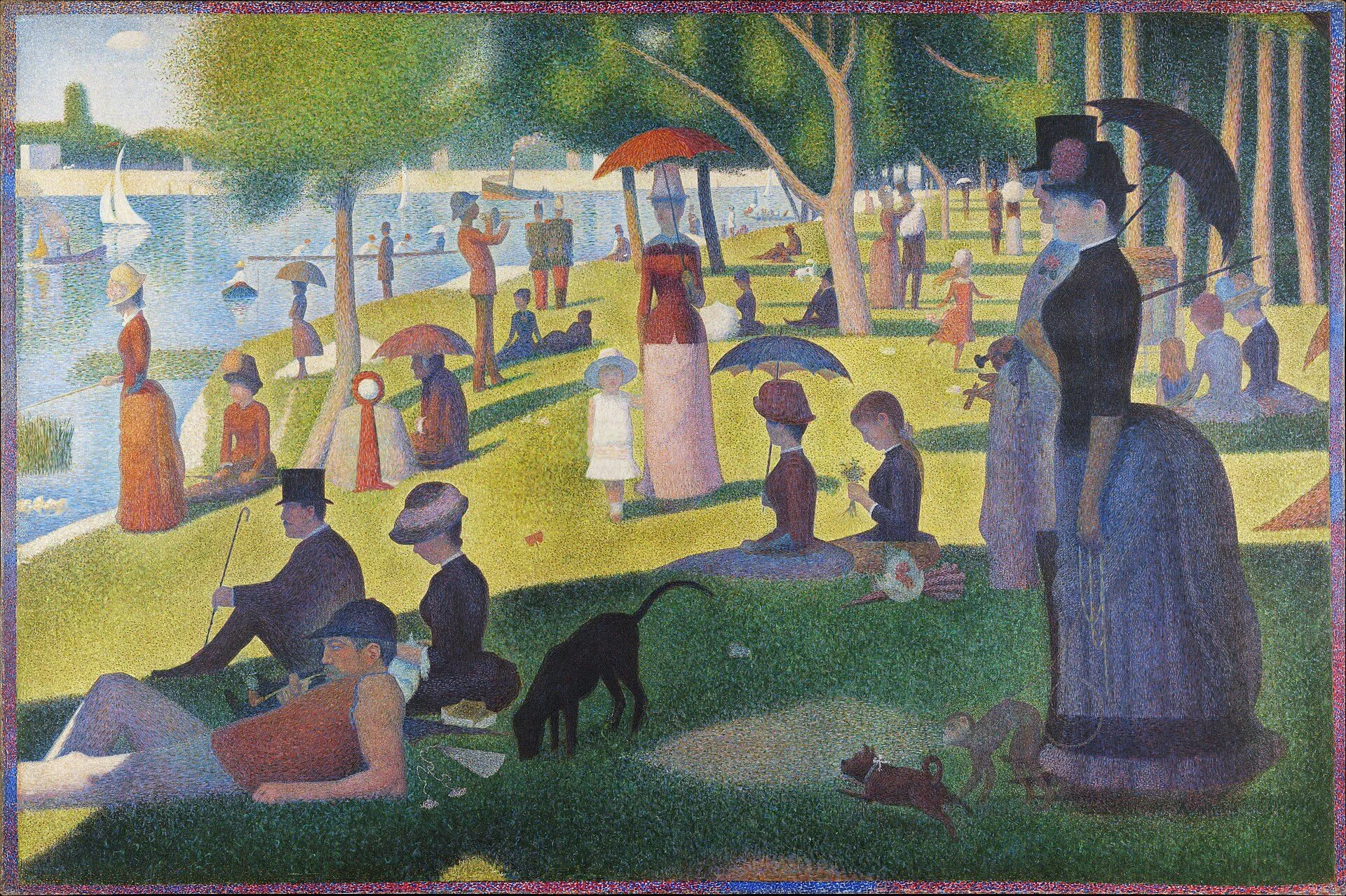
A useful comparison runs to A Sunday Afternoon on the Island of La Grande Jatte. Georges Seurat also slows public life into a controlled arrangement, but his order is cooler and more systematic. Seurat suspends the city through measured intervals and optical method. Cézanne, by contrast, thickens the scene. His stillness feels rural, manual, and weight-bearing. One painting is built on serial color logic; the other on the pressure of bodies and planes.
Within the same broader movement, the comparison also clarifies Cézanne's distance from Sunflowers. Van Gogh makes paint carry urgency and inner pressure. Cézanne makes paint carry structure. Both are post-impressionist, but they pull in very different directions: one toward emotional intensity, the other toward durable construction.
If you want the wider map behind that difference, read our essay Impressionism vs. Expressionism. It helps place Cézanne between what Impressionism still gives him and the more openly expressive distortions that emerge later.
Ordinary life as a structural test
The Card Players matters because it shows modern art finding seriousness in the ordinary without borrowing grandeur from history painting. Nothing here depends on myth, political event, or spectacular emotion. A provincial card game is enough, provided painting can discover the right formal terms for it. That shift is foundational for twentieth-century art. The road toward Cubism does not begin with abstraction out of nowhere; it begins with painters like Cézanne asking how a scene can be held together as structure.
The painting therefore lasts for more than historical prestige. It remains persuasive because it never confuses quietness with emptiness. The longer you look, the more the work reveals itself as an organized tension between observation and design. Cézanne does not illustrate peasant life. He uses peasant life to test what painting itself can become.
Related works
Test yourself with the quiz
Continue with the art quiz. If The Card Players now feels distinct to you, you should be able to separate Cézanne's structural stillness from Seurat's system and Van Gogh's pressure.
Primary sources
Frequently asked questions
Because Cézanne turns a humble card game into a test of structure, weight, and relation. The painting matters less as anecdote than as a model for how modern art can rebuild observation into form.
Cézanne painted five related versions of The Card Players between about 1890 and 1892, alongside many studies. The Met picture belongs to that larger serial project rather than standing as an isolated canvas.
Not really. Unlike older tavern scenes built around cheating, drink, or comic vice, Cézanne strips the subject of drama. The real focus is concentration, stillness, and pictorial construction.