
Post-Impressionism
Sunflowers
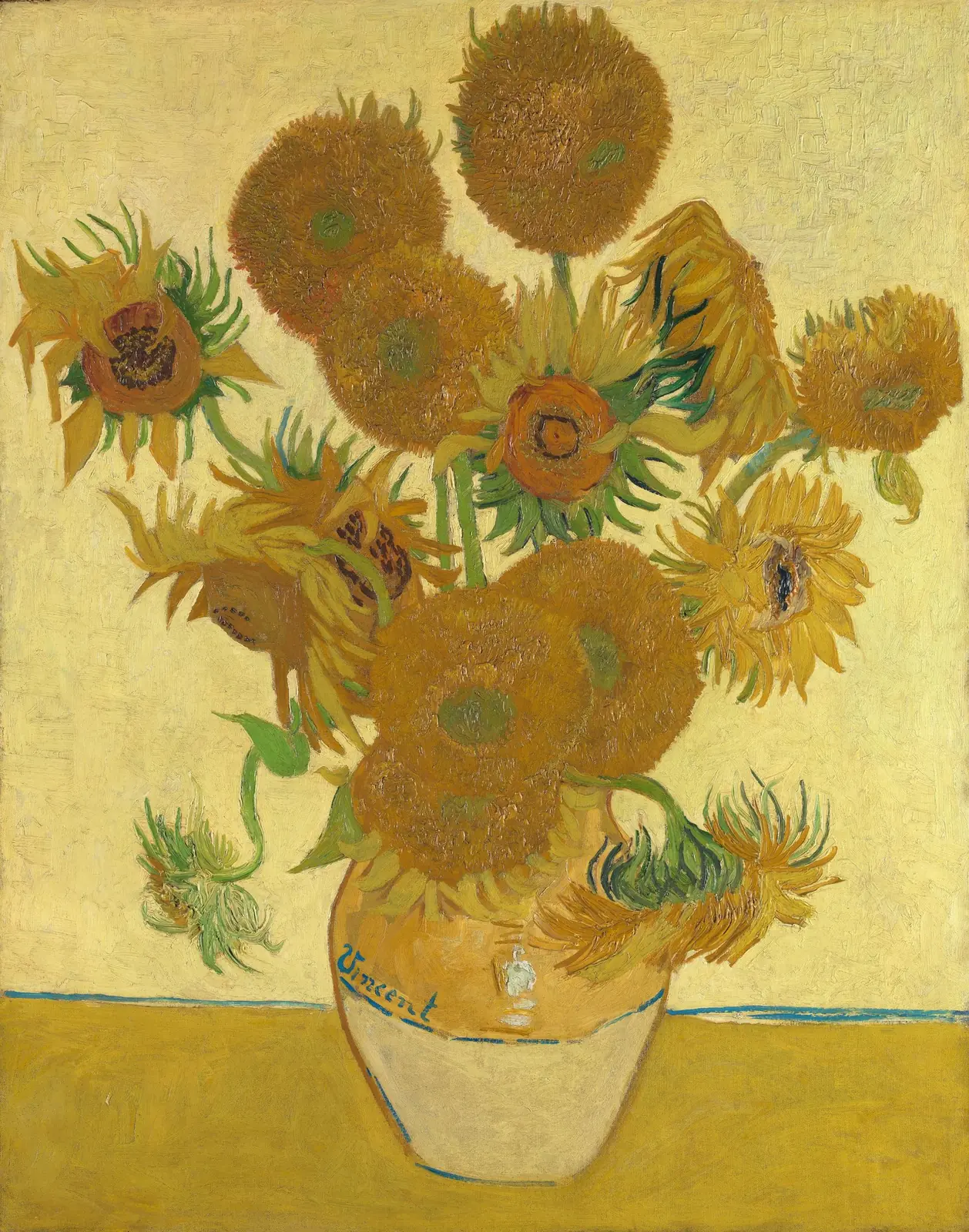
Vincent van Gogh turns a vase of flowers into a time machine. In Sunflowers, the limited palette, rough impasto, and staged bloom cycle create a high-pressure lesson in how Post-Impressionism transforms ordinary objects into emotional structure. The serial versions also read as laboratory tests, not decorative repeats.
A bouquet of time
Some blooms are fresh, others are wilting. Van Gogh paints the flowers not as decoration but as a cycle of life. In practice, the bouquet is arranged like a compressed sequence rather than a still arrangement.
The vase and tabletop are simple, keeping the focus on changing petal states and paint density. For comparison, look at the night sky turbulence of The Starry Night or the atmospheric spread of Impression, Sunrise.
Yellow as atmosphere
Van Gogh builds the image with layers of yellow, from pale lemon to deep ochre. The color is not just hue; it is mood.
The background vibrates with brushwork, making the air feel warm and dense.
Friendship and intention
Van Gogh painted these sunflowers to decorate the Yellow House before Paul Gauguin's visit. The painting carries both hospitality and strategic intent: it presents color as a public welcome and as an artistic manifesto.
It is a still life, but it is also a personal message, a gift in paint.
A modern icon
The Sunflowers series became one of the most recognizable works in modern art, celebrated for its directness and for its bridge from Impressionism to more volatile modern color systems.
It shows that intensity can come from ordinary things when an artist paints with full attention. By contrast, compare its concentrated pressure with The Scream or with later chromatic structure in Yellow-Red-Blue.
What the bouquet reveals about time and matter
Van Gogh paints flowers at different life stages in the same vase: full bloom, opening, drooping, and spent heads. The bouquet becomes a compressed timeline, not a decorative still life. Instead of ideal beauty, the painting accepts growth and decay as part of one emotional field.
The yellow-on-yellow strategy is deliberate risk. By narrowing the palette, Van Gogh forces variation through texture, value, and brush direction. Petals, seeds, and background all sit near one color family, yet each zone feels distinct because the paint handling shifts constantly between thick ridges and lighter strokes that catch light differently.
- The rough tabletop line gives the arrangement grounded immediacy.
- Heavy impasto around flower centers makes time feel physical.
- The simple vase inscription turns the image into a personal signature object.
Painted in Arles in 1888 while preparing the Yellow House for Paul Gauguin, this canvas is both hospitality and experiment. Across the Sunflowers versions, Van Gogh tests how far a restricted palette can go before form breaks, in a serial method closer to research than to decorative repetition.
The usual misunderstanding is to read Sunflowers as cheerful decor only. The bouquet is warmer than most still lifes, but structurally it is about time, wear, and controlled instability. That is why the painting feels both intimate and rigorous.
Use the art quiz as a quick check: can you connect Sunflowers to Vincent van Gogh when the options are mixed?
Explore more
Related works
Primary sources
Frequently asked questions
The National Gallery in London holds the Arles version from 1888. Van Gogh painted multiple Sunflowers canvases, so location depends on the specific version.
Certain pigments used by Van Gogh are chemically sensitive and can darken over time. Conservation research tracks these shifts to better understand the painting's original color balance.