
Realism / Musée des Beaux-Arts de Lyon
The Wave
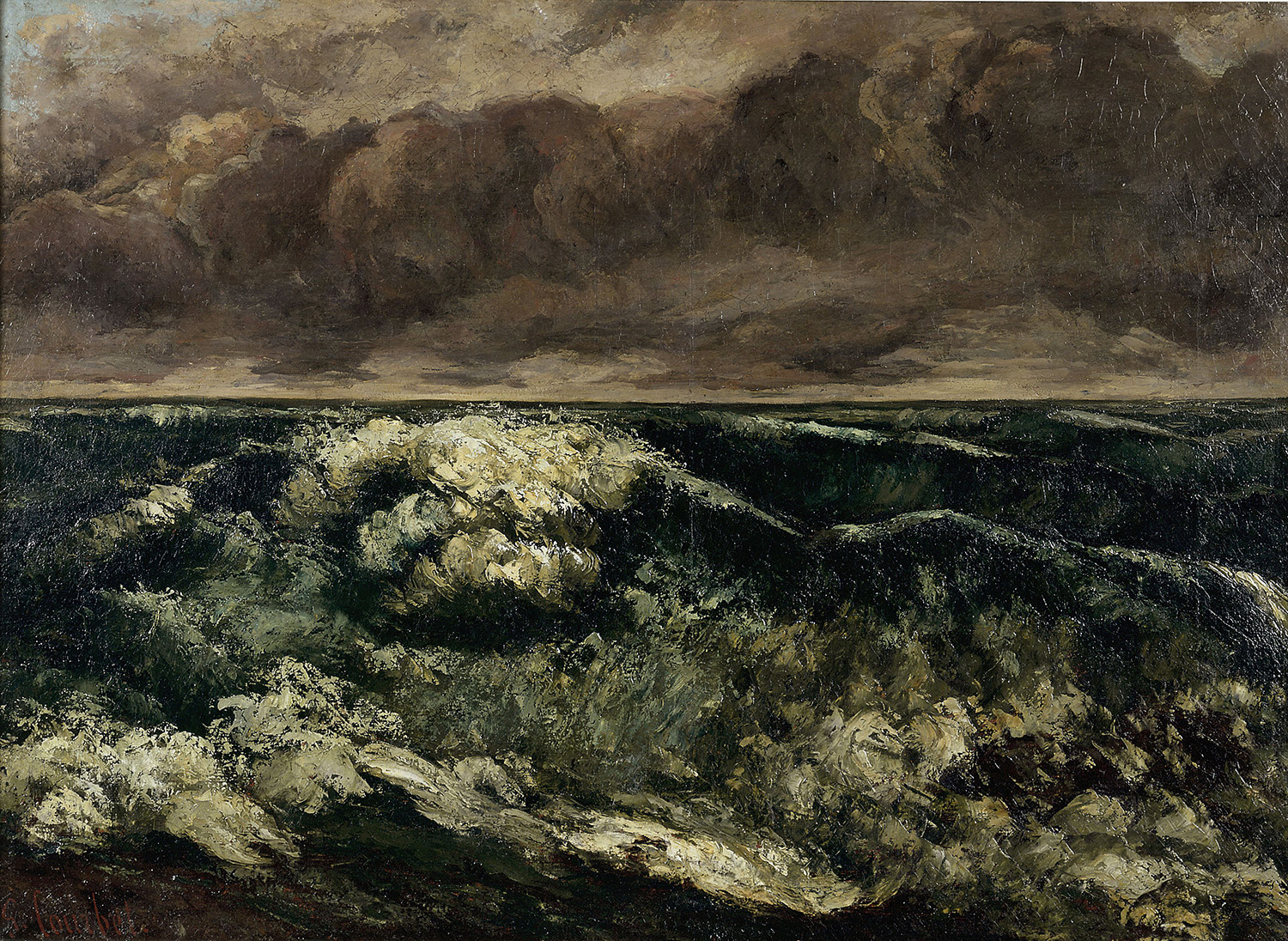
Courbet removes boats, shore, and story until only a wall of sea remains. Gustave Courbet's The Wave, painted in 1870 and held by the Musée des Beaux-Arts de Lyon, is one of the clearest seascapes in his late Realist language. It comes out of the wave series he began after staying at Étretat in 1869. The subject is almost nothing: green water, white foam, a low dark horizon, a heavy sky. The painting turns that nothing into pressure.
The Lyon museum links the work to Courbet's Normandy period, when he rented a house at Étretat and began making seascapes in response to the coast's storms, cliffs, and exposed weather. The important point is not topographic precision. The picture gives almost no local clue. Courbet strips the site down until the sea becomes a physical event: water rises, thickens, curls, and hardens into something close to rock.
What the painting shows
There is no shipwreck, no sailor, no beach anecdote, no picturesque cliff to make the view recognizable. The wave occupies the middle of the canvas like a mass pushing forward. The green of the sea is not a decorative color; it feels dense, cold, and mineral. White foam breaks across the surface, but it does not make the scene airy. It makes the weight more visible.
The horizon cuts the painting sharply. Above it, the sky is low and muted. Below it, the water moves in heavy ridges. Courbet refuses the usual marine pleasure of distance. Instead of sending the eye toward boats or sunset, he presses the viewer against the immediate force of water. The sea is not scenery here. It is matter in motion.
Realism without a human subject
Courbet is often introduced through social subjects, especially A Burial at Ornans. That painting makes villagers occupy the scale of history painting. The Wave transfers the same Realist bluntness into landscape. There is no mythic storm, no romantic ship at risk, no moral lesson attached to the sea. Courbet gives ordinary natural force the seriousness that earlier painting reserved for noble drama.
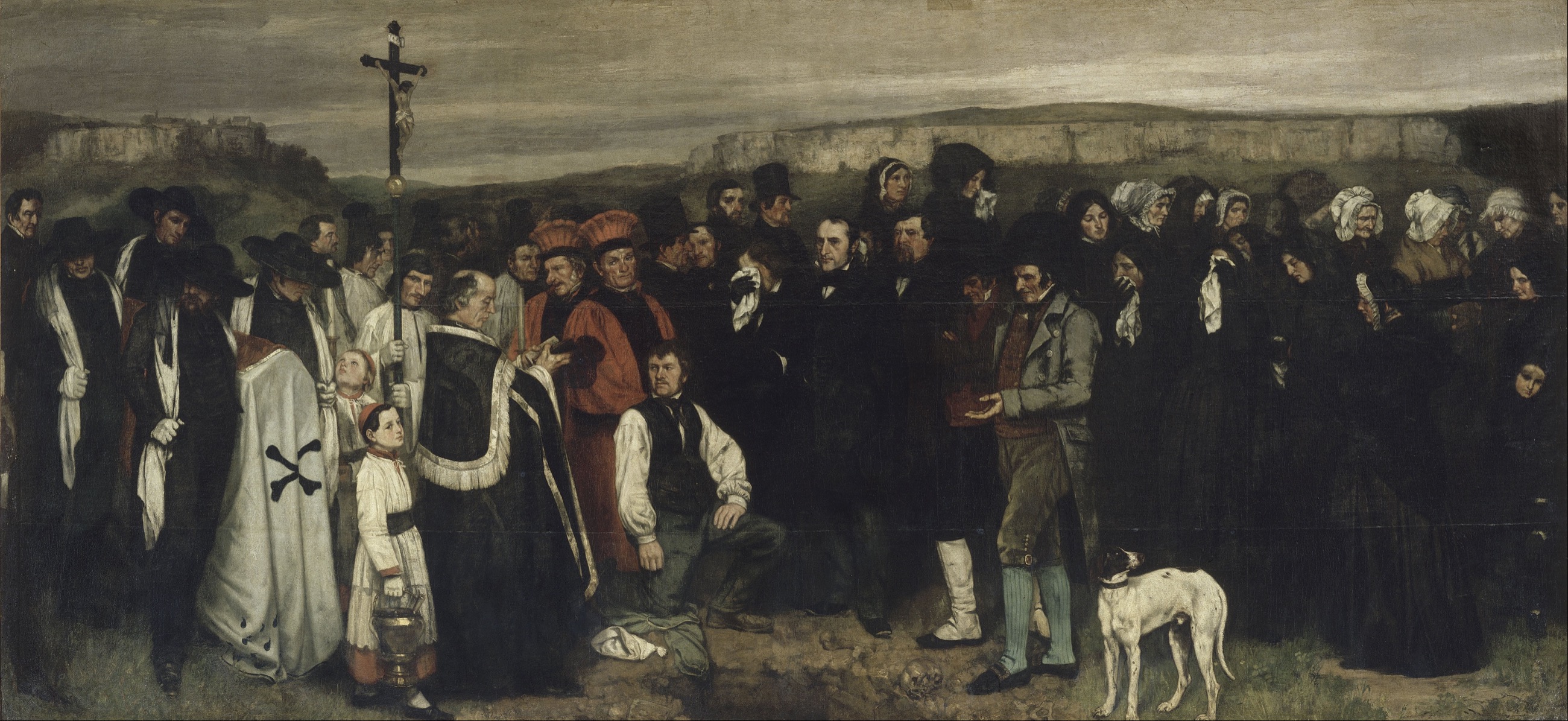
This is why the painting belongs inside Realism, even without peasants, workers, or urban life. Realism is not only the choice of modern subjects. It is also a refusal to polish the world into a polite image. Courbet's sea is rough because he wants water to retain resistance. The brush and palette knife leave marks that behave almost like impact.
Courbet's method: a wave that behaves like stone
The strangest quality of the canvas is its solidity. Courbet was a painter from Franche-Comté, a region of valleys, limestone, and heavy landforms. In the Lyon painting, the sea seems to borrow that geological weight. The wave is not transparent water described from a safe distance. It rises like a cliff, with strokes that make foam, spray, and mass hard to separate.
That handling keeps the painting from becoming a simple storm effect. The image is compact, frontal, and tactile. Courbet's Realism reaches the eye through the body: you feel the blow of the wave before you sort out the scene. The picture is small compared with his most famous works, but it has the force of a compressed encounter.
Courbet at Étretat before Monet's serial coast
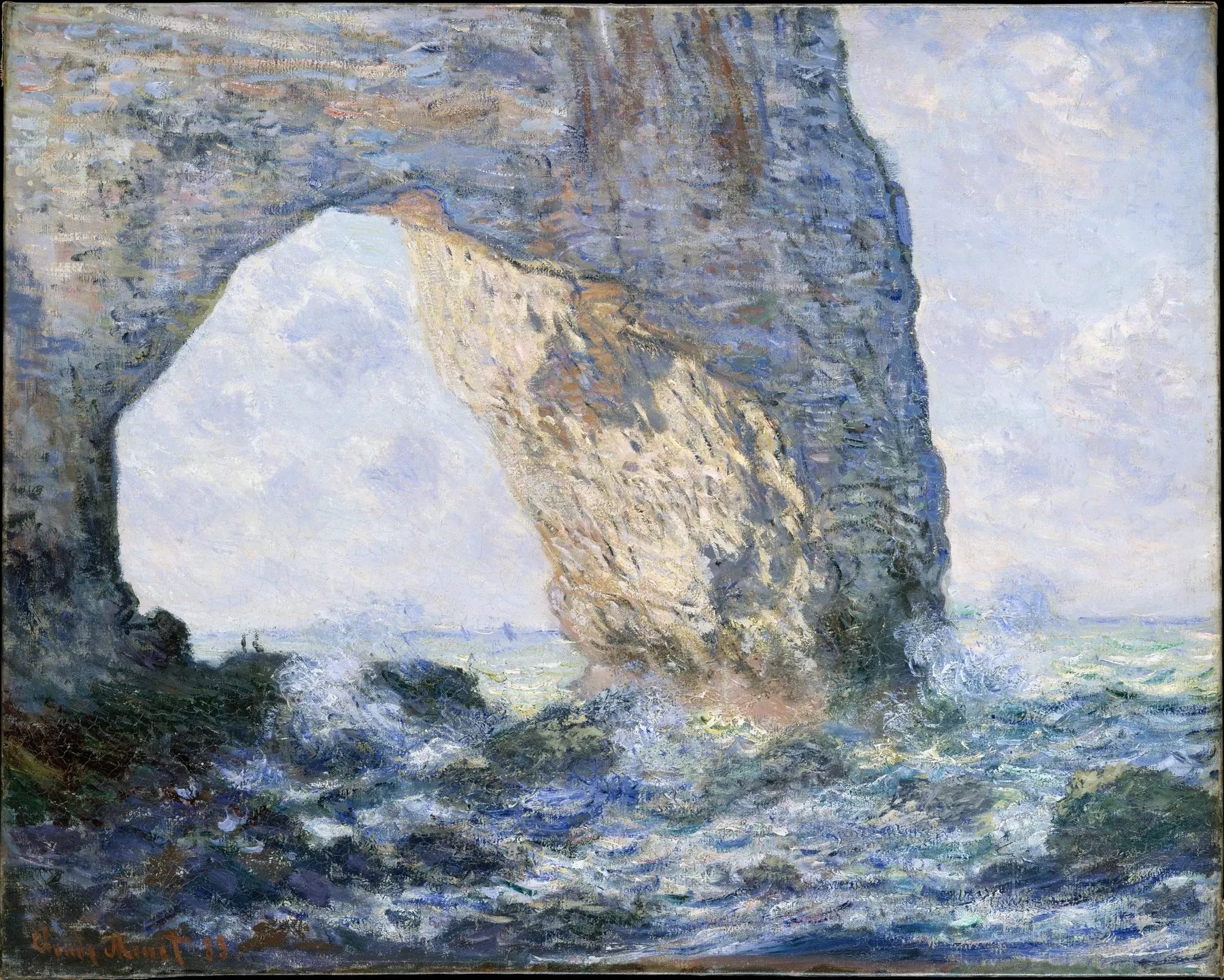
Courbet's Étretat paintings are important for the later history of the site. Compare The Wave with Monet's The Manneporte (Étretat). Courbet treats the coast as force and matter: the motif is narrowed until the sea itself becomes the subject. Monet, working later, uses Étretat as a repeatable motif for changing light, tide, and weather. The link is not imitation. It is a shared understanding that the same coast can be studied again and again because it never appears the same way twice.
How to read it in the museum
Stand back first. The painting resolves almost immediately into three forces: sky, horizon, and water. Then move closer and look at the paint. The wave is not built from smooth illusion but from thick marks, broken whites, dark greens, and compact strokes. Courbet wants the viewer to see both the sea and the labor that makes the sea visible.
Then test the absence of narrative. Nothing explains the wave from outside. No person gives it scale, no boat gives it danger, no coastline gives it tourism. The image asks a direct question: can raw natural force occupy a serious painting without becoming a story? Courbet's answer is yes, through mass, surface, and pressure.
Continue with Courbet's A Burial at Ornans, the guide to Realism, and Monet's The Manneporte (Étretat). Then test your eye with the art quiz.
Explore more
Primary sources
- Musée des Beaux-Arts de Lyon: The Wave
- Musée des Beaux-Arts de Lyon: La Vague
- Musée des Beaux-Arts de Lyon: Courbet, the cliff and the wave
- National Galleries of Scotland: Courbet's The Wave
- National Gallery: Gustave Courbet
- The Metropolitan Museum of Art: Courbet's The Calm Sea
- Wikimedia Commons file metadata
Frequently asked questions
The Wave is an oil painting by Gustave Courbet, dated 1870 by the Musée des Beaux-Arts de Lyon. It shows a stormy sea without anecdote, shoreline detail, boats, or figures, concentrating the image on one heavy breaking wave.
The painting is held by the Musée des Beaux-Arts de Lyon, which acquired it in 1881.
Courbet worked on wave paintings after staying at Étretat in 1869. The repeated motif let him study the sea as force, matter, and movement rather than as picturesque coastal scenery.
Yes. Its Realism does not come from narrative detail but from Courbet's refusal of idealized marine drama: thick paint, compressed framing, and the physical weight of water make nature feel immediate and resistant.