
Realism
A Burial at Ornans
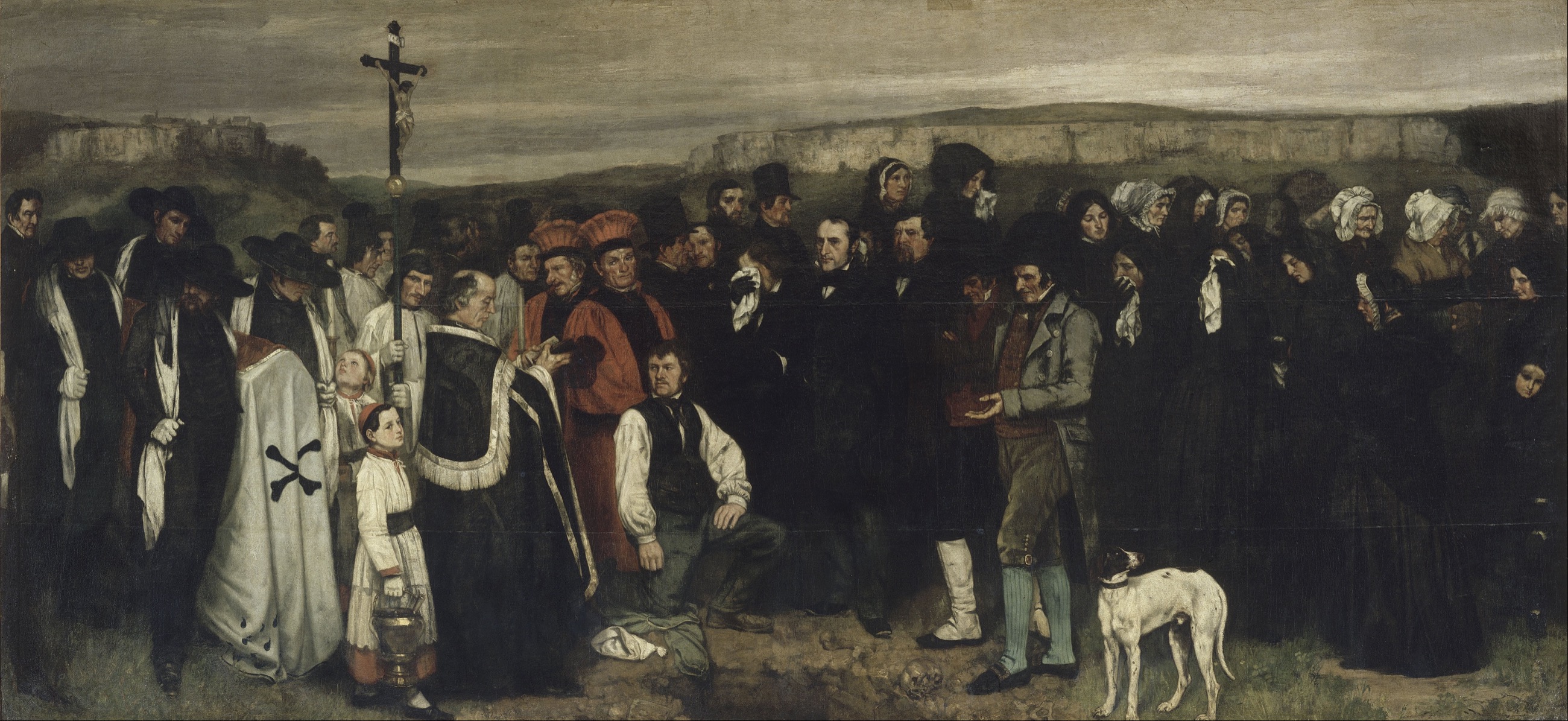
Gustave Courbet makes a provincial funeral look as large and unavoidable as a history painting. In A Burial at Ornans, painted between 1849 and 1850, there is no hero, no ideal beauty, and no biblical alibi to justify the scale. The dead person is almost beside the point. What fills the canvas is the community itself: priests, veterans, officials, women in mourning, a dog, an open grave, and the limestone landscape of Courbet's native region. The result is one of Realism's decisive shocks.
A funeral stretched across the width of the canvas
The scene is immediately legible, but never theatrical. A line of mourners occupies the middle of the painting almost from edge to edge. At the center stand clergy and attendants around the grave. To one side, veterans and officials anchor the civil world; to the other, women in black hold the emotional weight of the ceremony. A small dog wanders in the foreground, and behind the figures rise the pale cliffs and winter sky of Franche-Comte. Courbet gives the burial the horizontal spread of a public event rather than the tight focus of a devotional scene.
That choice matters because the picture refuses a single dramatic center. Your eye moves from face to face, black coat to black coat, patch of earth to white surplice, instead of being pulled toward an isolated climax. The burial is shown as attendance, ritual, and social arrangement. The painting is about how a community gathers around death, not about how one body is redeemed by it.
Why the scale caused a scandal
When Courbet exhibited the work at the Salon of 1850-51, the size itself was provocative. At more than six meters wide, it belonged to the scale traditionally associated with history painting: battle, religion, myth, state ceremony. Courbet used that scale for villagers from Ornans. He did not shrink them into anecdote or comic local color. He painted them life-size and forced Parisian viewers to confront them as the subject of a major work.
That is why critics reacted so sharply. The scandal was not only that the figures looked ordinary. It was that ordinary people had been granted the visual seriousness once reserved for saints, generals, and heroes. Courbet treats a burial in the countryside as an event worthy of monumentality, and in doing so he attacks the old hierarchy of subjects from inside the museum tradition itself.
A village portrait without idealization
Courbet does not organize the crowd into a noble chorus. Faces are tired, ruddy, distracted, stubborn, or simply blank. Some figures seem fully present; others look as if they would rather be elsewhere. That refusal of idealization was central to the outrage. Critics complained about vulgarity because the painting does not flatter anyone, not even grief. It shows a social body made of real bodies, each carrying its own weight, age, and awkwardness.
This is also why the canvas still feels modern. The dead person remains unnamed, but the gathering becomes intensely specific. Clerical authority, military memory, municipal standing, family grief, and provincial custom all appear together in visible form. Courbet does not translate village life into a sentimental symbol. He lets it remain contingent, local, and structurally unequal.
Paint thick enough to feel like earth
Courbet's realism is not only a matter of subject. It is also a matter of paint. Flesh, black fabric, white linen, limestone, and freshly opened soil are built through dense handling, often reinforced by the palette knife. Instead of smoothing everything into academic polish, Courbet lets the picture surface stay tactile. The blacks are deep, the whites heavy, and the earth in the foreground feels as if it belongs to the same material world as the mourners' clothes.
That material density keeps the burial from turning into polite spectacle. The picture does not float. It lands. Courbet wants you to feel cloth, mud, stone, and cold air as part of the same reality. The method is blunt because the subject demands bluntness: death here is not allegory. It is a social and physical fact.
From Courbet to Manet
A useful internal comparison is Olympia. Manet creates scandal differently, through frontal gaze, compressed space, and the urban logic of class and transaction. Courbet's provocation is slower and broader. He shocks by giving provincial mourners the scale of a public monument. But the two paintings share a decisive move: neither asks modern viewers to hide inside idealization.
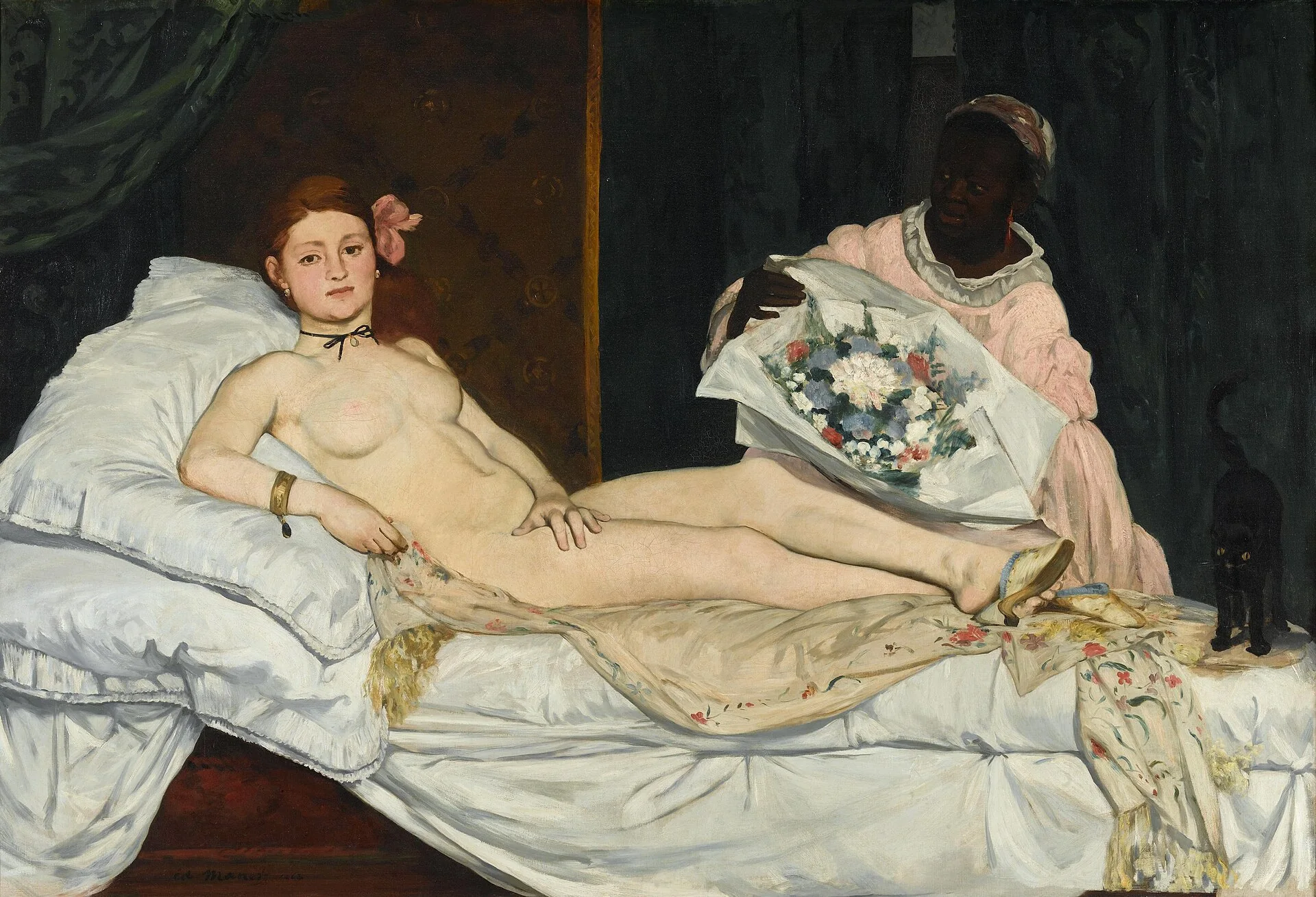
The link matters because it keeps Courbet from being flattened into a provincial exception. He helps open the path from nineteenth-century Realism to modern painting. Once ordinary people, contemporary subjects, and visible facture can claim serious scale, later artists can push that claim in new directions.
A burial turned into public history
Courbet originally gave the work an even more ambitious title: a painting of human figures, the history of a burial at Ornans. That wording tells you what he is attempting. The point is not to mythologize the village funeral. It is to insist that history is already present there, in local ritual, social rank, political tension, and the material visibility of ordinary people.
A Burial at Ornans therefore clarifies something essential about Courbet. Realism is not neutral transcription. It is a decision about what deserves scale, labor, and seriousness. In that sense, the painting remains one of the clearest statements of the movement: the modern world does not need allegory to become large.
Related works
Test yourself with the quiz
Then try the art quiz.
Primary sources
Frequently asked questions
It shows a burial in Courbet's native region of Ornans, with clergy, villagers, veterans, officials, an open grave, and the local limestone landscape spread across a monumental canvas.
Courbet gave ordinary villagers life-size presence on a scale usually reserved for history painting. Critics saw that decision, and the lack of idealization, as a direct challenge to artistic hierarchy.
Yes, though not as a single event picture or slogan. Its politics lie in what it grants ordinary people: size, dignity, visibility, and the right to occupy serious painting without mythological disguise.