
Northern Renaissance
Melencolia I
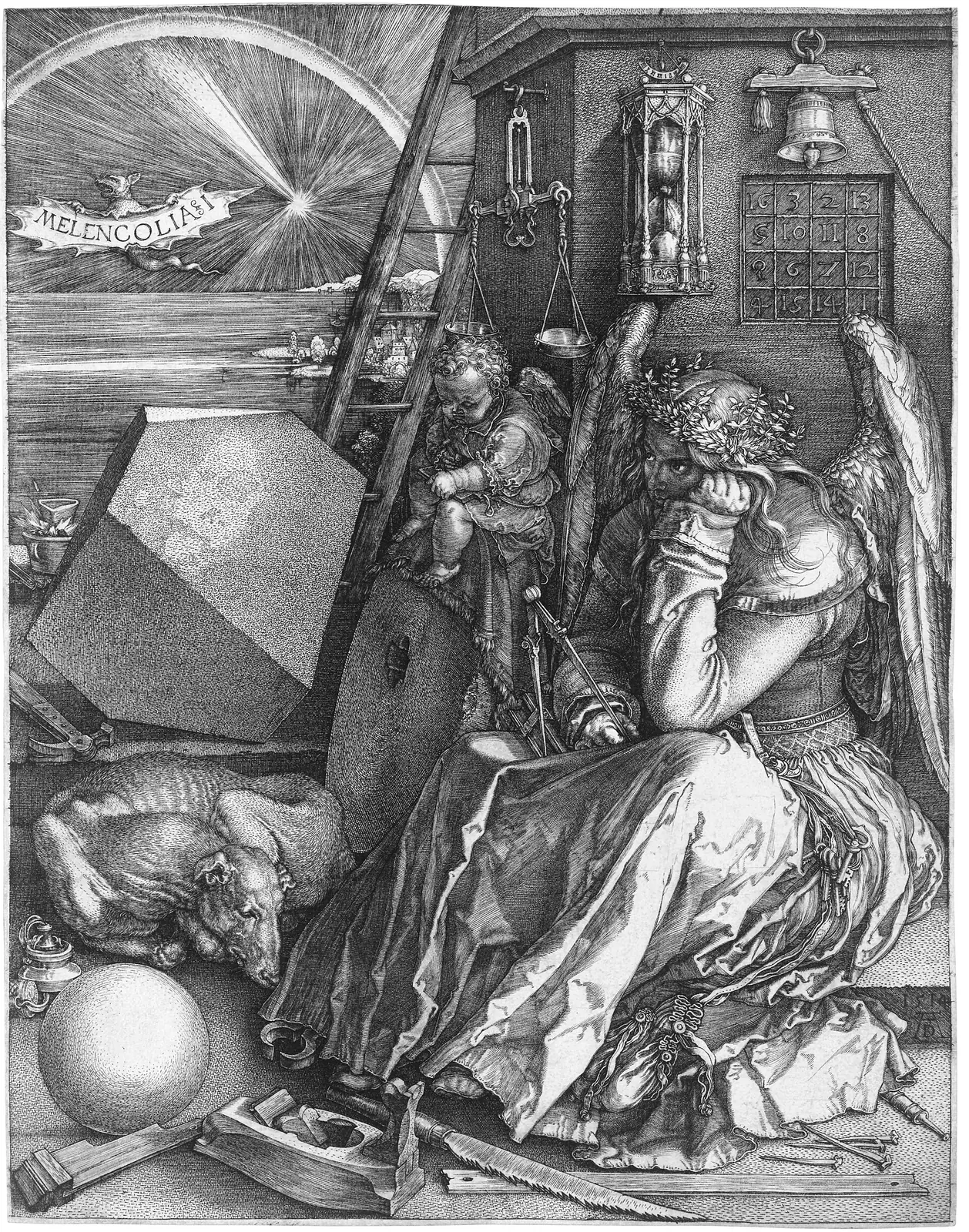
A print full of instruments, yet no action is completed. In 1514, Albrecht Dürer built Melencolia I as an image of intelligence under pressure: precise, ambitious, and blocked at the exact moment where invention should begin.
Nuremberg, 1514: a print made at a turning point
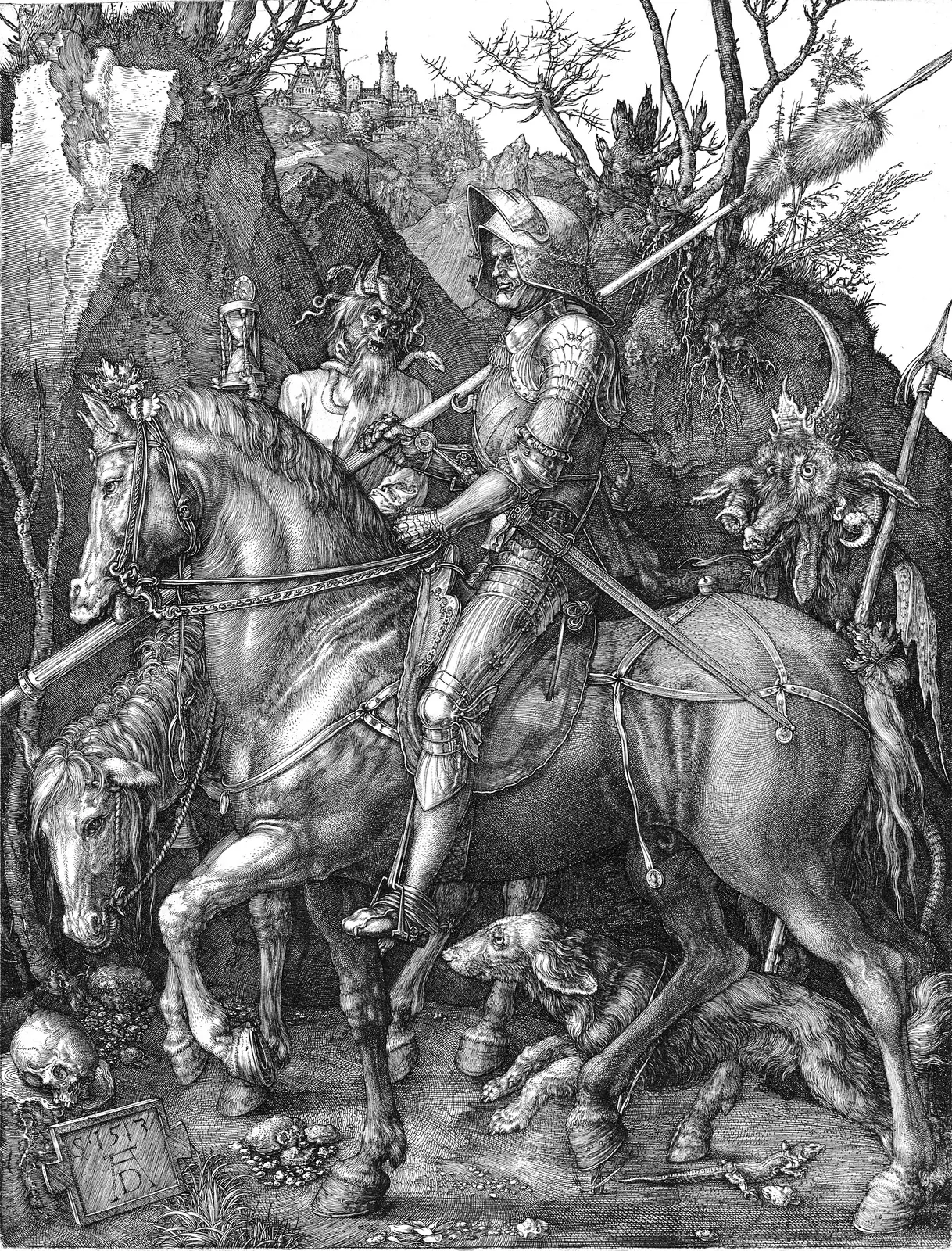
Melencolia I belongs to Dürer's great printmaking sequence of the 1510s and to a wider Northern Renaissance culture that valued mathematics, perspective, and measured design. It appears in the same period as Knight, Death and the Devil, but the mood is radically different: no forward march, no heroic certainty, only concentrated suspension.
That shift matters historically. Dürer is not illustrating a biblical episode or a civic event; he is staging an intellectual condition. In early sixteenth-century Europe, debates on melancholy linked exceptional thought to risk, exhaustion, and instability. The engraving enters that debate directly.
What the engraving shows, concretely
At center sits a winged figure with a lowered gaze and idle tools nearby. Around her: compass, ruler, saw, plane, nails, scales, bell, hourglass, ladder, a polyhedron, and a millstone. A bat-like banner carries the title, while a distant glow opens a narrow horizon.
This is not random accumulation. Each object points to measurement, making, or time. The visual problem is clear: the workshop has everything required for production, but production does not happen. Dürer turns a psychological impasse into a visible system.
Why melancholy mattered in 1514
In medieval medicine, melancholy was tied to black bile and disorder. In humanist circles, it could also signal elevated imagination. Melencolia I sits between those meanings. The figure is neither theatrically desperate nor peacefully contemplative; she is overloaded, vigilant, and paused.
That ambivalence explains the print's longevity. It does not reduce melancholy to a diagnosis or a metaphor. It shows how knowledge, ambition, and fatigue can coexist in one mind without resolution.
Line, shadow, and geometry as argument
The engraving's authority comes from craft. Dense burin work builds tonal depth around the figure, while sharper highlights isolate key forms. The famous magic square in the upper-right corner sums to 34 in every direction and embeds 1514 in the bottom row, binding number to authorship and date.
Read with Knight, Death and the Devil, the method becomes even clearer. In that print, Dürer organizes line for moral advance; here he organizes line for cognitive friction.
How to analyze Melencolia I without over-interpreting it
Start with structure: the central figure, the geometric block, and the distant horizon light. Then group objects by function, not by mystery: devices of time, devices of measure, tools of craft. Only after that step should you read emblematic motifs such as the square or the bat banner.
- Treat symbols as a network, not as isolated riddles.
- Use engraving technique (line density, tonal transitions) as evidence.
- Cross-check with Dürer's other prints before making grand claims.
The sheet's core idea is simple and unsettling: method can be perfect while creation remains stalled.
Ready to test your eye? Use the art quiz and try to identify Albrecht Dürer among close visual neighbors.
Explore more
Related works
Primary sources
Frequently asked questions
She represents suspended intellectual labor: surrounded by tools and geometry, she is poised to act but unable to complete the work.
It links number, order, and authorship. Every row and column totals 34, and the bottom row includes 1514, anchoring the print in a precise mathematical and historical frame.
Read structure first, symbols second: identify the main masses and light zones, then group objects by function before interpreting deeper meaning.