
American Regionalist Artist
John Steuart Curry
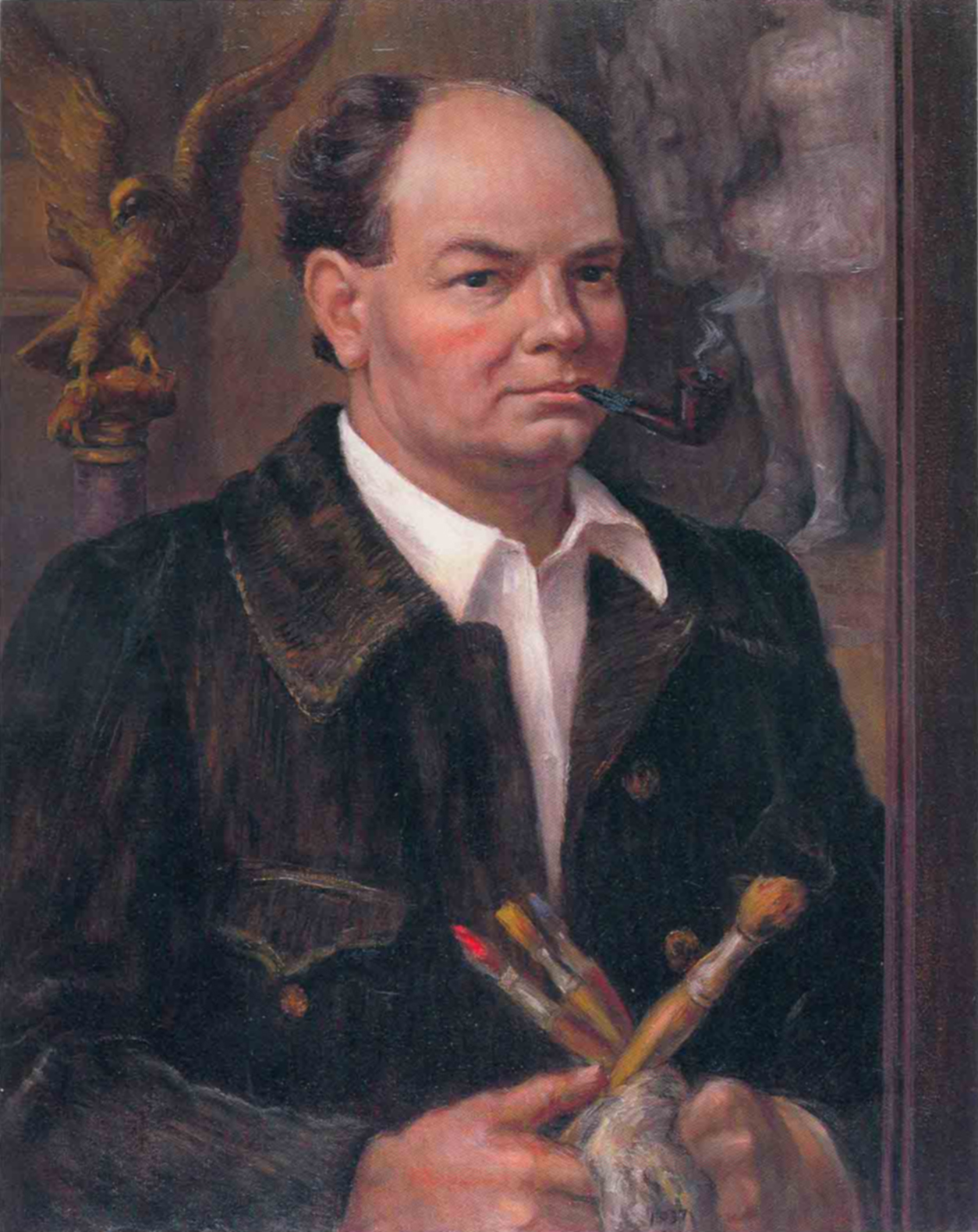
John Steuart Curry is one of the artists who keep American Regionalism from collapsing into a single calm rural image. He stands beside Grant Wood and Thomas Hart Benton as one of the central figures of American Regionalism, but his version of that movement is harsher and more exposed. By bringing storm, physical strain, and public history into it, he makes the movement broader, rougher, and more dramatic.
Training, career, and public image
Curry was born on a farm near Dunavant, Kansas, in 1897, and that origin mattered throughout his work. He studied first at the Kansas City Art Institute and then at the Art Institute of Chicago before moving through illustration in New York and later into painting and mural work. He never treated the rural Midwest as a decorative backdrop. For him it was a place of labor, weather, conflict, and history, and his varied training helps explain the immediate readability of his images.
That combination of local knowledge and public legibility is central to his art. Curry does not paint the Midwest as a private memory. He paints it as a shared stage where weather, bodies, animals, and public stories collide. That is why his work often feels less settled than Wood's. It is built around exposure rather than containment.
Motion, strain, and open weather
Curry's pictorial world is full of movement. Horses surge, storms gather, bodies brace themselves, and historical figures seem pushed by the same forces that move the land around them. Even when he paints a recognizably local subject, he rarely leaves it static. The image is usually under some form of pressure: climatic, bodily, or historical.
That is one reason Curry matters inside American Regionalism. He stops the movement from hardening into one tone of rural dignity. He gives it a more unstable and dramatic edge. Local America in Curry is not only made of barns, fields, and familiar faces. It is also made of wind, panic, speed, fear, and public spectacle.
The Line Storm and Curry's method
The Line Storm shows his method in compact form. A wall of storm overtakes the plains while farm life below struggles to remain legible. Curry does not need a crowd of figures or a grand historical narrative to create tension. A wagon, a barn, a field, and a sky are enough once the weather is made to dominate the image.
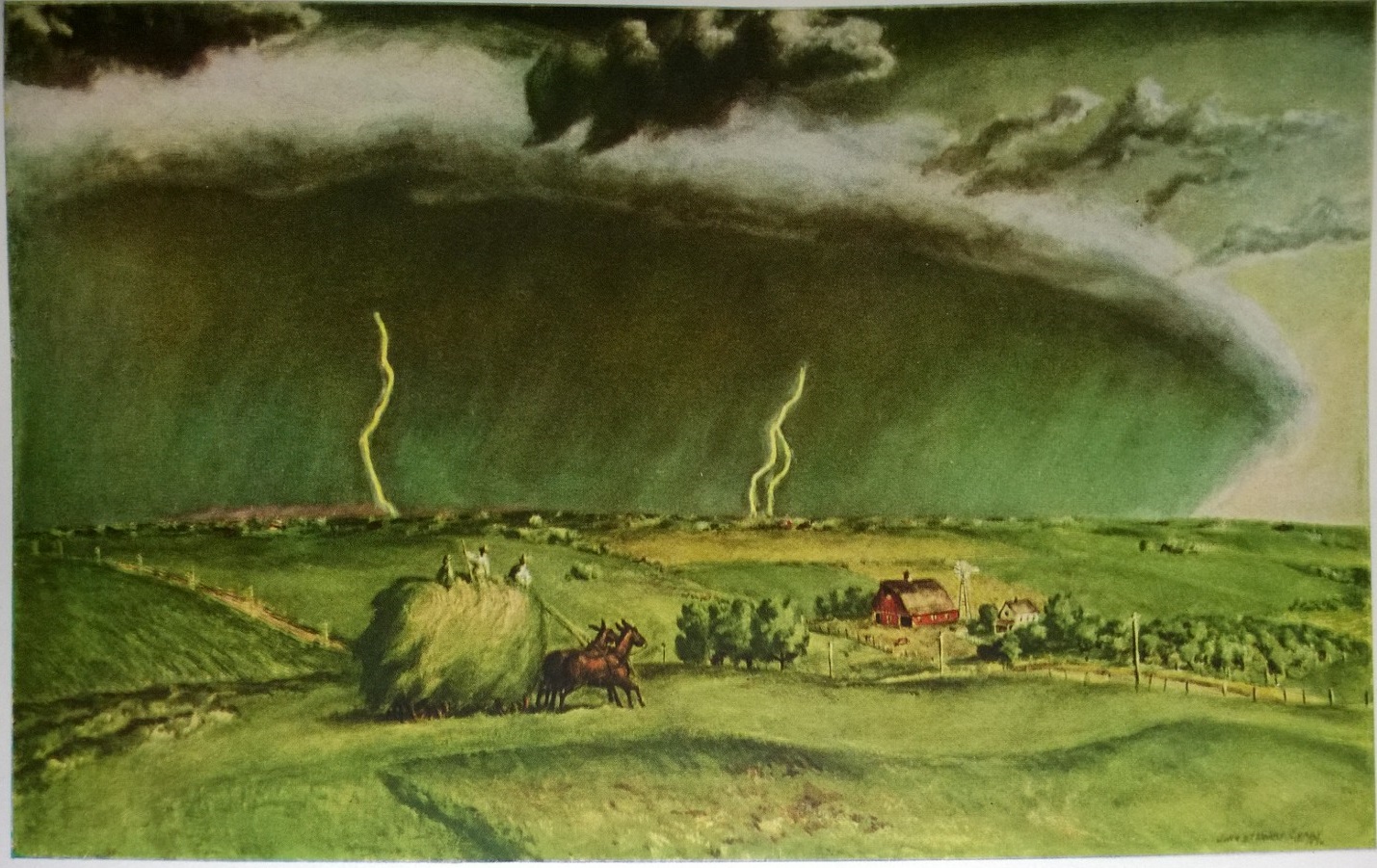
The print also makes clear how different Curry is from Wood. Compare it with American Gothic. Wood compresses the world into a rigid type; Curry opens it into a field of unstable forces. Both are Regionalists, but they give the movement very different emotional temperatures.
Murals, history, and public argument
Curry's art does not stop with storms and farm scenes. He also pushed into public mural painting, where his sense of drama found a larger civic scale. His best-known mural project, Tragic Prelude, made John Brown into a violently charged figure in Kansas history. That work helps explain Curry's larger ambition. He did not want local art to remain quiet or private. He wanted it to enter public buildings and public argument.
This mural ambition is part of Curry's career arc as well. His first solo exhibition at the Whitney Studio Club in 1930 brought major visibility, and the later University of Wisconsin appointment gave him a public teaching platform alongside his studio work. He belongs to the same broader world as New Deal imagery, documentary photography, and other attempts to define the country in public terms, but he does it through painting and print rather than neutral record.
Legacy and impact
Curry's legacy lies partly in how he widens American Regionalism. He shows that regional art can be both local in subject and large in ambition. His images are rooted in Kansas and the rural Midwest, but they are never merely provincial. They ask how climate, history, violence, and labor become visible, which is why the work stays alive well beyond its period labels.
He also changes the internal balance of the movement. Without Curry, American Regionalism can look too quiet, too static, too easily summarized by a single icon. With him in view, it becomes broader, rougher, and more public. That is his lasting impact on how the 1930s are pictured.
Continue with John Steuart Curry
Then try the art quiz.