
American Regionalism
American Gothic
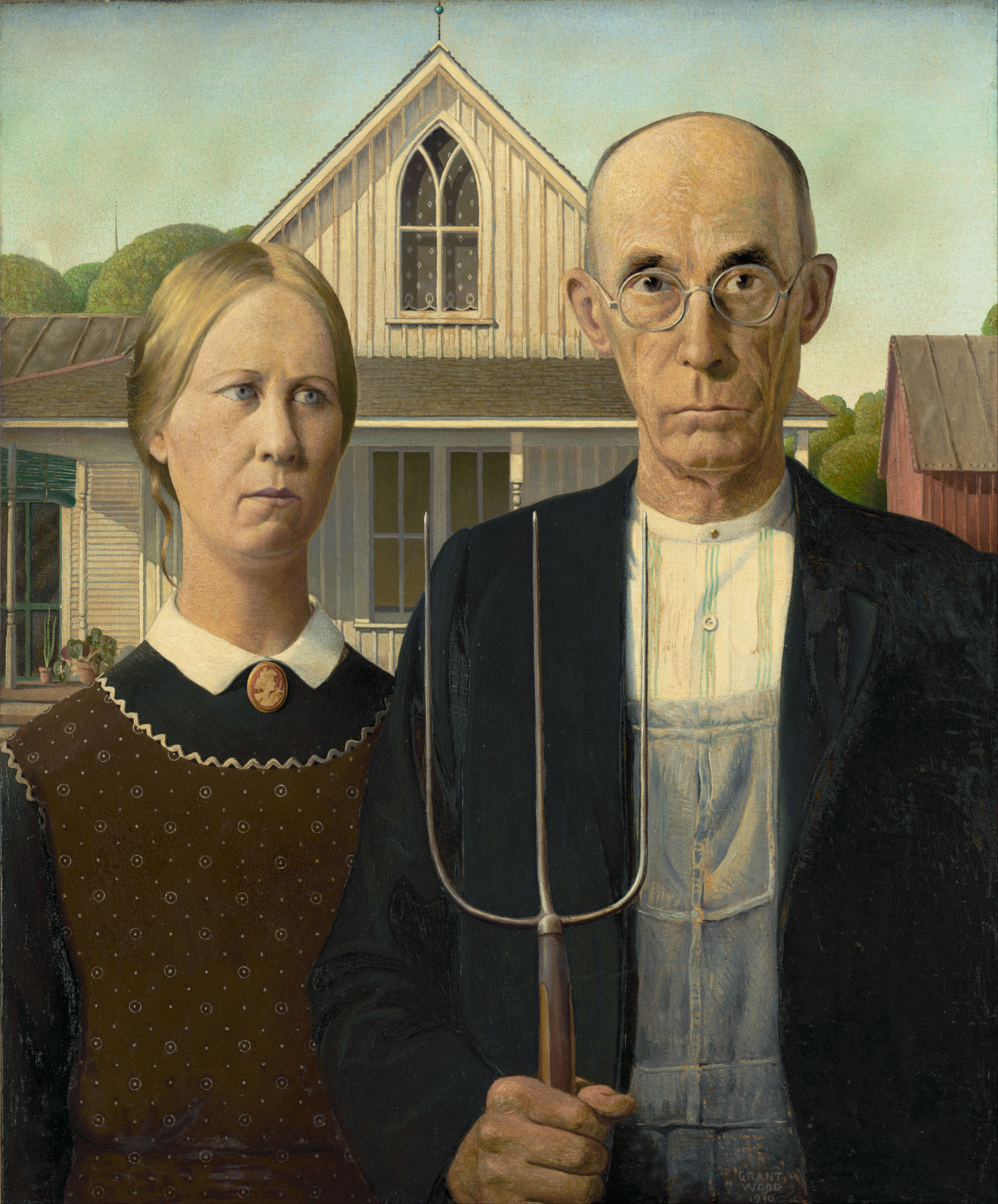
Grant Wood paints two Iowans with such hard clarity that they stop looking like neighbors and start looking like a national type. That is why American Gothic remains stranger than its fame suggests. The picture gives you a house, a pitchfork, overalls, a cameo brooch, and two severe faces, but it never tells you whether to read them as proud, repressed, funny, admirable, old-fashioned, or all of those at once. Painted in 1930 and now central to the story of American Regionalism, it turns local detail into an image the country still cannot stop quoting.
Two figures, one house, one rigid system of echoes
The scene is simple to name and hard to settle. A man in overalls and jacket stands with a pitchfork before a white house with a pointed Gothic window. Beside him is a younger woman in an apron and colonial-style dress. They do not touch. They do not smile. They are cropped tightly enough that the house feels less like background scenery than like an extension of their stance and their values.
Wood makes the image memorable by repeating forms with almost obsessive clarity. The three tines of the pitchfork echo the stripes of the man's overalls. The pointed arch of the window rises behind the pair like a visual signature. Even the long faces, the vertical seams, and the upright pose all pull in the same direction. The painting is not casual observation. It is a highly edited arrangement of hard edges and deliberate correspondences.
The title points first to the house
The word "Gothic" does not mean medieval fantasy here. It refers to the Carpenter Gothic style of the house, based on a real home in Eldon, Iowa, with a narrow pointed window. Wood reportedly saw the house and imagined the kind of people who might belong to it. That matters because the title directs you away from pure portraiture and toward a relation between architecture, social type, and performance.
The figures are therefore less a documentary couple than a constructed pairing. Wood used his sister Nan and his dentist Byron McKeeby as models, but he does not present them as themselves. He turns them into a visual proposition about local America: disciplined, upright, handmade, slightly stiff, and impossible to read as either simple sincerity or simple parody.
Wood turns local detail into an emblem
Wood's intention is clear: this is not a joke meant to vanish after one glance. He wants a Midwestern subject to carry public force. Instead of apologizing for Iowa as merely provincial, he gives it exactness, stylization, and symbolic pressure. That is why the picture has survived so many incompatible interpretations. It is specific enough to feel rooted, but compressed enough to feel exemplary.
His method is just as important. Wood sharpens everything: contours, textures, plant leaves, hair, cloth, wood trim, and facial modeling. Nothing dissolves into painterly atmosphere. The image advances through precision and containment. That tightness is what gives the work its charged stillness. These people do not seem caught in passing life; they seem fixed into an emblem.
After Munich, Iowa is painted with Northern precision
Wood's 1928 trip to Munich changed his painting. There he saw Northern Renaissance art at close range and absorbed its hard clarity, minute description, and polished exactness. American Gothic is one of the clearest signs of that change. The Midwestern subject stays American, but the discipline of the surface owes a real debt to older northern models.
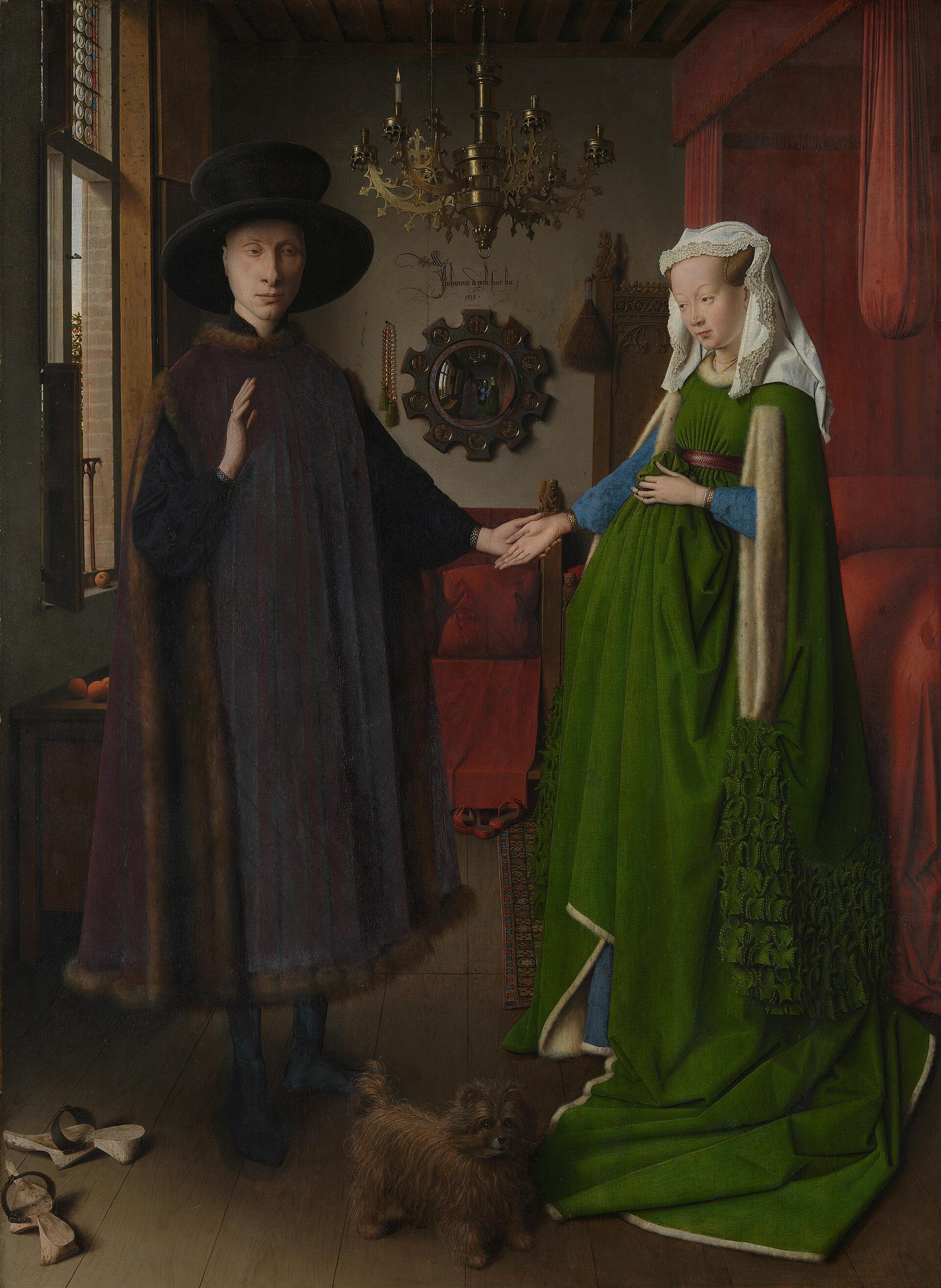
Beside Jan van Eyck, Wood stops looking merely homespun. The painting is regional, but it is not naive. He looks at Iowa through a highly self-conscious pictorial language. He does not simply record local life; he stylizes it until it becomes legible as a national image.
Not a documentary image of the Depression
American Gothic appeared just after the 1929 crash, so viewers often drag it directly into the Great Depression. The timing matters, but the painting is not documentary in the way Migrant Mother is documentary. It does not show visible hunger, labor collapse, or emergency. Its pressure is slower. Wood offers a type of American self-presentation at the very moment when the country's confidence had become uncertain.
That is one reason the picture lasts. It does not explain a crisis; it gives a face to a national argument about seriousness, thrift, rural identity, and the meanings of "real America." The ambiguity is structural, not accidental. The image can be admired, distrusted, imitated, and mocked because Wood built it to sit between all those responses.
How the painting became a national template
The painting became famous almost immediately after it was shown at the Art Institute of Chicago in 1930, and its afterlife has only grown. That afterlife matters because it tells you something about the picture's design. It is easy to recognize in seconds, easy to quote, and impossible to exhaust. Every parody depends on the original image already feeling complete and rigid enough to survive repetition.
American Gothic therefore does two things at once. It crystallizes one branch of American art between the wars, and it shows how a painting can become a cultural template far beyond the museum. Few works move so easily between art history, political cartooning, mass media, and ordinary memory.
Continue from American Gothic
Then try the art quiz.
Primary sources
Frequently asked questions
It shows two sternly posed figures before a white Iowa house with a Gothic window. The man holds a pitchfork, and the picture turns local detail into a highly controlled national image.
It is neither simple mockery nor simple celebration. Grant Wood gives the figures dignity, stiffness, humor, and unease at the same time, which is why the painting stays open to more than one reading.
Because the image is instantly legible, visually strange, and easy to remember. Its hard clarity turned it into a national icon that people keep quoting, parodying, and arguing over.