
American Regionalism
The Line Storm
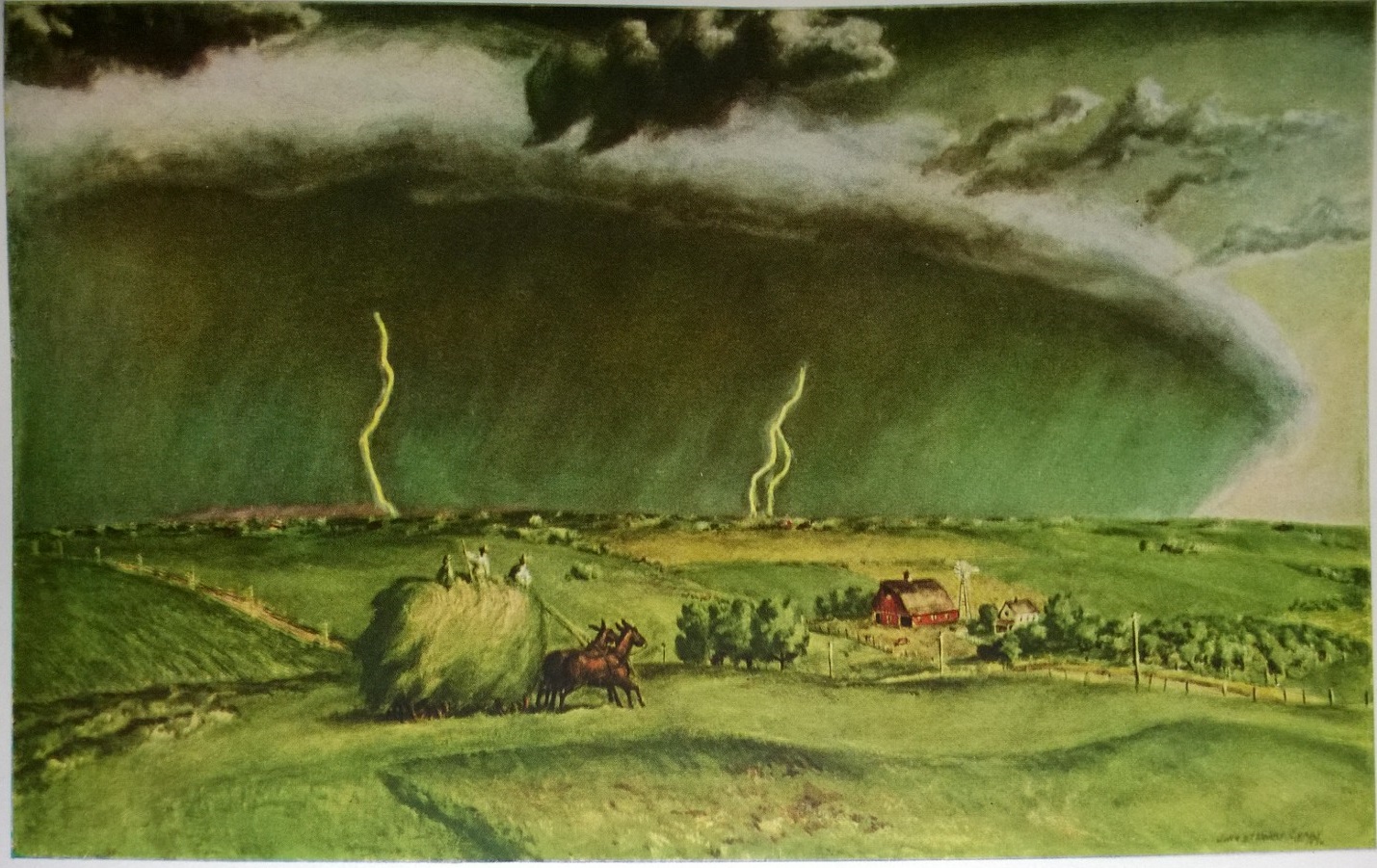
John Steuart Curry makes weather the main actor: a dark wall of storm rolls across the plains while the farm below looks suddenly small and exposed. That is the power of The Line Storm. Instead of giving American Regionalism another fixed rural type, Curry gives it motion, threat, and atmosphere under pressure. Made in 1935 and rooted in the American Regionalism of the 1930s, the lithograph turns open farmland into a public image of vulnerability.
A farm beneath a moving wall of weather
The image is built around a huge curved storm front that occupies most of the composition. Below it sit fields, a red barn, telegraph poles, a house, and a hay wagon pulled across the land. Lightning forks in the distance. Nothing in the landscape looks imaginary, yet everything has been organized so that the weather dominates every other fact on the page.
Curry does not isolate one dramatic figure. He lets the storm organize the whole field. The wagon, animals, buildings, and horizon all seem caught inside one sweeping movement from left to right. That is why the print feels larger than its actual size. The space has been simplified and bent toward one event: the moment when the land realizes it is no longer in control.
Why weather is the real subject
At first glance, you might think this is a farm scene with a storm added to it. In fact, the storm is the subject, and the farm is what makes its force legible. Curry was raised in Kansas, and his work repeatedly returns to rural life not as pastoral calm but as something exposed to violence, speed, labor, and sudden change. In The Line Storm, weather is not background atmosphere. It becomes public drama.
That matters for reading the image historically. The Great Plains were not abstract territory in the 1930s. They were bound up with drought, instability, agricultural pressure, and arguments about what rural America meant. Curry does not illustrate one specific news event. He gives the plains a visual syntax of strain. The land looks inhabited and worked, but never fully secure.
Curry's intention is to make exposure visible
Curry's intention is not to record the weather neutrally. His method is to reduce the farm to a few clear elements, then let the storm gather them into a single event. The print does not say that rural life is picturesque or self-contained. It shows a worked landscape suddenly placed under pressure, which turns meteorology into a statement about how exposed that world really is.
Regionalism here is not stillness but exposure
Set The Line Storm beside American Gothic and the difference inside American Regionalism becomes obvious. Grant Wood locks his Iowa figures into frontal stillness and hard design. Curry opens the world up. His farm is wider, less controlled, and more vulnerable to forces moving through it.
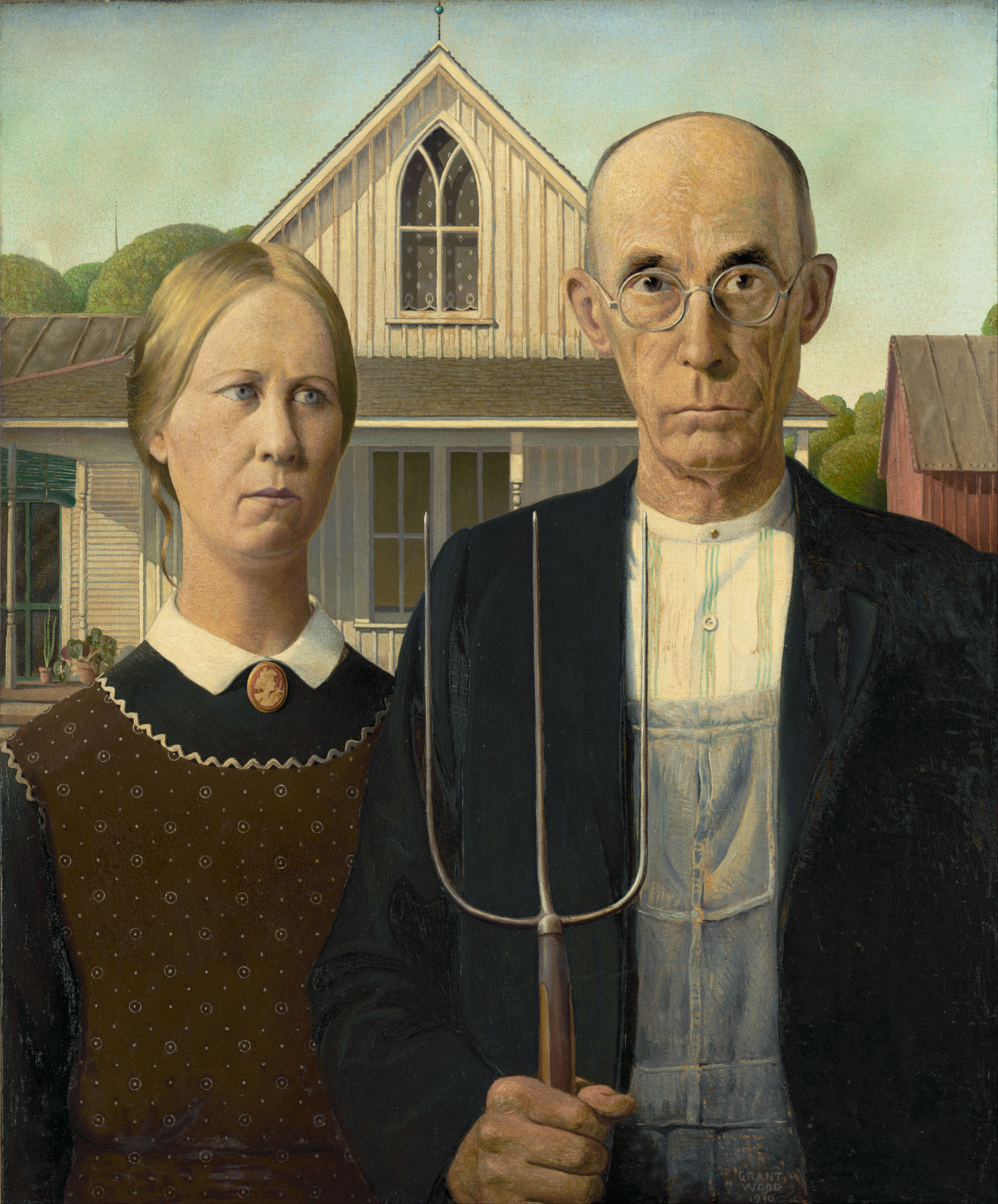
That contrast helps define Curry's place in the movement. He is one of the painters who stop Regionalism from shrinking into a single tone. In his hands, local America is not only upright, constructed, and emblematic. It is also unstable, windy, muscular, and exposed. The nation appears not only through houses and faces, but through climate and open land.
Why the lithograph matters
The Line Storm is a lithograph, not a singular easel painting, and that changes how the work functions. Lithography lets the image circulate more widely, which suits Curry's public ambitions. This is not private atmosphere for a single collector. It is a reproducible image of local America, designed to move through exhibitions, portfolios, and public visual culture.
The medium also suits the subject. Lithography sharpens large masses, broad tonal shifts, and directional energy. Curry can make the storm front feel heavy without losing the legibility of fences, wagon, poles, and buildings below. The result is both graphic and expansive: a local weather event turned into a durable public image.
Continue from The Line Storm
Then try the art quiz.
Primary sources
Frequently asked questions
It shows a huge storm front sweeping across open farmland while a hay wagon, horses, houses, poles, and fields sit exposed beneath it. The real drama comes from the weather overtaking the whole landscape.
Because it shows that American Regionalism was not only about still rural types or quiet front porches. John Steuart Curry gives the movement a harsher, more exposed language of weather, labor, and public tension.
The lithograph matters because it turns Curry's storm image into something reproducible and widely circulable. That fits a movement that wanted local America to enter public view, not remain private or isolated.