
American Regionalist Artist
Grant Wood
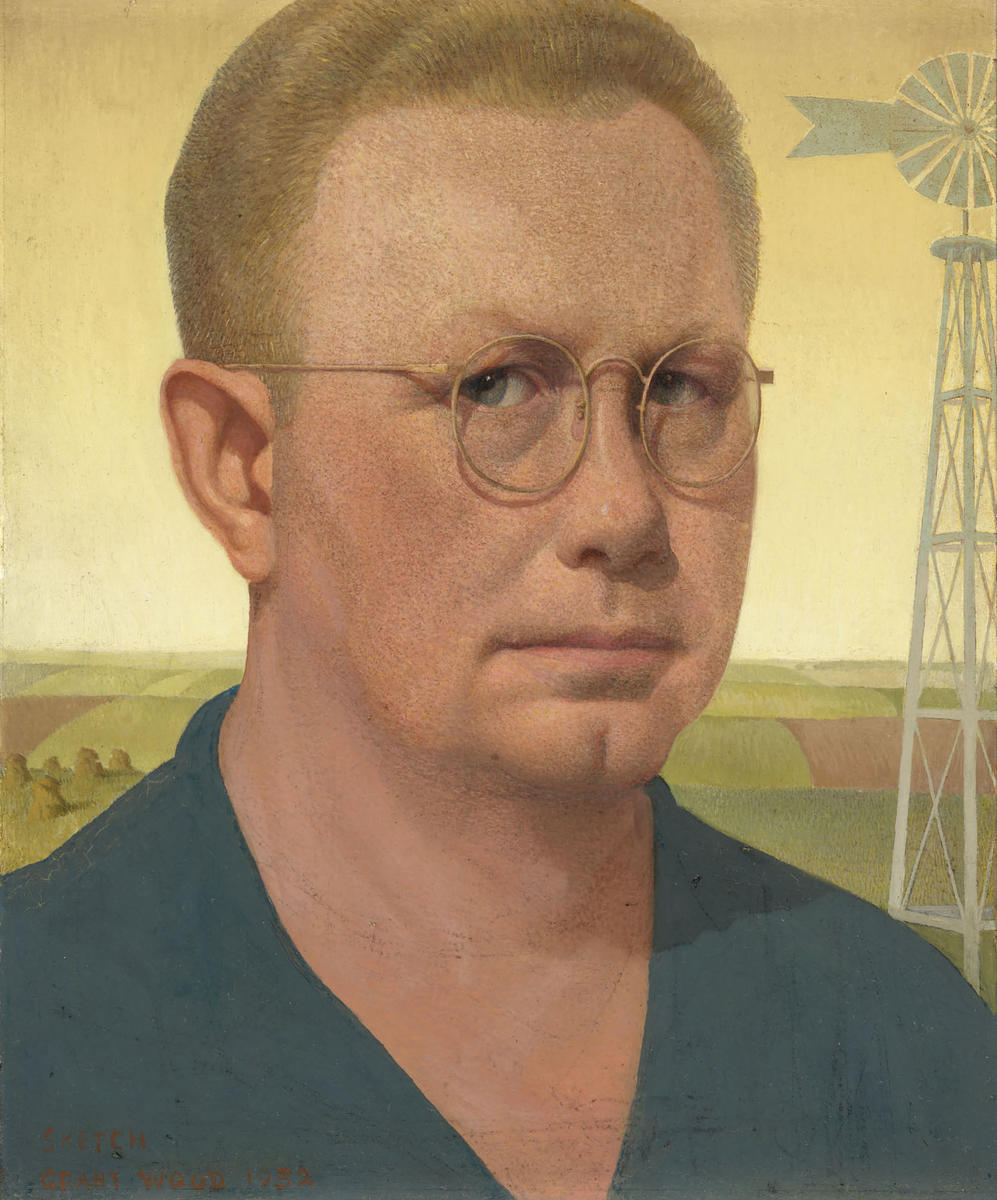
Grant Wood is the American painter of pointed windows, hard collars, Iowa fields, and faces that look both local and emblematic. He is often reduced to one image, American Gothic, but that shortcut hides what makes him important. Wood helped define a 1930s American answer to modern art: local subject matter, sharpened design, and a pictorial language that could make the Midwest look at once intimate, strange, and nationally symbolic.
From Iowa craft to designed image
Wood was born in 1891 in Iowa and spent most of his life tied to the Midwest, especially Cedar Rapids. Before he became famous as a painter, he trained in craft-related settings and studied decorative design as well as fine art. That background matters. His paintings are not loose or improvisational. They are built with the patience of someone who thinks hard about surface, finish, and designed relation.
He also knew that local material could be pictorially ambitious. Wood did not accept the idea that a serious artist had to leave the Midwest behind in order to matter. His houses, fields, plants, clothes, and faces are all chosen from local life, but they are never left as mere anecdote. He compresses them until they begin to behave like types, symbols, and formal units at the same time.
Munich and Northern precision
The crucial shift came after Wood's 1928 trip to Munich. There he encountered older northern European painting and changed direction. The freer, softer handling of his earlier work gave way to a more exact and controlled surface. That is why his mature paintings feel so firm. The contours tighten, textures clarify, and every repeated form starts to matter.
This is one reason Wood should not be mistaken for a naive localist. His local America is filtered through serious looking at older art, especially the kind of exact surface associated with the Northern Renaissance. He turns Iowa into an art-historical problem, not just a regional subject.
American Gothic shows the whole method
In American Gothic, Wood's method appears all at once. The house, the Gothic window, the pitchfork, the striped overalls, the cameo brooch, the plant leaves, and the paired faces all belong to one controlled system. Nothing is thrown in casually. The painting is funny, severe, and slightly uneasy because every part has been tightened into the same visual register.
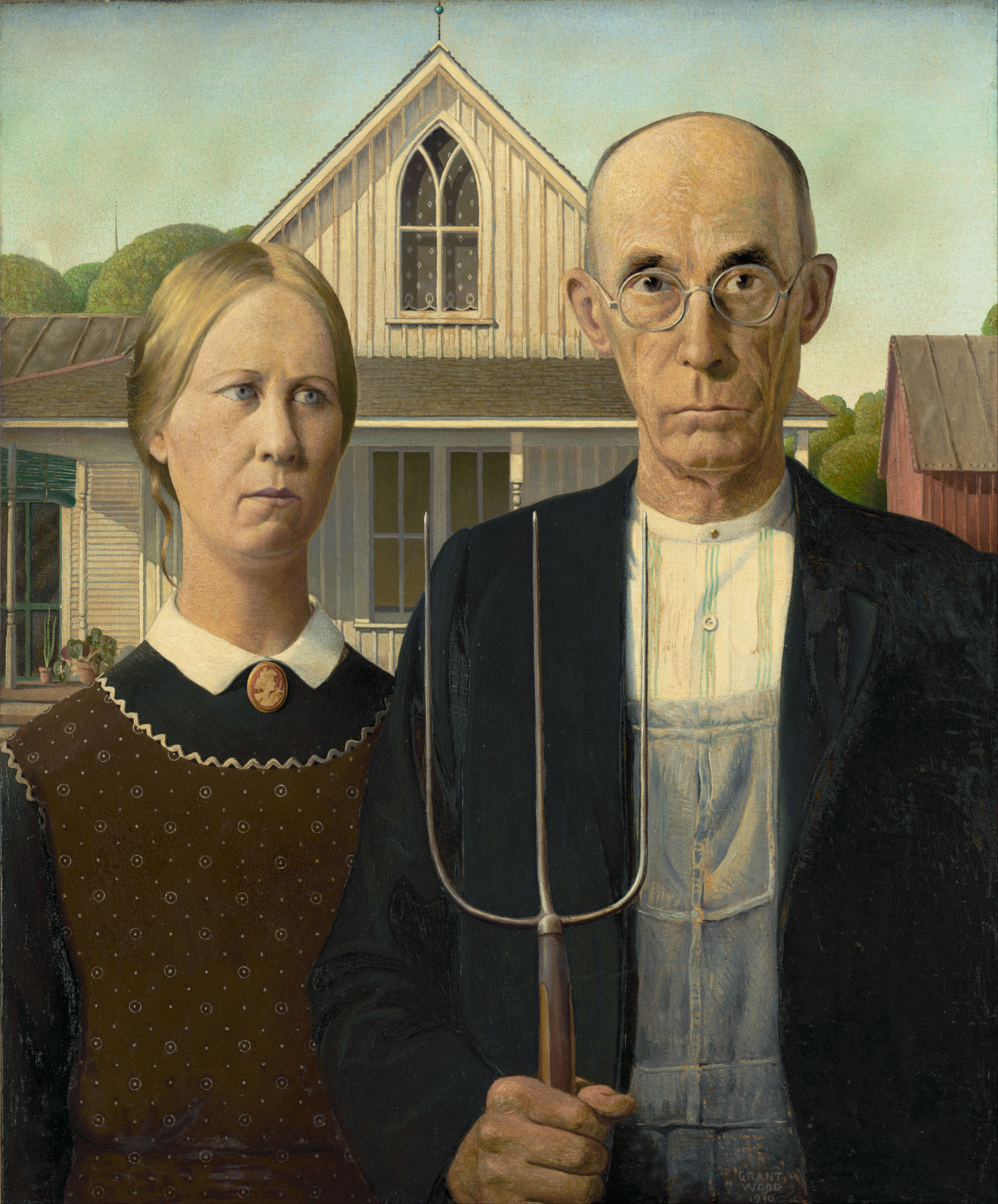
The painting also shows why Wood resists a single label. He is not simply a satirist mocking provincial stiffness, and he is not simply a celebrant of rural virtue. He keeps admiration, distance, humor, and pressure together inside the same image. That balance explains why the picture survives parody, quotation, and argument.
Regionalism and modernity
Wood became a central figure of American Regionalism, alongside other painters of local American life. But Regionalism should not be mistaken for pure nostalgia or anti-modern retreat. In Wood, local subject matter becomes a way to ask what a national art might look like when the United States was arguing with European modernism, abstraction, urban change, and economic crisis all at once.
Set Wood's stylized control beside Migrant Mother and the difference is immediate. Lange's photograph is documentary and urgent; Wood's painting is constructed and emblematic. Yet both become durable ways of picturing the country during the same troubled decade.
Afterlife: parody, memory, and self-image
Wood's legacy is larger than one museum-famous canvas, but American Gothic explains why he keeps returning. Few painters have produced an image so easy to recognize and so difficult to exhaust. The painting has been parodied endlessly because it already functions like a ready-made national template. Change the costumes, the objects, or the faces, and the structure still holds.
That afterlife tells you what Wood achieved. He did not merely record the Midwest. He gave it a visual grammar sturdy enough to travel through caricature, advertising, politics, and mass memory without disappearing. That is a rarer kind of importance than simple fame.
Continue with Grant Wood
Then try the art quiz.