
Movement Guide
Expressionism
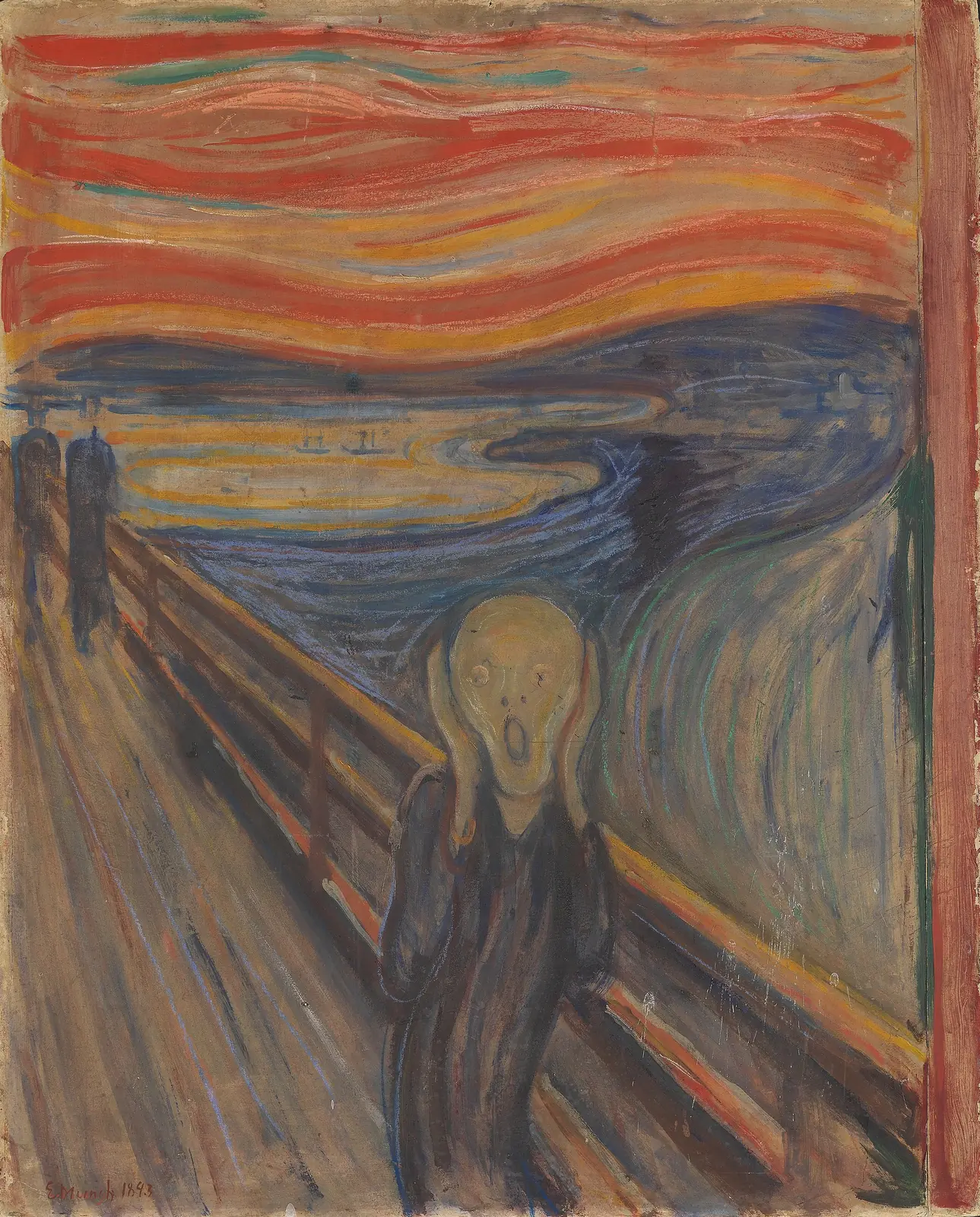
Expressionism prioritizes inner pressure over optical accuracy. Distortion, color, and line are used to externalize psychological states.
Around 1900, modern life accelerated: industrial growth, crowded cities, political volatility, and new psychiatry reshaped how people described the self. However, Expressionist artists responded by refusing neutral description. They made visible what felt unstable, anxious, ecstatic, or fractured beneath ordinary appearances.
Set against Impressionism and Post-Impressionism, Expressionism marks the point where fidelity to outer appearance yields to fidelity to inner pressure. Our essay Impressionism vs. Expressionism is the quickest way to see that break.
What defines it
- Emotional intensity and intentional distortion used to communicate feeling before factual description.
- Color treated as a psychological force, not a faithful transcription of local hue.
- Expressive line and contour that register nervous energy, urgency, or rupture.
- Subjects centered on vulnerability, alienation, desire, and modern social pressure.
Techniques and innovations
- Compressed, unstable space that prevents detached viewing.
- Visible brushwork and abrupt edges that keep process present inside the image.
- Strategic exaggeration of hands, faces, and sky to amplify affect.
- Cross-pollination with print culture, stage design, and early abstraction.
Not one school, but a field of experiments
Expressionism is better understood as a field than a single doctrine. In Norway, The Scream creates a template for existential panic through wave-like line and unnaturally heated color. In German contexts, artists associated with Die Brucke and Der Blaue Reiter explored harsher urban tension or spiritual abstraction. Different aims, shared pressure.
Follow the chain from Edvard Munch to Wassily Kandinsky. Works like Improvisation 28 (Second Version) and Composition VII show how emotional distortion can move toward non-figurative structure without losing intensity.
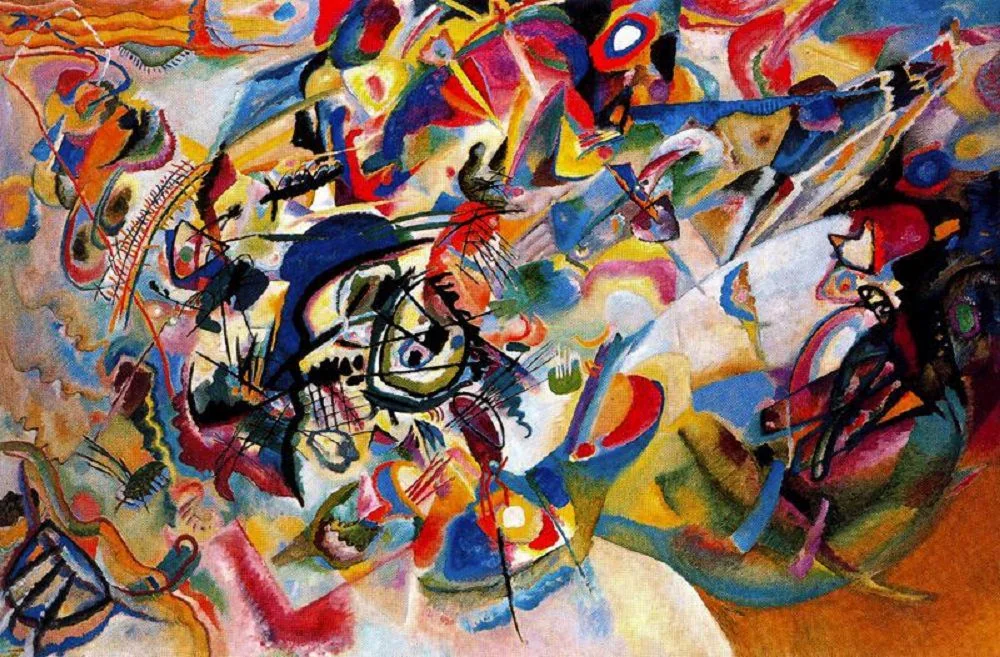
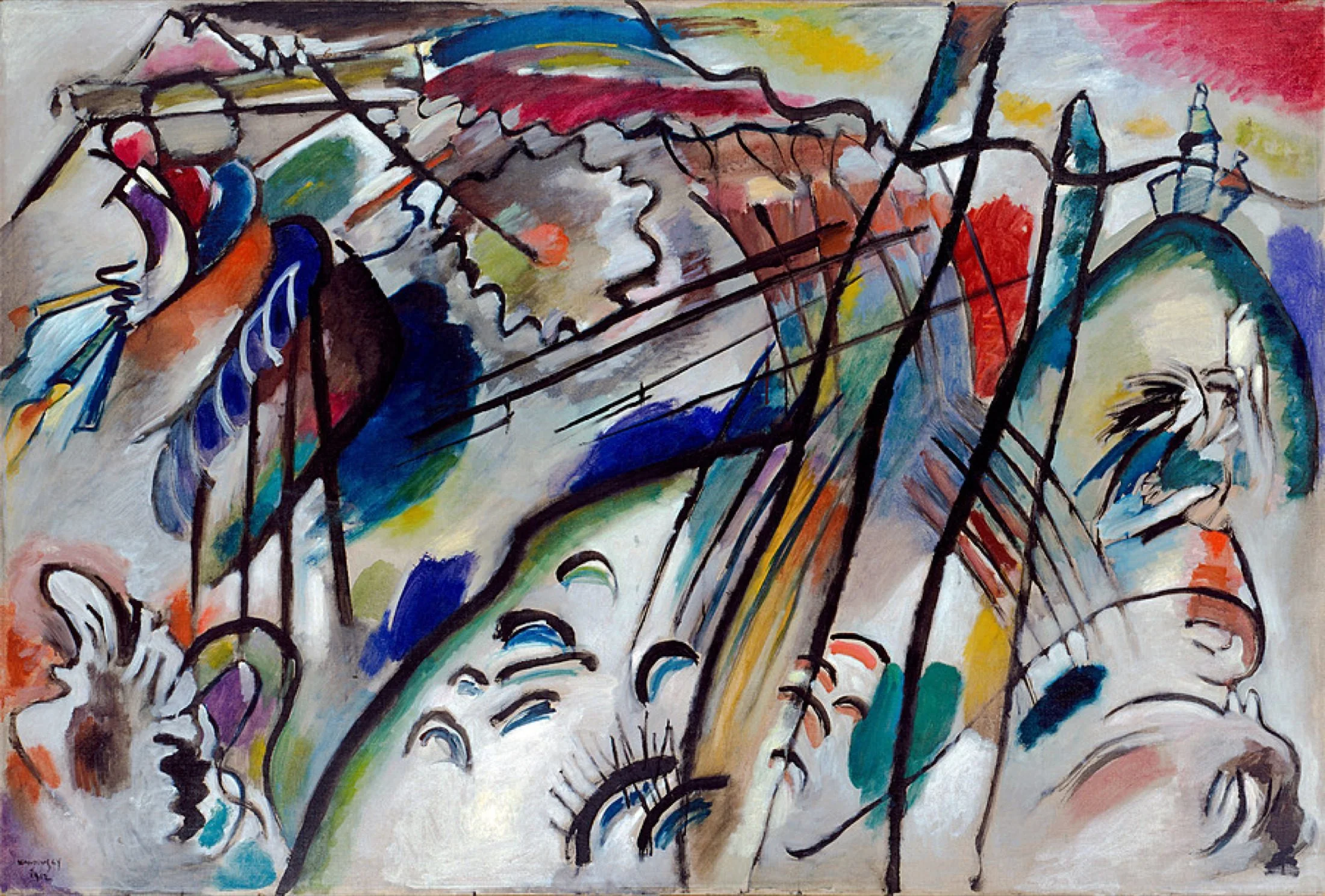
How to read distortion as information
A common mistake is to treat expressionist deformation as mere style. It is usually analytical. A tilted bridge, a melting horizon, or a screaming contour tells you where psychic pressure concentrates. In practice, form stops being a transparent container and becomes the message itself.
Compare expressionist methods with Romanticism and Symbolism. Romanticism uses drama to stage historical and existential stakes; Symbolism often encodes private myth. Expressionism tends to make distress immediate and bodily, with less narrative cushioning.
The contrast is equally sharp beside Neo-Impressionism. Seurat regulates perception through method; Kirchner and Kandinsky destabilize it so that form itself carries psychic force.
- Read exaggerated color relationships as mood signals.
- Track repeated motifs that return with changing emotional charge.
- Treat distortions as deliberate diagnostics, not technical errors.
- Check whether the image seeks empathy, shock, or spiritual elevation.
Why Expressionism still matters
Expressionist logic remains central in 2026 because contemporary visual culture still rewards affective compression: posters, editorial graphics, music visuals, and social feeds often prioritize emotional legibility over descriptive completeness. The movement predicted this shift by showing that an image can be factually imprecise and psychologically exact.
It also changed art history's grammar. Later movements, including Abstract Art, inherit its conviction that subjectivity can structure composition at the deepest level, not merely decorate it.
Politics, trauma, and afterlives
Expressionism was shaped by political violence and social fracture long before it entered textbooks. War, censorship, and displacement altered both careers and styles. Some artists moved toward spiritual abstraction, others toward harsher social critique. In each case, the movement registers modern instability at the level of color, contour, and pace.
Its afterlife extends beyond painting. Film lighting, stage sets, graphic novels, and contemporary visual journalism still borrow expressionist compression when reality feels too charged for neutral description. That persistence explains why Expressionism is not just a historical episode but an active visual strategy.
A useful comparison is to place expressionist works next to apparently calmer images from adjacent movements. The contrast reveals that Expressionism is not simply louder color or rougher brushwork; it is a different theory of what an image should do. Instead of stabilizing the world for the viewer, it exposes instability as a primary fact of experience. That conceptual shift is one reason the movement remains central to serious visual education.
For students, the practical takeaway is simple: do not ask whether an expressionist image is objectively accurate. Ask whether its formal distortions are structurally coherent with the emotion it claims to stage. Coherence, not naturalism, is the movement's core test.
Key artists
Key works in Explainary
For the clearest route back through this set of movements, compare this page with Impressionism, then Post-Impressionism, then Neo-Impressionism. The essay Impressionism vs. Expressionism condenses those distinctions.
Continue with the art quiz to validate recognition, context, and comparison.
Primary sources
Frequently asked questions
Impressionism records fleeting light and outward perception. Expressionism bends color, line, and space to make inner pressure visible.
Post-Impressionism is a broad field of experiments after Impressionism. Expressionism is one later, sharper direction in which distortion becomes a primary language rather than one option among many.
No. Neo-Impressionism organizes perception through method and controlled color relationships. Expressionism intensifies distortion and emotional pressure instead.