
Post-Impressionist Artist
Paul Gauguin
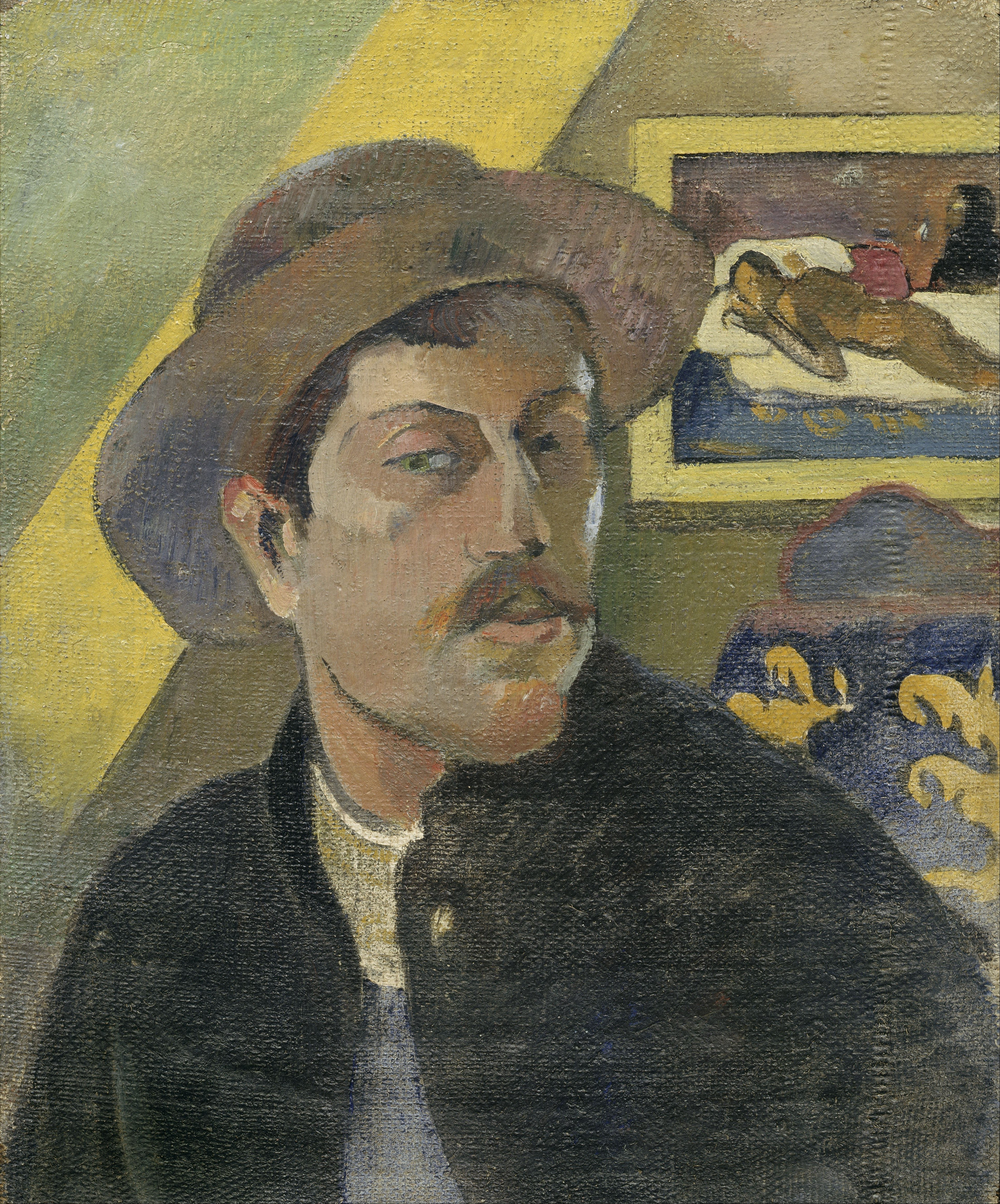
Paul Gauguin breaks with Impressionism by treating color as a sign, contour as a boundary, and distant places as fields of invention rather than neutral description. He pushes modern painting away from optical transcription with unusual force. With Gauguin, a picture no longer has to persuade through atmosphere first. It can persuade through simplification, symbolic pressure, and a world deliberately rebuilt on the canvas.
From stockbroker to painter
Gauguin was born in Paris in 1848, worked for a time as a sailor, then entered the financial world before choosing painting as a full vocation. That delayed commitment matters. He does not emerge as a prodigy smoothly formed inside the schools. He arrives through rupture, leaving bourgeois stability behind and entering painting with unusual decisiveness. Early on he exhibits with the Impressionists, but the alliance does not last as a final home.
What he takes from that first circle is real: brighter color, a willingness to break with academic finish, and the idea that modern painting can rebuild itself from current debates rather than inherited hierarchy alone. What he rejects is equally important. He does not want painting to stop at fleeting perception. He wants it to compress memory, myth, belief, desire, and imagined distance into one surface.
Beyond Impressionism: synthesis instead of atmosphere
That shift becomes clear in Brittany and around Pont-Aven. Gauguin simplifies forms, hardens contours, and lets broad color zones carry weight. Instead of asking how light disperses over objects, he asks what structure and palette can make a scene mean. That places him near the center of Post-Impressionism. He pushes modern painting toward symbolic organization rather than toward the transcription of sensation.
Read him beside Van Gogh and the difference sharpens. Van Gogh accelerates brush rhythm until feeling seems to circulate through the whole surface. Gauguin tends to slow the field down. He flattens it, simplifies it, and makes color more declarative. Both move beyond Impressionism, but Gauguin does so through synthesis rather than through chromatic turbulence.
Tahiti is not neutral ground
Gauguin's Tahitian work sits at the center of his legacy and of the unease around it. He turns Tahiti into a place of origin, myth, and imagined distance more than a society described on its own terms. But that desire unfolds inside a French colonial world. The paintings cannot be separated from the power imbalance that allowed him to treat Polynesia as material for invention.
That does not make the pictures formally weak. It makes the reading more demanding. Gauguin's art is powerful because he fuses decorative economy, symbolic ambition, and sensual force. It is also compromised by the fantasies through which he constructs remoteness and primitivism. Both facts belong on the page at once.
The Lyon frieze: color as construction
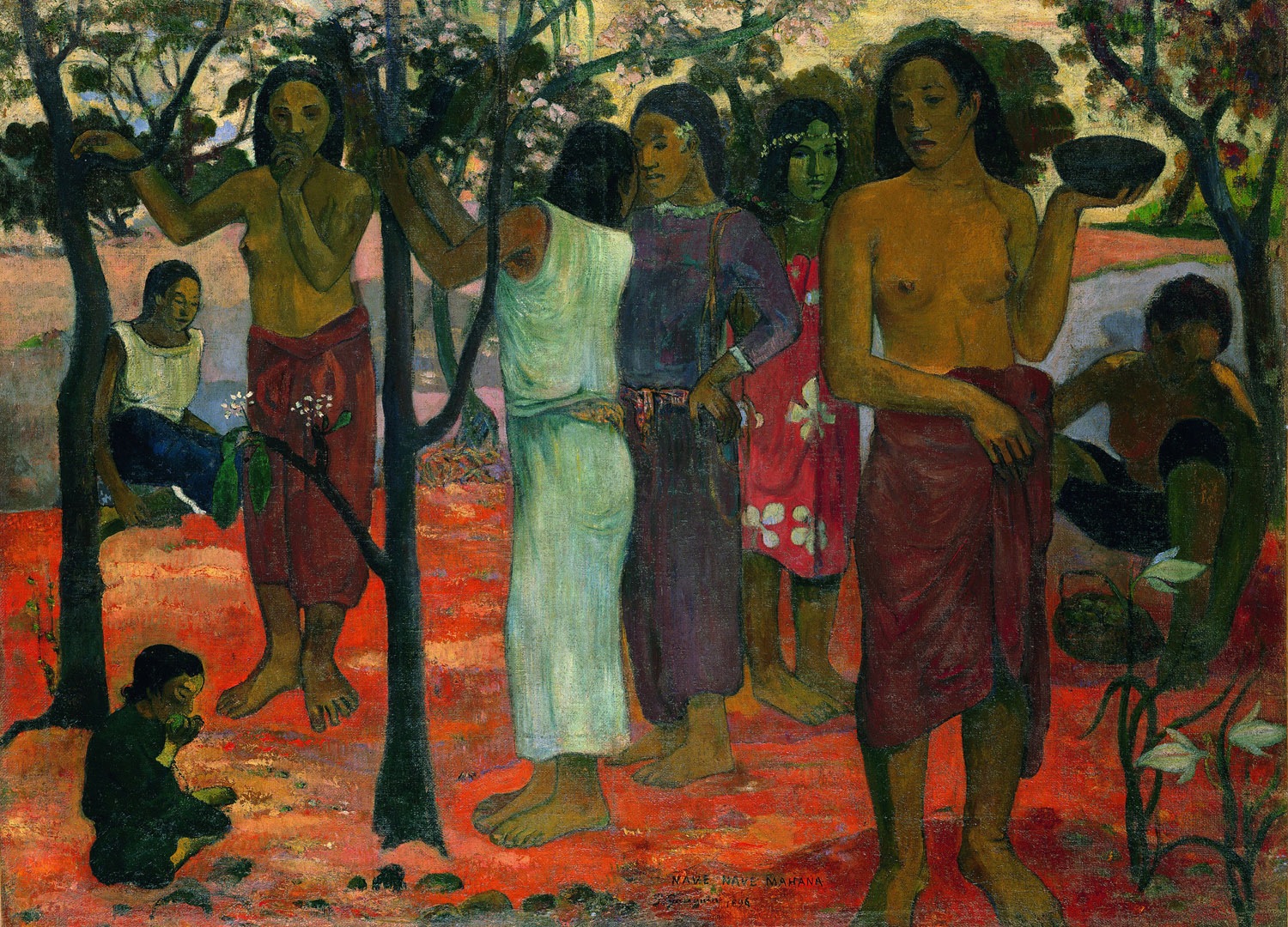
Nave Nave Mahana, now in the Musée des Beaux-Arts de Lyon, shows Gauguin's Tahitian method in a more compact form than his large Boston canvas. Figures stand across a red ground, trees divide the surface, and the title promises "Delicious Days" while the image stays deliberately staged. The painting is not only about Tahiti; it is about how Gauguin turns place into color, contour, and myth.
A mural of bodies, signs, and questions
Where Do We Come From? What Are We? Where Are We Going? is the clearest work on Explainary for seeing how Gauguin thinks. The canvas is long, mural-like, and organized as a philosophical field rather than as a single scene. It keeps bodies readable, but it asks color, contour, title, and sequence to do the heavier work of meaning. Gauguin wants the image to hold together before it becomes fully interpretable.
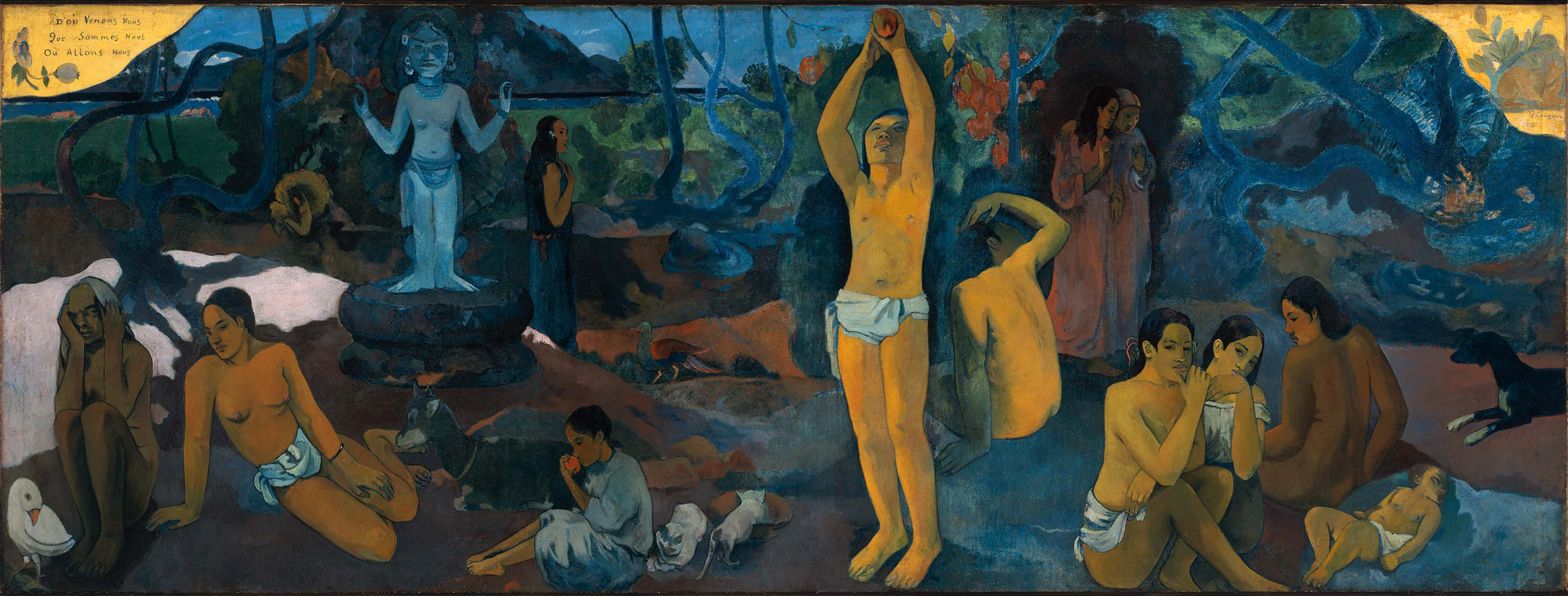
The picture also shows why Gauguin cannot be reduced to exotic surface. He thinks at the scale of total composition. He wants an image that can bear metaphysical pressure without returning to academic allegory. That is a large ambition, and he reaches it through anti-natural color and flattened form rather than through classical clarity.
Gauguin beside Van Gogh
In the autumn of 1888, Van Gogh brought Gauguin to Arles to share the Yellow House and give substance to his idea of a Studio of the South. For a few weeks they painted side by side, argued constantly, and grew more sharply at odds. In December Gauguin said he was leaving; Van Gogh then went through the crisis associated with the mutilation of his ear, and the experiment ended abruptly. The episode is more than a story of failed cohabitation. It exposes different pictorial temperaments. Van Gogh pushes speed, directional stroke, and chromatic risk into the open. Gauguin distrusts too much immediacy. He wants the image held harder in reserve, more simplified, more governed by memory and invention.
Sunflowers and Where Do We Come From? What Are We? Where Are We Going? can belong to the same historical field while feeling so different. One makes paint behave like emotional voltage. The other turns painting into a meditative structure of signs.
Legacy and discomfort
Gauguin's legacy runs forward through Symbolist painting, the Nabis, Fauvist color, and broader modernist simplification. He helped make it thinkable that a picture could be flat, patterned, anti-natural, and still carry intellectual seriousness. Modern painting owes him a great deal on that formal front.
It also remains necessary to read him without romantic fog. Gauguin is not simply the hero who escaped Europe to recover truth elsewhere. He is a major artist who built radical pictures through desire, projection, and colonial distortion. The work stays important because it is formally strong enough to bear that harder reading.
Reading paths from Gauguin
Read Nave Nave Mahana for the compact Tahitian frieze, then Where Do We Come From? What Are We? Where Are We Going? for the same method enlarged into a philosophical panorama. From there, Post-Impressionism and Van Gogh make Gauguin's synthetic control easier to place. Then try the art quiz.
Primary sources
- MoMA: Paul Gauguin
- The Met: Paul Gauguin (1848-1903)
- Britannica: Paul Gauguin
- Musée des Beaux-Arts de Lyon: Nave Nave Mahana
- Museum of Fine Arts, Boston: Where Do We Come From? What Are We? Where Are We Going?
- Museum of Fine Arts, Boston: Gauguin and Polynesia
- Wikimedia Commons: portrait file metadata