
High Renaissance Artist
Raphael
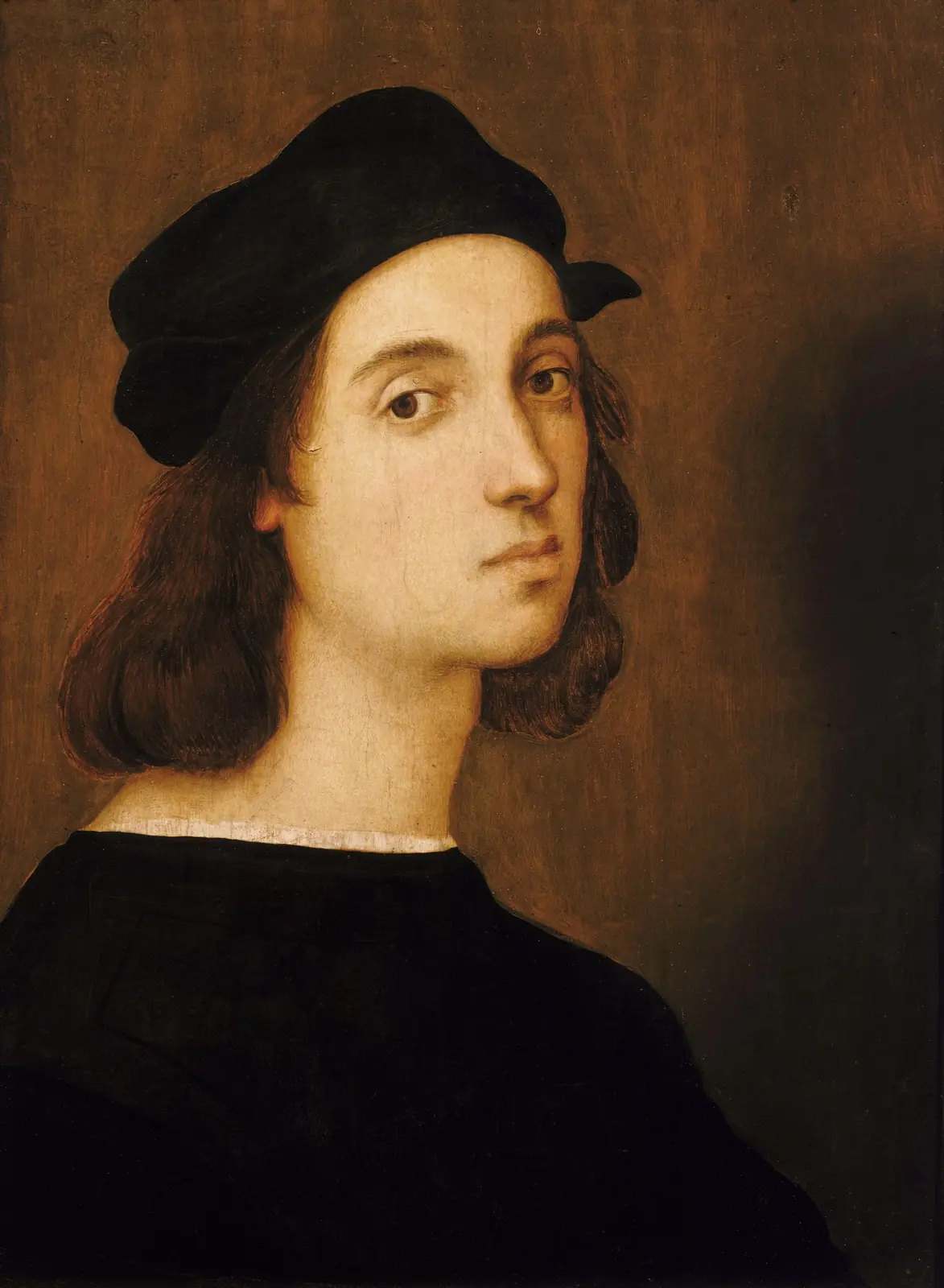
Raphael can look easier than Leonardo or Michelangelo because his pictures read so quickly. That ease is built. He can fit a crowd, a program of ideas, and a major commission into one image without losing clarity.
At the center of the High Renaissance, Raphael does not pursue Leonardo's mystery or Michelangelo's pressure. He organizes bodies, gestures, architecture, and thought so that the whole image remains readable. That discipline made him a model for painters, workshops, academies, and public institutions for centuries.
Court upbringing and early training
Born in Urbino, in the Marche region of central Italy, in 1483, Raphael, properly Raffaello Sanzio da Urbino, grows up inside a court culture where painting, poetry, architecture, and diplomacy already overlap. His father, Giovanni Santi, is himself a court painter and poet, which means Raphael encounters art early as part of a broader language of prestige and learning, not as an isolated craft.
He trains first in central Italy, close to Perugino's lucid order. That early formation leaves a durable mark. Even before Florence and Rome, Raphael prefers clean grouping, steady space, and figures that remain readable without strain. He starts from calm, not from rupture.
Florence and the art of synthesis
When Raphael reaches Florence in the first years of the sixteenth century, he finds two very different lessons in front of him. Leonardo offers atmosphere, soft transitions, and psychologically charged relation between figures. Michelangelo offers bodily power, compression, and a much harder sense of force.
Raphael learns from both, but he does not imitate either for long. In Florentine Madonnas such as the Madonna of the Goldfinch or La Belle Jardiniere, he borrows pyramidal stability and close figure relation, then removes heaviness. The result is one of his signatures: a composition that feels composed without feeling labored.
He inherits Umbrian calm, Florentine drawing intelligence, and soon Roman monumental ambition, then turns them into something unusually stable. By the time he reaches papal Rome, he is already equipped to work at institutional scale.
Rome under Julius II and Leo X
Rome gives Raphael the scale that makes the career decisive. Summoned under Julius II, he enters a court that wants theology, law, poetry, and classical learning turned into public image. The Vatican rooms are not decorative overflow. They are a program of authority, and Raphael proves almost immediately that he can make such programs readable.
Under Leo X, the field widens further. Raphael produces portraits, altarpieces, and tapestry cartoons for the Sistine Chapel while his workshop expands around him. After Bramante's death, he also assumes major architectural responsibility at St. Peter's. His sense of order is not confined to one format. It moves from wall painting to tapestry, architecture, and urban thinking.
How Raphael keeps complexity clear
Words like harmony, grace, and balance are accurate, but they undersell him. Raphael uses clarity as a working method. He makes large pictorial programs readable without flattening them.
This is what separates him from his two great Florentine-Roman neighbors. Leonardo often opens perception and lets thought remain mobile. Michelangelo compresses force into anatomy and torsion. Raphael does something more civic. He arranges many presences so that disagreement, hierarchy, and conversation can occupy one shared visual order.
The School of Athens at full scale
That method is easiest to see in The School of Athens. The fresco is one wall in the Stanza della Segnatura, where philosophy stands beside theology, poetry, and law. Raphael turns philosophical difference into structured coexistence. Architecture stabilizes the field, gesture chains route attention, and grouped figures make intellectual positions readable without collapsing them into a diagram.
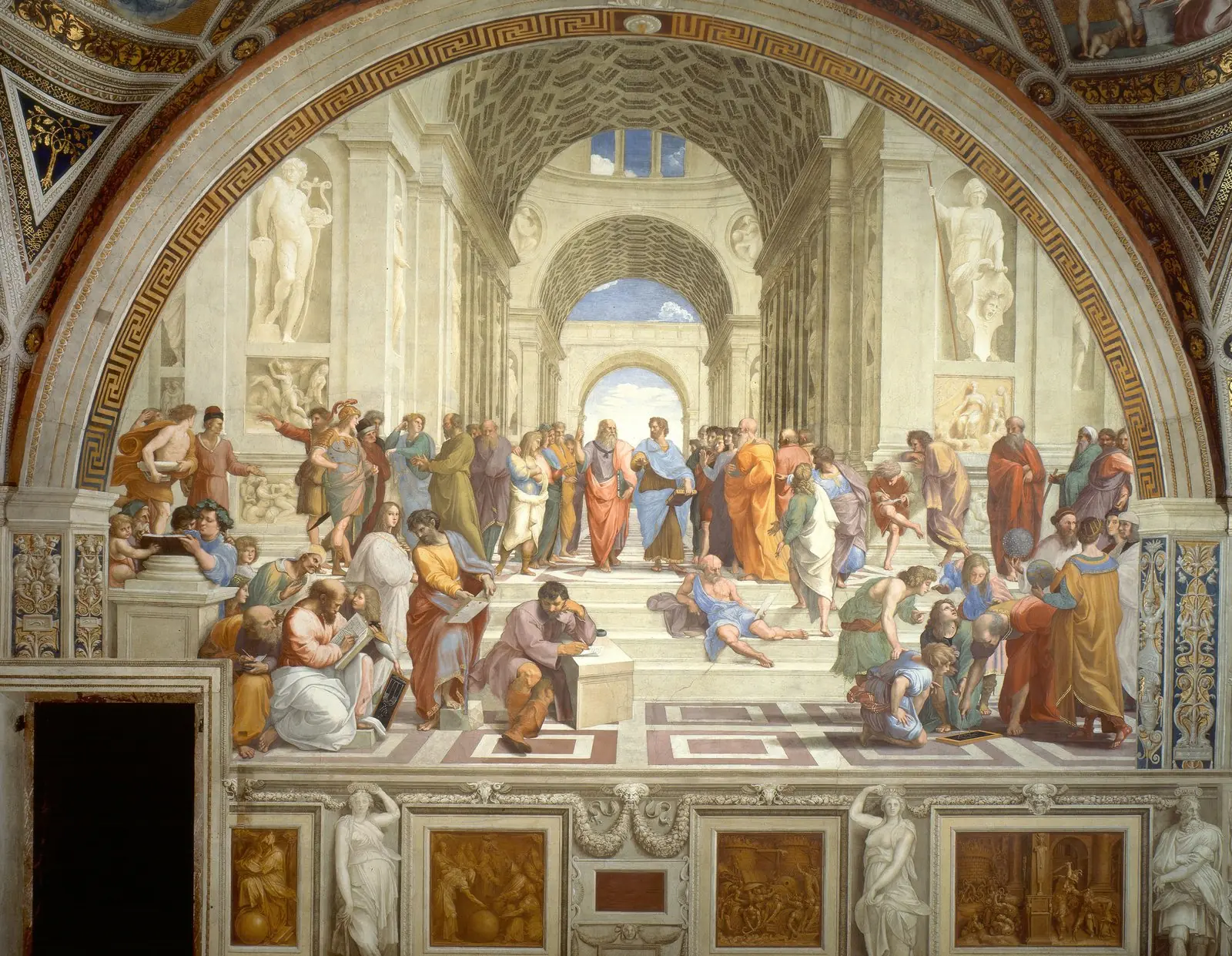
For later academies, this fresco becomes a practical lesson. It shows how many figures can share one scene without narrative collapse. In papal Rome, that skill is also political. Raphael makes authority look intelligent rather than coercive.
Madonnas, portraits, and the art of ease
Raphael's greatness is not limited to large fresco cycles. In the Madonnas, the same intelligence works at intimate scale. A child leans, a mother turns, hands touch, and the whole relation feels immediate, yet the arrangement is never casual. He makes devotion look calm without making it inert.
The portraits are just as important. In works such as the Portrait of Baldassare Castiglione, Raphael gives dignity without stiffness. The sitter feels self-possessed, not theatrical. This is one reason his paintings were copied so extensively. He offers artists a way to join idealization with legibility. The scale changes, but the method does not.
Workshop, prints, and the spread of a style
Raphael's Roman career is also an organizational story. He handles commissions that require assistants, cartoons, rapid delegation, and high consistency across large projects. The workshop around him, including figures such as Giulio Romano, does not simply multiply output. It helps turn Raphael's way of ordering images into something teachable and transferable.
Print culture reinforces that spread. Through engravings by Marcantonio Raimondi and others, Raphael's inventions circulate far beyond Rome. His art becomes available not only as original painting, but as a reproducible model. Raphael is not just admired; he is studied, copied, and built into how Europe learns to picture authority, narrative, and grace.
Legacy and afterlives
Raphael's long afterlife is less about taste than method. Academies return to him because his compositions show how to stage many bodies, gestures, and ideas without losing direction. His art becomes a training ground for history painting, public decoration, and institutional image-making well beyond the Renaissance.
His late years expand that legacy further. After Bramante's death, he takes on architectural responsibilities at St. Peter's and participates in archaeological work in Rome while still managing major commissions. When he dies in 1520 at only thirty-seven and is buried in the Pantheon, he is already more than a painter. He stands as a model of the artist who can organize visual culture across media and institutions.
Continue with related pages
To follow that clarity into the next major shift, read Renaissance vs Baroque: What's the Difference in Art?. Raphael's order looks different once it is set beside Baroque light, diagonals, and spectator pressure.
Then use the art quiz to see whether you can separate Raphael's clarity from Leonardo's ambiguity and Michelangelo's force when Renaissance works are mixed together.
Sources
Frequently asked questions
Leonardo often builds mystery through atmosphere and open-ended observation, while Michelangelo works through pressure and bodily force. Raphael is usually clearer and more social: he organizes many figures, ideas, and gestures into a stable, readable whole.
Because it shows his central gift at full scale. Raphael turns a crowded intellectual program into an image that feels ordered immediately, without losing difference between figures and positions.
No. In his later years he also worked as an architect and took part in archaeological and urban projects in Rome, which helps explain why his sense of order extends beyond easel painting.
Teachers and students kept returning to Raphael because his compositions show how to stage many bodies, gestures, and ideas without losing legibility. He became a model for drawing, history painting, and public decoration.